Bennington Triangle: 5 Vanished in 5 Years, None Ever Found
A veteran guide who knew every ridge. A student vanished on a marked trail. Five people gone near one Vermont mountain in five years. What happened?
A 74-year-old man who had spent his life in these woods walks ahead of his hunting party. He's the guide. He knows every ridge. And then he's gone — for good. That was the first one.
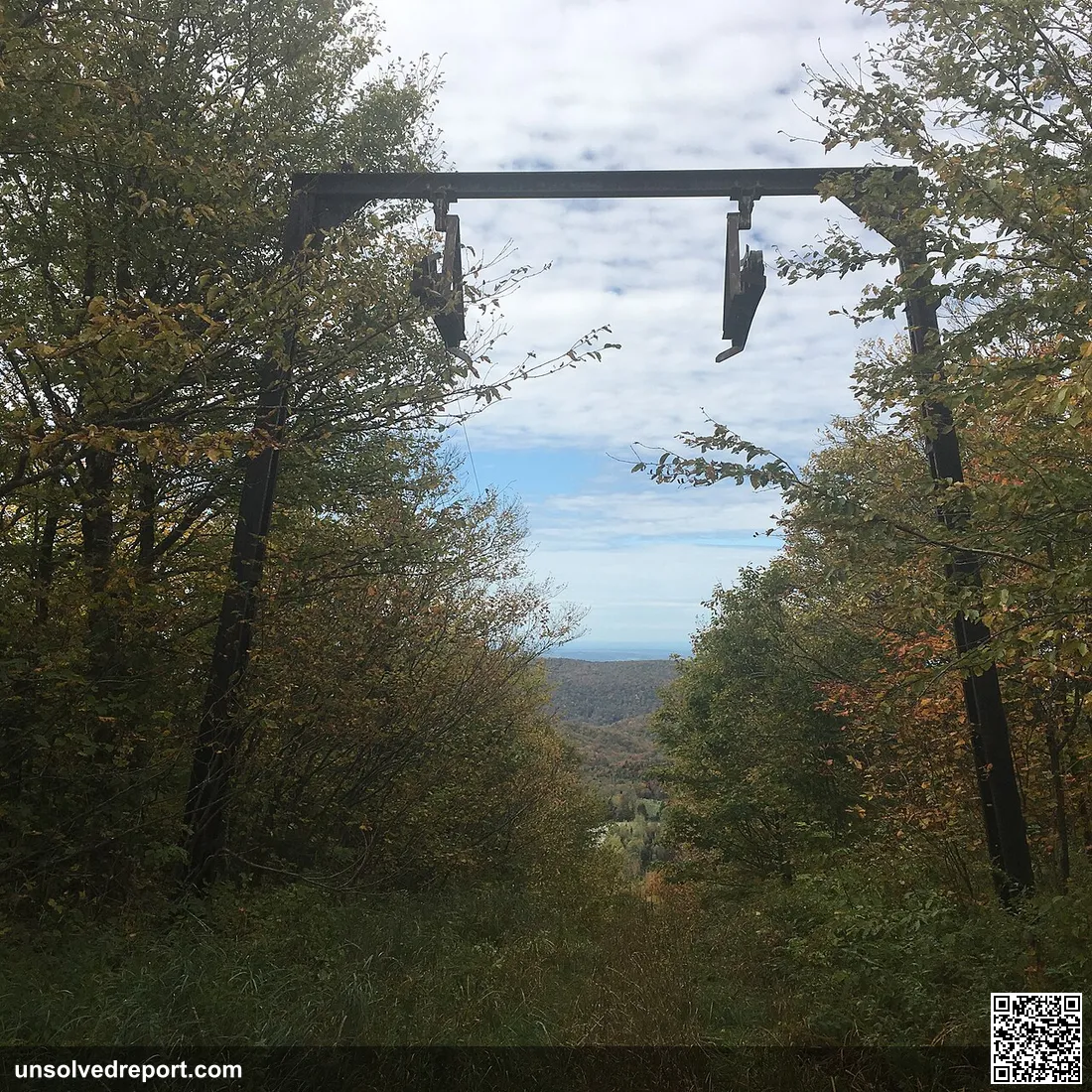
Glastenbury Mountain climbs more than 3,700 feet over southwestern Vermont, draped in thick second-growth forest with a length of the Long Trail stitched through it. Today it's quiet country. But in the late 1940s, this mountain became the setting for a run of disappearances so unsettling — one of the more chilling entries among history's most baffling vanishings — that decades later a Vermont author handed them a name: the Bennington Triangle. Here's the thing to hold onto from the start. The name is modern marketing. The vanishings are documented history.
This story keeps those two things apart. The people who went missing were real — their cases printed in newspapers, logged in police files. The "triangle" came much later. The supernatural lore came later still. Telling them apart is the whole job.
> The 60-Second Brief
> - Five people vanished near Glastenbury Mountain, Vermont, in roughly 1945–1950 — a span of about five years.
> - November 12, 1945 — 74-year-old hunting guide Middie Rivers disappeared near Bickford Hollow; searchers recovered only a single rifle cartridge or a handkerchief.
> - December 1, 1946 — 18-year-old Bennington College student Paula Jean Welden vanished on the Long Trail; a search drawing hundreds of volunteers and a roughly $5,000 reward turned up nothing.
> - 1947 — Welden's case is the direct reason Vermont's legislature created the Vermont State Police, the state's first statewide police force.
> - October 28, 1950 to May 12, 1951 — Frieda Langer, 53, disappeared near the Somerset Reservoir; her remains surfaced roughly six and a half months later, in ground already searched.
> - 1992 — folklorist Joseph A. Citro coined the name "Bennington Triangle" on Vermont Public Radio, more than 40 years after the last disappearance.
What the Record Actually Shows
The phrase "Bennington Triangle" wasn't born until 1992, when New England folklorist and author Joseph A. Citro used it on a Vermont Public Radio broadcast. He built the name openly on the Bermuda Triangle and never once pretended otherwise — it was a storyteller's frame for a cluster of cases that had already happened more than forty years before (Wikipedia; Mental Floss). The disappearances themselves run from roughly 1945 to 1950.
Start with the man from that opening. Middie Rivers was a 74-year-old hunting guide who knew the terrain cold. On November 12, 1945, he was leading a party near Bickford Hollow, west of Bennington, when he pulled ahead of the group. Nobody saw him again. The search came up almost empty — depending on which account you read, a single rifle cartridge, or a handkerchief found the next spring (Wikipedia). That's all the mountain gave back.
The case we know best belongs to Paula Jean Welden. Born October 19, 1928, she was an 18-year-old sophomore at Bennington College. On December 1, 1946, after a shift in the dining hall, she changed into walking clothes — most accounts say a red jacket, jeans, and light sneakers — and headed out to hike the Long Trail. No bag. No spare clothing. Barely any money. Everything about it says short outing. A motorist gave her a lift toward Route 9. A group of hikers, Ernest Knapp among them, ran into her on the trail near dusk and pointed her the right way. After that — nothing. No confirmed sighting, ever again, the kind of clean vanishing-without-a-trace that echoes the Flannan Isles lighthouse keepers (Disappearance of Paula Jean Welden, Wikipedia; New York Almanack).
The hunt for her was huge. Hundreds of volunteers, National Guard troops, college students, firefighters — all of them sweeping the area. A reward of around $5,000 was raised. Bennington College actually paused classes to put more boots on the ground. They found nothing. And the failures of that search left a mark: Vermont had no statewide police force, and the local response drew sharp criticism. The fallout reshaped the state. In 1947 the Vermont legislature created the Vermont State Police — a direct institutional legacy of Welden's case (New England Historical Society). A missing teenager rewrote how an entire state polices itself.
Three more names are usually folded in. Paul Jepson, an eight-year-old boy, vanished on October 12, 1950, after being left briefly in a vehicle near the Bennington town dump; tracking dogs reportedly followed his scent to a road, then lost it there. Frieda Langer, a 53-year-old experienced hiker, disappeared on October 28, 1950, near the Somerset Reservoir — she'd slipped into a stream and turned back toward camp to change clothes. Hers is the only case with an ending. At the time, searchers with aircraft and hundreds of people found nothing. But on roughly May 12, 1951, her remains turned up — in an area that had already been searched. The body's condition made the cause of death impossible to pin down, though investigators leaned toward accidental drowning or exposure (Wikipedia; Mental Floss).
One name that gets repeated a lot deserves a flag. James Tedford, a veteran said to have vanished from a moving bus in December 1949 somewhere between stops, gets retold endlessly. But the "vanished from a sealed bus" version is poorly sourced and has almost certainly been polished over the years. Treat the dramatic details as unverified.
And there's a plainer history here that the legend tends to bury. Glastenbury was once a logging and charcoal town. By the early 20th century the timber was spent, the settlement emptied out, and what remained was a near-ghost town surrounded by miles of disorienting, regrown wilderness. Rugged. Easy to get lost in. Hold that fact — it matters a lot when you start weighing explanations.
The Mystery That's Actually Real
Peel off the branding and a genuine question is still standing: how does one place absorb several people — including a 74-year-old who knew the woods and an experienced 53-year-old hiker — across a few short years, leaving almost nothing behind?
Two details keep the Welden case truly unsolved. First, the near-total emptiness of the evidence. In a heavily searched, fairly compact area, no remains, no clothing, no definitive sign of her was ever confirmed. Second, the limits of the time — no state police, jurisdictions tripping over each other, a search that started late and ran disorganized — meant the trail went cold almost before it began. It's entirely possible we lost the evidence to bad timing, not to anything stranger.
So here's the honest version. The individual cases are unsolved. But they aren't necessarily connected. Wrapping them in a single name quietly suggests a single cause — and the documented record never establishes one.
Theories, Weighed Honestly
The ordinary explanation (best supported). Every disappearance has a plausible plain cause: a fall, hypothermia, getting lost in brutal terrain, or — near the roads — possible foul play. It's the same lesson researchers eventually applied to the Dyatlov Pass incident, where decades of dark speculation gave way to a mundane, terrain-driven explanation. Frieda Langer's eventual recovery near water fits an accidental-death reading neatly, and the fact that her body surfaced in a zone already combed shows just how easily that landscape hides things. Skeptics, including the framing in Mental Floss, land here.
A human predator (speculation). Some researchers look at the clustering and wonder whether a person was behind one or more cases. In Welden's investigation a local man was briefly treated as a person of interest — but no charges were ever filed, and nothing ties any single individual to multiple cases (Wikipedia). It's a hunch, not a finding.
Folklore and the supernatural (legend, not evidence). Citro's books threaded in regional lore — a Bigfoot-like "Bennington Monster," strange lights, and a much-repeated claim that the Abenaki saw the mountain as cursed, a spot "where the four winds meet." Eerie stuff, and genuinely interesting as culture. But it's folklore, full stop. The "four winds" curse in particular isn't well documented in primary Abenaki sources, and it should be read as legend, not history.
The Bennington Triangle holds its grip because it sits right on the seam between the documented and the unknowable: real people, real searches, a real overhaul of state law enforcement — and a handful of cases that, eighty years on, the record still can't close. Somewhere up on that mountain, the woods are still keeping their answers. And they're not the only quiet place in America that does — ask anyone who's dug into the Sodder children's 1945 disappearance just a few states over.
Frequently Asked Questions
What is the Bennington Triangle?
It's the name given to a cluster of five disappearances near Glastenbury Mountain, Vermont, between 1945 and 1950 — a 74-year-old hunting guide, an 18-year-old college student, an eight-year-old boy, a 53-year-old hiker, and a bus passenger whose case is poorly documented. Folklorist Joseph A. Citro coined the "Bennington Triangle" name in 1992, deliberately modeled on the Bermuda Triangle, more than four decades after the cases themselves (Wikipedia).
Was Paula Welden ever found?
No. She vanished on December 1, 1946, while hiking a stretch of the Long Trail, and no confirmed sighting, remains, or belongings of hers have ever surfaced despite a search involving hundreds of volunteers and National Guard troops. Her case remains officially unsolved (Disappearance of Paula Jean Welden, Wikipedia).
Did all five disappearances happen in exactly the same spot?
No — they're spread across the broader Glastenbury Mountain area over roughly five years, not one single location. Middie Rivers vanished near Bickford Hollow in 1945, Welden on the Long Trail in 1946, and Paul Jepson and Frieda Langer near the Somerset Reservoir area in 1950; the "triangle" is a loose geographic frame drawn around the region, not a documented pattern in the case files themselves (Wikipedia).
Is there a rational explanation for the Bennington Triangle?
Most researchers point to the terrain itself: Glastenbury was an abandoned logging town surrounded by disorienting, regrown wilderness, and 1940s Vermont had no statewide police force to coordinate a fast search. Falls, hypothermia, and getting lost in rugged country account for the documented facts without needing anything stranger, a reading favored by outlets like Mental Floss.
Why did Paula Welden's disappearance lead to the creation of the Vermont State Police?
The botched, disorganized search for Welden exposed how badly Vermont's patchwork of local and county law enforcement handled a major missing-person case. The public backlash was strong enough that the state legislature created the Vermont State Police in 1947, directly citing the failures of her case (New England Historical Society).
Was Frieda Langer's disappearance ever solved?
Partially. Langer, 53, vanished on October 28, 1950, near the Somerset Reservoir after turning back alone to change clothes; her remains were recovered around May 12, 1951, in an area that had already been searched. The body's condition made an exact cause of death impossible to confirm, though investigators favored accidental drowning or exposure over foul play (Wikipedia).
Original Data: The Welden Reward Against Two Other Landmark Missing-Person Rewards
No single source sets the $5,000 reward raised for Paula Welden's 1946 search against other historic missing-person rewards in comparable, inflation-adjusted terms. The table below compiles the nominal reward figure from each case's own record, then converts each to 2026 purchasing power using the same CPI-based calculator for every row.
| Case | Year offered | Reward offered (nominal) | Reward in 2026 dollars | Source |
|---|---|---|---|---|
| Paula Jean Welden (Bennington Triangle) | 1946 | $5,000 | $85,892.31 (in2013dollars.com CPI calculator) | New England Historical Society; in2013dollars.com |
| Lindbergh baby kidnapping | 1932 | $75,000 ($25,000 from New Jersey State Police + $50,000 from the Lindbergh family) | $1,833,832.12 (in2013dollars.com CPI calculator) | Wikipedia, "Lindbergh kidnapping"; in2013dollars.com |
| Murder of JonBenét Ramsey | 1997 | $100,000 | $208,710.28 (in2013dollars.com CPI calculator) | Wikipedia, "Murder of JonBenét Ramsey"; in2013dollars.com |
Adjusted to today's dollars, the Welden reward is by far the smallest of the three: about 4.7% of the Lindbergh case's inflation-adjusted total (85,892.31 ÷ 1,833,832.12, our calculation) and about 41% of the Ramsey case's (85,892.31 ÷ 208,710.28, our calculation). The gap tracks the scale of each case's public profile — a nationally covered kidnapping in 1932, a nationally covered murder case in 1997, and a Vermont college and local community raising what they could for a search in 1946 — rather than any difference in how seriously each disappearance was treated at the time.
How We Compiled This
- Sources. Five pages, each fetched directly: the New England Historical Society's account of the Welden reward; the Wikipedia articles "Lindbergh kidnapping" and "Murder of JonBenét Ramsey" for their respective reward figures; and in2013dollars.com's CPI inflation calculator, queried separately for each of the three nominal amounts and years.
- Definitions. "Reward offered (nominal)" is the dollar figure publicly reported as offered at the time, not necessarily the amount ever paid out. "Reward in 2026 dollars" is the purchasing-power equivalent as computed by in2013dollars.com's own CPI-based calculator — a figure the source generates, not this article's arithmetic.
- How calculated. The two percentage comparisons in the reading paragraph divide the Welden case's 2026-dollar figure by the Lindbergh and Ramsey cases' 2026-dollar figures, using only the calculator's own output for each.
- Limitations. Wikipedia's Lindbergh kidnapping article states its own inflation-adjusted figure for the $75,000 reward as "approximately $1,795,301 in 2026" — about 2% below the $1,833,832.12 this table gets from in2013dollars.com for the same nominal amount and year, likely reflecting a different CPI vintage or rounding method. This table uses in2013dollars.com throughout for methodological consistency across all three rows rather than mixing sources' own conversions. A reward amount measures public fundraising and publicity, not the scale of the search effort, the number of investigators involved, or how the case was ultimately resolved.
📌 Data status: verified 2026-09-29.
Sources & Further Reading
- Bennington Triangle — Wikipedia
- Disappearance of Paula Jean Welden — Wikipedia
- The 1946 Disappearance of Paula Welden on Vermont's Long Trail — New York Almanack
- Paula Jean Welden Disappears and the Vermont State Police Are Born — New England Historical Society
- The Lost Girl of Vermont's 'Bennington Triangle' — Mental Floss