JAL 1628: The 50-Minute UFO the FAA Radar Confirmed, Then Denied
A JAL 747 crew tracked a carrier-sized object over Alaska for 50 minutes in 1986. FAA radar caught it too — then officials said the briefing never happened. What's confirmed, what isn't.
A veteran 747 captain with more than 10,000 flight hours watched two lighted objects rise from below his cockpit and pace him over Alaska — then a third object, one he compared to an aircraft carrier, appeared behind them. Anchorage air traffic control was watching the same sky on radar and saw a return too. The FAA's own division chief later said federal officials told him, on the record, that the resulting briefing to the CIA and FBI "never took place." What follows is what the FAA's declassified case file, the crew's testimony, and the skeptics who studied both actually established — and where the documented facts stop and the guesswork begins.
> The 60-Second Brief
> - November 17, 1986, 17:11 local time: JAL Cargo Flight 1628, a Boeing 747-200F, is at 35,000 feet near Fort Yukon, Alaska, en route Paris–Anchorage–Tokyo.
> - 3 crew members are in the cockpit: Captain Kenju Terauchi, First Officer Takanori Tamefuji, Flight Engineer Yoshio Tsukuba.
> - ~50 minutes: the duration of the tracked encounter, spanning several hundred miles of flight.
> - 10,000+ flight hours: Terauchi's experience level as a former fighter pilot, cited as why his account carries weight.
> - 1987 briefing: FAA official John Callahan says the agency briefed the CIA, FBI, and Reagan-era science staff on the radar data, then was told the meeting "never took place."
> - 2 outside aircraft — a United Airlines flight and a USAF C-130 — were vectored toward the area and reported seeing nothing.
The Documented Facts
This is not a campfire story. It is one of the best-documented UFO cases on record — alongside cases like the Ariel School sighting — because professionals were watching the sky and the radar at the same time.
The aircraft was Japan Air Lines Cargo Flight 1628, a Boeing 747-200F flying from Paris to Tokyo with a stop in Anchorage, carrying French wine. The encounter began at 17:11 local time on November 17, 1986, while the jet cruised at 35,000 feet near Fort Yukon, Alaska (Wikipedia). In the cockpit were three crew: Captain Kenju Terauchi, First Officer Takanori Tamefuji, and Flight Engineer Yoshio Tsukuba (Enigma Labs).
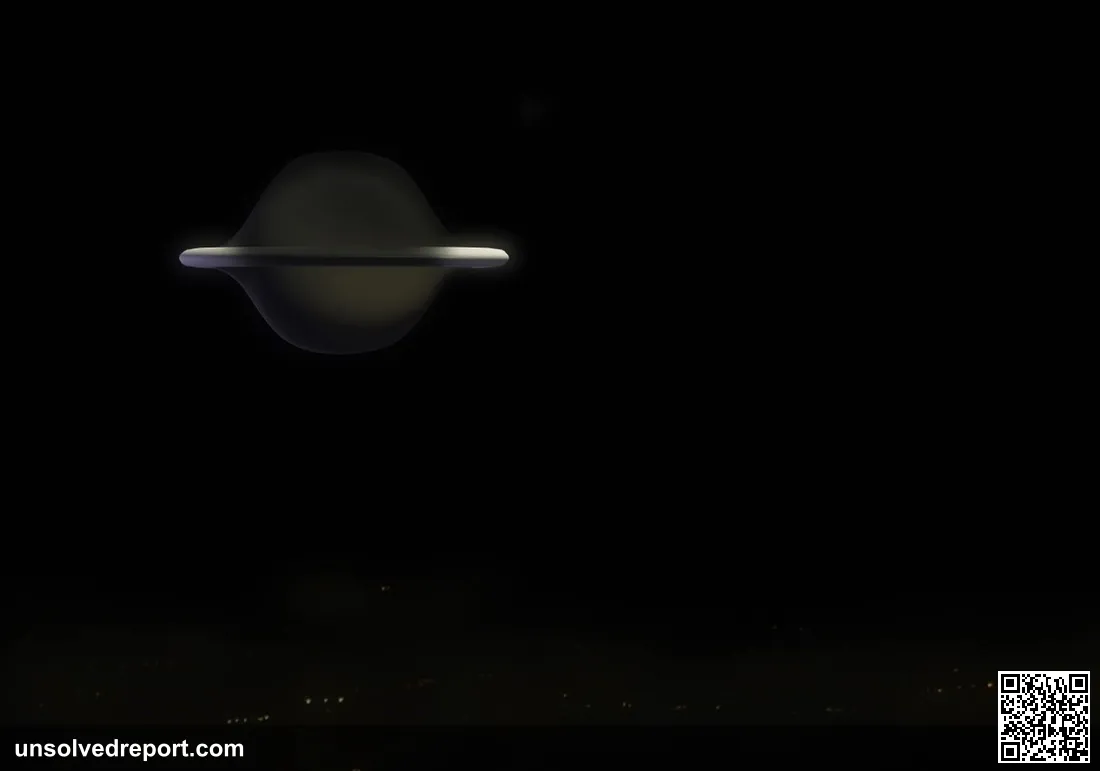
What did they see? Terauchi described two small lighted objects that closed in and paced the plane, then a much larger craft he called "the mother ship" — a giant, walnut-shaped object with a rim around its middle and flashing colored lights (The Debrief; Enigma Labs). When the small objects were closest, he said the cabin lit up and he could feel their heat on his face (The Debrief) — a physical-effects claim that echoes the injuries reported in the Cash-Landrum incident six years earlier. The other two crew were more guarded: from their seats they could make out "lights" that did not look like town lights, but they could not resolve any solid craft (The Debrief).
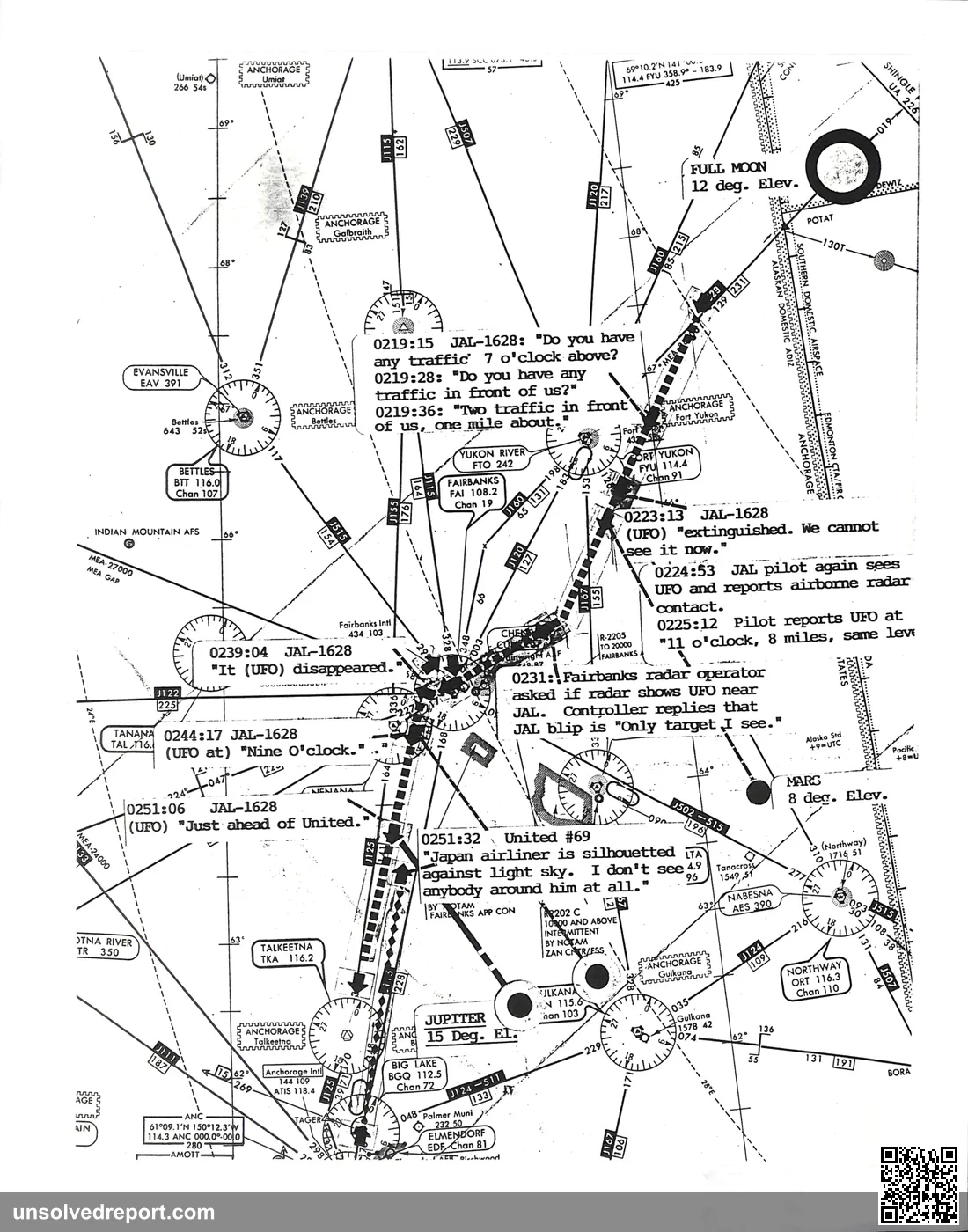
Here is the part that lifts this case above the ordinary. The crew was not alone in noticing something. Anchorage air traffic control acknowledged seeing a return near the JAL flight on FAA radar, and for a stretch the encounter was tracked on multiple scopes (Wikipedia) — making it one of the few cases of that era, like the Belgian UFO wave, where both visual and radar evidence arrived simultaneously. The whole episode unfolded over roughly 50 minutes and several hundred miles as the jet flew on toward Anchorage (Enigma Labs).
And it got a real federal paper trail. John Callahan, then the FAA's Division Chief of the Accidents and Investigations Branch in Washington, pulled the radar data and the air traffic control tapes. By his account, in early 1987 the FAA administrator arranged a briefing for representatives of the CIA, the FBI, and members of President Reagan's scientific staff — after which, Callahan said, the officials told the room: "This never took place. We never had this meeting, and this was never recorded" (a vanishing act reminiscent of the official silence that followed the Battle of Los Angeles in 1942) (Enigma Labs). Callahan says he kept the original files, and decades later the raw FAA records were released to the public (Internet Archive — FAA JAL 1628 Records).
The Genuine Open Question
Strip away the noise and one honest puzzle remains: what made the radar returns, and what were three sober airline professionals actually looking at for the better part of an hour?
The FAA never landed on "spaceship." Its public position was modest — the agency said it lacked the resources and the mandate to investigate UFOs at all (The Debrief). On the radar question, the agency's own story shifted: it first acknowledged a return, then leaned toward the idea that the extra blips were a "split image" or an uncorrelated ghost target — a known radar artifact — rather than a solid craft (Wikipedia). Two aircraft vectored toward the scene, a United Airlines flight and a U.S. Air Force C-130, reported seeing nothing but the JAL jet itself (Wikipedia).
So the case sits in a genuinely uncomfortable middle. The visual sighting is hard to dismiss because the lead witness was a highly experienced pilot. The radar evidence is hard to confirm because the returns were ambiguous and never independently corroborated by the nearby aircraft. The official verdict amounts to "unidentified" — not because anyone proved it was alien, but because no single ordinary explanation cleanly accounts for everything at once.
Theories and Interpretations
Here is where we draw the line clearly between what is documented and what is guesswork. Everything below is interpretation, not fact.
The astronomical explanation (best supported, skeptic favorite). Veteran UFO investigator Philip J. Klass argued the bright objects were ordinary sky. In his analysis, the two small lights were "bright stars peeking through sporadic cloud cover," and the looming mother ship was "probably the planet Jupiter," with Mars also in roughly the same patch of sky (The Debrief). Crucially, Klass noted Jupiter was sitting low — about 10 degrees above the horizon — which can make a planet look like it is hovering out at the plane's own altitude (Wikipedia). Astronomer Robert Sheaffer added that Terauchi was not "an unbiased or objective observer," and the FAA itself described him as a "UFO repeater" who reported several other sightings before and after (Wikipedia). Plausibility: high for the lights; this is the leading conventional answer.
The radar-artifact explanation (well supported). On the electronics side, skeptics point out that the extra returns were most consistent with a split image or an uncorrelated primary/beacon target — a ghost blip — and that the nearby aircraft saw nothing, which is exactly what you would expect if there was no physical craft (The Debrief; Wikipedia). Plausibility: high, and it pairs naturally with the planets-and-stars reading.
The "contradiction" critique (a caution, not a craft). Skeptics also note Terauchi's accounts drifted over time — for instance, telling controllers he lost sight of the object after a turn, but later saying it stayed with him (Wikipedia). That does not prove the planets theory; it simply warns that even an expert's memory of a stressful night can stretch. Plausibility: a fair note on the evidence, not an explanation in itself.
The extraterrestrial / cover-up theory (unproven speculation). This is the version that made JAL 1628 famous: a true alien mothership, escorted by smaller craft, deliberately concealed by a CIA that "disappeared" the evidence. The honest assessment is that there is no proof of an extraterrestrial vehicle, and no public smoking-gun document confirming a deliberate cover-up. What exists is Callahan's compelling first-hand testimony about the closed-door briefing (Enigma Labs) — striking, but not the same thing as evidence that the lights themselves were alien. Treat this firmly as unverified. It is the most thrilling reading and the least supported.
The frustrating, fascinating bottom line: the conventional explanations cover most of what happened, yet the case refuses to close completely, because a credentialed pilot and a federal investigator both walked away convinced something genuinely strange had occurred.
2025: The Cover-Up Claim Enters Congress's Official Record
JAL 1628 itself did not resurface with new declassified paperwork in 2025 — the full FAA case file, over 1,500 pages of documents, tapes, and radar plots, has been publicly archived for years. But the pattern at the center of the case — a federal official alleging he was told a UAP-related meeting "never happened" — moved from a pilot's anecdote to the subject of formal congressional testimony. On September 9, 2025, the House Oversight and Government Reform Committee's Task Force on the Declassification of Federal Secrets, chaired by Rep. Anna Paulina Luna, held a public hearing at which active-duty and veteran military witnesses — including Navy Senior Chief Petty Officer Alexandro Wiggins and Air Force veterans Jeffrey Nuccetelli and Dylan Borland — testified under oath about UAP encounters and alleged suppression of evidence, and Rep. Eric Burlison released video of a U.S. military drone engaging an unidentified object off Yemen in October 2024 (DefenseScoop). The hearing did not address JAL 1628 specifically, but it reflects the same institutional question Callahan raised about his 1987 briefing: whether U.S. agencies have systematically kept UAP evidence out of the public record.
Frequently Asked Questions
Was the JAL 1628 UFO sighting ever officially explained?
No single explanation was ever confirmed. The FAA said it lacked the mandate to investigate UFOs and never issued a final verdict; its own account of the radar returns shifted from acknowledging a target to suggesting a "split image" or uncorrelated ghost return, a known radar artifact (Wikipedia). The case remains officially unresolved rather than solved.
Did FAA radar actually confirm the UFO, or just something unusual?
Anchorage air traffic control acknowledged a return near the JAL flight and tracked it on multiple scopes for part of the encounter (Wikipedia), but the FAA later leaned toward describing the extra returns as a radar artifact rather than a solid object, and two aircraft vectored to the area saw nothing (The Debrief; Wikipedia).
What is the leading skeptical explanation for what Captain Terauchi saw?
UFO investigator Philip J. Klass argued the two small lights were bright stars visible through broken cloud, and that the larger "mothership" was most likely the planet Jupiter, sitting low on the horizon in a way that can make a planet appear to hover at aircraft altitude, with Mars nearby in the same part of sky (The Debrief; Wikipedia).
What did John Callahan claim happened after the FAA reviewed the radar data?
Callahan, then the FAA's Division Chief of the Accidents and Investigations Branch, said the FAA administrator arranged an early-1987 briefing for representatives of the CIA, FBI, and Reagan administration science staff, after which officials told the room the meeting "never took place" and was never recorded (Enigma Labs). Callahan says he retained the original files, which were later released publicly.
Is Captain Terauchi's account considered reliable?
Accounts differ. He was a highly experienced pilot, which lends his testimony weight, but the FAA itself described him as a "UFO repeater" who reported multiple sightings before and after this flight, and skeptics note his description of the encounter shifted in some details over time, such as whether he lost sight of the object after a turn (Wikipedia).
How does JAL 1628 compare to other well-documented UFO cases?
It is frequently ranked among the best-documented UAP encounters because it combined visual testimony from professional aircrew with a corroborating (if disputed) radar return — a combination shared by relatively few cases, such as the Belgian UFO wave. Physical-effects claims, like Terauchi's report of feeling heat from the lights, echo injuries reported in the Cash-Landrum incident.
Skeptics say planets, believers say spacecraft — but notice what both sides quietly agree on: a senior government investigator insists a meeting about this flight was scrubbed from the record. When the people tasked with explaining the sky start telling each other a briefing "never happened," the real mystery may not be what was in the air that night, but what landed in a filing cabinet afterward — and how many other cases are sitting in the same drawer.
Original Data: How Bright Was the "Mothership," Really?
Philip Klass's CSICOP press release, as quoted in Robert Sheaffer's 2014 Skeptical Inquirer article, gave Jupiter's magnitude and position on the night of the sighting, but no source has translated that figure into how that brightness compared to the brightest star in Earth's night sky. Running Klass's number through the standard astronomical brightness formula gives that comparison.
| Object | Magnitude / position as published | Source |
|---|---|---|
| Jupiter, as seen from JAL 1628 on November 17, 1986 | "-2.6 magnitude," "only 10 degrees above the horizon" | Robert Sheaffer, "JAL 1628: Capt. Terauchi's Marvelous 'Spaceship'," Skeptical Inquirer, Nov/Dec 2014 (quoting Klass's CSICOP press release); the 10-degree figure also appears, attributed to Klass, in Wikipedia, "Japan Air Lines Cargo Flight 1628" |
| Mars, same night | "slightly lower on the horizon," "about 20 degrees to the right of Jupiter but not as bright" | Robert Sheaffer, Skeptical Inquirer, Nov/Dec 2014 (quoting Klass's CSICOP press release) |
| Sirius, the brightest star in Earth's night sky (for comparison) | apparent magnitude −1.46 | Wikipedia, "Sirius" |
| Jupiter's brightness relative to Sirius | approximately 2.9 times brighter (10^(0.4 × (−1.46 − (−2.6))) = 10^0.456 ≈ 2.86, our calculation) | — |
Using the standard stellar-magnitude formula on the −2.6 figure Klass published, Jupiter would have been about 2.9 times brighter than Sirius. The quoted press release adds that Jupiter's low altitude made it "appear to the pilot to be at roughly his own 35,000 ft. altitude."
How We Compiled This
- Sources. Robert Sheaffer's 2014 Skeptical Inquirer article, which quotes Philip J. Klass's CSICOP press release (and notes that it credits astronomers Nick Sanduleak and C. B. Stephenson of Case Western Reserve University for computing the positions and bearings of bright celestial bodies), Wikipedia's "Japan Air Lines Cargo Flight 1628" article (which also reports Klass's 10-degree figure), and Wikipedia's "Sirius" article (for the comparison star's magnitude).
- Definitions. Apparent magnitude is the standard astronomical scale for how bright an object looks from Earth; lower (more negative) numbers mean brighter objects, and each step of 5 magnitudes represents a factor of exactly 100 in brightness.
- How calculated. Brightness ratio = 10^(0.4 × (magnitude of fainter object − magnitude of brighter object)) = 10^(0.4 × (−1.46 − (−2.6))) = 10^(0.4 × 1.14) = 10^0.456 ≈ 2.86.
- Limitations. This calculation addresses only Jupiter's published brightness, not the reported size of the object, the radar return, or the crew's other observations. According to Sheaffer, Klass's later Summer 1987 analysis dropped the fainter Mars and attributed the airplane radar sighting to an echo from thin clouds of ice crystals, so the figures here represent Klass's initial published position, not his final one.
📌 Data status: verified 2026-09-29.
Sources & Further Reading
- Japan Air Lines Cargo Flight 1628 — Wikipedia
- What Really Happened to Japan Airlines Flight 1628 in 1986? — The Debrief
- Airline Crew Encounters UAP Over Alaska — Enigma Labs
- FAA Japan Air Lines Flight 1628 Records — Internet Archive
- JAL 1628: Capt. Terauchi's Marvelous "Spaceship" (Philip J. Klass) — Skeptical Inquirer
- Military whistleblowers share new evidence of alleged UAP at transparency hearing — DefenseScoop, Sept. 9, 2025
Drake Equation Explained: 6,000 Planets In, Still Zero Signals
6,000+ exoplanets confirmed and counting, yet the Drake Equation's answer still swings from millions of civilizations to just us. Here's why the math won't settle it.
Area 51's Real Secret: It Faked Half of America's UFO Sightings
Area 51 stayed "top secret" for 50 years — not because of aliens. The real reason fueled half of America's UFO sightings. What's still hidden there now?
Bob Lazar Area 51: 37 Years, One Story, Zero Proof — Why?
Bob Lazar named element 115 in 1989, before it existed. In 2025 Congress heard his story again. In 2026 a new documentary dropped. Still no proof. Why?