The San Jose Galleon: The Billion-Dollar Wreck Nobody Can Claim
The San Jose galleon sank in 1708 loaded with gold and emeralds nobody has recovered. Four rivals are now fighting over it — here's fact vs. hype.
June 8, 1708. Off the coast of Cartagena, in the dark Caribbean, a 64-gun Spanish galleon catches fire and rips itself in half. The blast lights up the night. Then the sea swallows it whole. In a matter of minutes the San Jose is gone, dragging down roughly 600 men and a hold packed with gold, silver, and emeralds gathered from every corner of Spain's American empire.
That was three centuries ago. Today that same cargo - the headlines love to slap "up to 20 billion dollars" on it - is at the center of one of the strangest fights on the planet. Not a fight between rival pirates. A fight between a whole country, an American salvage company, the kingdom of Spain, and Indigenous communities whose ancestors mined the silver. In 2026, the fight got uglier still, when a Colombian heritage watchdog accused the country's own recovery program of looting the wreck it is supposed to protect.
Here's the wild part. The true, documented facts are so dramatic that the made-up numbers actually get in the way. So let's separate them. What does the record really say? And where does the storytelling take over?
> The 60-Second Brief
> - The San Jose sank on June 8, 1708, off Cartagena during Wager's Action, killing roughly 600 of its crew.
> - Period sources put its cargo at 7 to 11 million pesos in gold and silver, plus emeralds from Colombia's mines.
> - Headline valuations range from $1 billion to $20 billion — no inventory has ever confirmed either figure.
> - Colombia announced locating the wreck on December 5, 2015, using a REMUS 6000 underwater vehicle.
> - In November 2025, a remotely operated vehicle recovered a cannon, a porcelain cup, and three coins from the site.
> - In March 2026, a heritage oversight group accused Colombia's recovery program of looting incidents dating back to 2016 and 2022.
What the records confirm about the sinking
The San Jose was the flagship - the lead ship of Spain's treasure fleet, the Tierra Firme fleet. Its job was to haul a fortune back across the ocean to help pay for a war. Not any war: the War of the Spanish Succession, a sprawling European brawl that pitted Bourbon France and Spain against a grand alliance led by Britain, the Dutch Republic, and Austria.
Spanish silver wasn't just shiny. It was a war chest. And the British knew exactly where it was headed. Sinking or seizing a treasure fleet wasn't piracy or dumb luck - it was strategy. Take the bullion, and you starve an enemy crown of the money that fed and armed its soldiers.
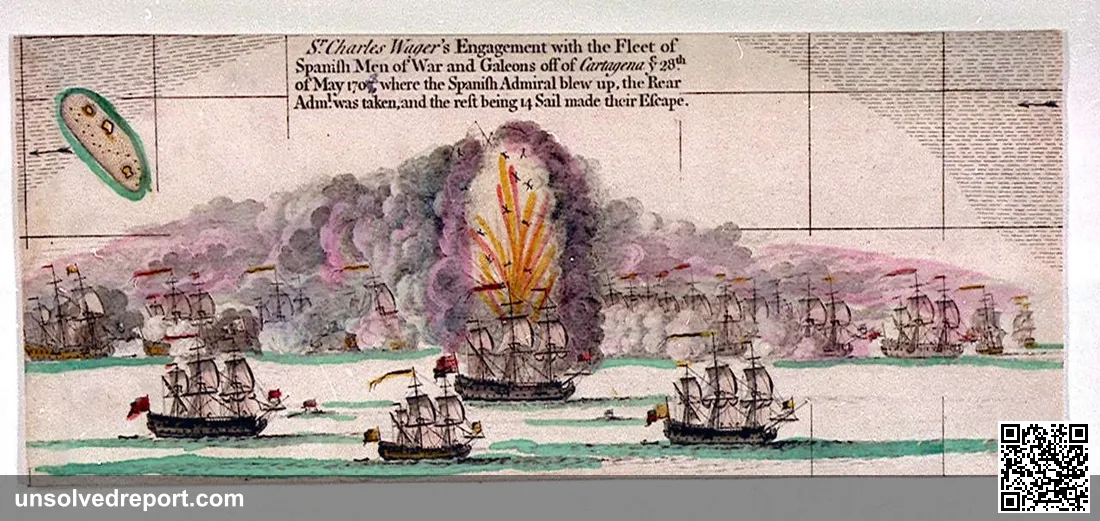
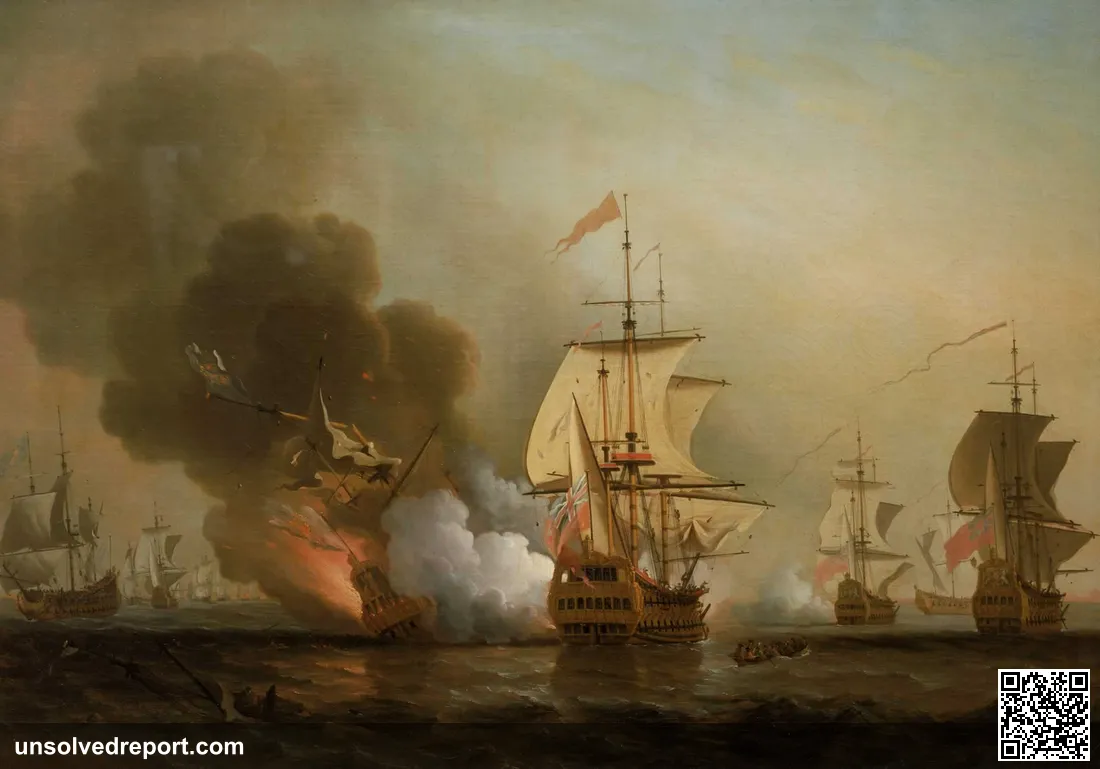
So on June 8, 1708, near the Baru peninsula off Cartagena, a British squadron under Commodore Charles Wager came hunting. Naval historians still call the clash that followed Wager's Action. Wager's plan was simple and greedy: pull alongside the San Jose, capture it, and sail home with the treasure and all.
It went wrong in the most spectacular way imaginable. Somewhere in the night battle, the San Jose's powder magazines went up. The whole ship blew apart and dropped like a stone. Contemporary accounts agree on the grim arithmetic: nearly the entire crew, close to 600 people, died. Only a handful made it out. Wager had hoped to tow home a fortune. Instead he watched it vanish into deep, black water.
And that single explosion is the whole reason treasure hunters have circled this wreck for three hundred years. Think about it. The treasure was never spent. Never recovered. Never split up or scattered. It went straight to the seabed in one go - and as far as anyone can prove, most of it has been sitting down there ever since.
What was actually on board? Period sources put it at something like 7 to 11 million pesos in gold and silver, plus emeralds dug from the mines of present-day Colombia, plus other goods loaded across the Spanish Main. That cargo list is imperfect. People argue over the exact totals. But it's real - and it's the factual seed from which every billion-dollar claim has grown.
Where the 20 billion dollar figure comes from
Now the honest part, because this is where it gets slippery. There is no verified inventory confirming what the cargo is worth today. None. The famous headline numbers - you'll see anywhere from 1 billion to 20 billion dollars - aren't measurements. They're guesses, built by taking the old cargo manifests and multiplying by modern prices for gold, silver, and collectible coins, then adding a bonus for how rare and historically priceless the artifacts might be.
Here's how the range splits:
- The low estimates (around 1 billion dollars) basically treat the metal like a giant ingot - melt value.
- The high estimates (up to 20 billion dollars) bet that the wreck is loaded with rare collector coins and flawless emeralds, the kind whose value to collectors would crush their melt value.
But notice what nobody has done: nobody has weighed the cargo. Not one peso of it. So read that 20 billion figure for what it is - a top-of-the-range marketing number, not a confirmed price tag. And that distinction is not nitpicking. It sits at the very center of the legal war, because Colombia has chosen, on purpose, to argue that the wreck is priceless cultural heritage - not a pile of stuff you can sell.
The disputed discovery
The modern chapter of this story opens in 1981 and 1982. An American salvage firm called Sea Search Armada (SSA), bankrolled by a group of US investors, said it had found the galleon - and handed coordinates over to the Colombian government.
What followed wasn't gold. It was decades of lawsuits. Was SSA owed a cut? Colombian courts weighed in. A US court weighed in. And the question of what SSA was actually owed never got cleanly resolved. It just festered.
Then came the moment everyone remembers. On November 27, 2015, the Colombian Navy located a wreck and said: this is the San Jose. President Juan Manuel Santos announced it to the world on December 5, 2015. How were they so sure? Partly because of the galleon's distinctive bronze cannons - some engraved with dolphins - imaged on the seabed by a REMUS 6000 autonomous underwater vehicle, a robotic sub run with help from the Woods Hole Oceanographic Institution.
But buried in that triumphant announcement was a detail with explosive legal weight. Colombia said this was a brand-new discovery, at coordinates different from the ones SSA had handed over years earlier. Read that again. If the 2015 find is a different spot on the ocean floor, then SSA's old claim might not stick to it at all. One set of coordinates, billions of dollars hanging on whether they match.
The salvage-law backdrop
To understand why everyone's clawing at each other, you have to know one uncomfortable truth: the law of sunken treasure is a genuine mess.
For centuries, two old doctrines - the law of finds and the law of salvage - rewarded the people who dragged wrecks back up. Sometimes with a fat cut. Sometimes with outright ownership of whatever they hauled to the surface. The basic idea was blunt: a wreck is abandoned property, finders keepers.
But the tide has turned. Over recent decades the law has swung toward protecting heritage. The 2001 UNESCO Convention on the Protection of the Underwater Cultural Heritage nudged nations to treat any shipwreck older than 100 years as cultural patrimony - something to be preserved where it lies, not sold off piece by piece. Many archaeologists put it bluntly: selling artifacts to pay for the recovery, the classic treasure-hunter playbook, wrecks the scientific value of a site. Colombia has threaded this needle by passing its own laws on submerged heritage and hammering the cultural framing again and again.
And this is the whole ballgame. Because the gap between calling the San Jose a treasure and calling it heritage is, quite literally, worth billions - and it decides who gets to claim anything. A salvor is owed money for recovering property. But nobody is owed a commission on a nation's patrimony. Same wreck. Two words. Completely different futures.
The four-way claim
So who's fighting? Four parties, and here's the unsettling thing - each one has a real argument.
- Colombia claims the wreck as national submerged cultural heritage, and frames the recovery as a scientific, patrimonial project - not a treasure hunt.
- Sea Search Armada insists it found the wreck first and is owed a big share, and is chasing a multibillion-dollar claim through international arbitration.
- Spain argues that as the original flag state, the warship and everything in it stays Spanish property under the principle of sovereign immunity for state vessels.
- Indigenous and Andean communities, including Bolivia's Qhara Qhara nation, say much of that silver was mined by their ancestors under forced labor on their own lands - and that gives them a moral claim to the proceeds.
Four claimants. One wreck. No referee everyone agrees on.
The arbitration in The Hague
The SSA fight has landed in a serious place: international arbitration before the Permanent Court of Arbitration in The Hague. Reporting in early 2025 said that Colombia presented its legal defense, with hearings scheduled for late 2025 and SSA pushing a claim worth billions.
Colombia's game plan has two prongs. First, it disputes that the 2015 wreck is even the same site SSA reported decades ago - the coordinates question again. Second, it argues the galleon's contents are cultural heritage, not commercial salvage, which would knock the legs out from under any percentage-of-value payout. A Colombian government investigation reportedly concluded the ship went down because of the British attack and its own poor condition - not the kind of circumstances that would help a salvor's case. And as of the latest reporting? Still pending. No final, binding decision on who gets what.
The recovery operations
Colombia has been creeping toward recovery, not charging at it. Starting around 2024, the government described a careful, robot-led plan: document the wreck, selectively raise a few artifacts, and absolutely not strip it bare. Then, in November 2025, a remotely operated machine reached down and lifted items including a cannon, a porcelain cup, and coins from the seabed.
The backlash was instant. Some Colombian archaeologists asked the obvious question: why poke the wreck while the lawsuits are still raging? They warned about the dangerous precedent of cherry-picking objects off a site like this. The government pushed back, insisting the work was archaeological in purpose - and summed it up with a phrase that became almost a slogan. It was, they said, "not about treasure."
2026: A whistleblower alleges looting at the wreck site
The recovery program's "not about treasure" line didn't hold for long. In March 2026, a Colombian cultural-heritage oversight group called VNPCS, led by Francisco Muñoz Atuesta, sent an open letter to the country's attorney general alleging looting and unauthorized interventions at the San Jose site in 2016 and 2022 — claims the group says it first raised through legal channels back in January 2021, only to be ignored. Academic critics, including archaeologists Rodrigo Pacheco Ruiz and Juan Guillermo Martín Rincón, joined in questioning the transparency of the government's handling of the site, even as Sea Search Armada's multibillion-dollar arbitration claim over the wreck remained pending before the Permanent Court of Arbitration (The Art Newspaper).
Why this wreck matters beyond the gold
Strip away the breathless dollar figures, and something quieter and stranger remains. The San Jose is a time capsule.
A sealed early-18th-century warship is a frozen snapshot of colonial trade, metallurgy, ceramics, and naval engineering - an entire vanished world preserved in salt water. Even the coins are more than money. Struck at colonial mints, each one is a dated historical document you can hold in your hand.
So here's the honest framing. The San Jose almost certainly holds a fortune - but the real scale is unproven, and its most reliable value might end up being knowledge, not cash. And whoever finally wins the courtroom war, the deeper question hangs there unanswered: when a contested colonial cargo surfaces, is it property to be divided up - or heritage to be protected? The courts are only just starting to reach for an answer. The wreck, meanwhile, waits in the dark.
Fact versus legend
- Fact: The San Jose sank on June 8, 1708, in battle with a British squadron, killing roughly 600 people, carrying a documented cargo of millions of pesos in gold and silver plus emeralds.
- Fact: Colombia announced locating the wreck in 2015 using a REMUS 6000 AUV; recovery of select artifacts occurred in 2025.
- Partly verified: Sea Search Armada's claim to have found the wreck in the early 1980s is real and litigated, but whether it is the same site Colombia found is disputed.
- Speculation: The 20 billion dollar valuation. No inventory supports it; it is an upper-bound estimate.
Frequently Asked Questions
How much is the San Jose galleon treasure actually worth?
Nobody knows for certain. Headline figures ranging from $1 billion to $20 billion are estimates built by applying modern gold, silver, and collector prices to old cargo manifests — not measurements of a recovered inventory, since no one has weighed the cargo (Colombia One).
Who owns the San Jose galleon treasure?
That's unresolved and contested by four parties: Colombia, which claims it as national cultural heritage; Sea Search Armada, which says it found the wreck first and is owed billions; Spain, which argues sovereign immunity applies to a sunken warship; and Indigenous Andean communities, including Bolivia's Qhara Qhara nation, who trace a moral claim to ancestors forced to mine the silver (Wikipedia).
When and how did the San Jose galleon sink?
It sank on June 8, 1708, off Cartagena, Colombia, when its powder magazines exploded during a battle with a British squadron under Commodore Charles Wager, a clash historians call Wager's Action. Nearly the entire crew, close to 600 people, died as the ship went down almost instantly (Wikipedia).
Has anyone actually recovered treasure from the San Jose?
Not in bulk. Colombia announced locating the wreck in December 2015 using a REMUS 6000 underwater vehicle, and in November 2025 a remotely operated vehicle retrieved a small number of items — a cannon, a porcelain cup, and coins — for documentation, not large-scale salvage (CBS News; Divernet).
What did the 2026 looting allegations claim?
A Colombian heritage oversight group, VNPCS, alleged in a March 2026 open letter that unauthorized interventions and looting occurred at the wreck site in 2016 and 2022, and that the group's earlier legal complaints about it, filed in January 2021, had been ignored by authorities (The Art Newspaper).
Why is Sea Search Armada suing over the San Jose wreck?
Sea Search Armada says it located the galleon in 1981–1982 and handed coordinates to the Colombian government, entitling it to a share of any recovery. Colombia disputes this by arguing the site it identified in 2015 is a different location, and the dispute is now before international arbitration at the Permanent Court of Arbitration in The Hague (Colombia One).
Original Data: What the "7 to 11 Million Pesos" Cargo Would Melt Down To Today
As this article notes, nobody has weighed the San Jose's cargo, but the period estimate of "7 to 11 million pesos" can still be run through a real calculation: the Spanish silver peso (piece of eight) had a published silver content, and silver has a live market price today. Treating the historical peso figure as pure silver coin at the 1497 minting standard gives a floor-level melt value.
| Cargo figure (historical estimate) | Silver content per peso | Total fine silver | Value at silver spot price (Oct 5, 2026) | Source |
|---|---|---|---|---|
| 7,000,000 pesos (low end of period estimate) | 25.561 g fine silver (1497 Spanish dollar standard; the page's next listed standard is 1728, after the 1708 sinking) | 178,927 kg / 178.9 metric tons (7,000,000 × 25.561 g, our calculation) | approximately $353.3 million (178,927,000 g ÷ 31.1035 g per troy oz × $61.42 per troy oz, our calculation) | Wikipedia, "Spanish dollar"; JM Bullion live silver spot price, Oct 5, 2026; cargo figure: Wikipedia, "Wager's Action" |
| 11,000,000 pesos (high end of period estimate) | 25.561 g fine silver (1497 Spanish dollar standard) | 281,171 kg / 281.2 metric tons (11,000,000 × 25.561 g, our calculation) | approximately $555.2 million (281,171,000 g ÷ 31.1035 g per troy oz × $61.42 per troy oz, our calculation) | same |
Treating the whole historical cargo figure as if it were pure silver coin puts today's melt value at roughly $353 million to $555 million — well below even the "around $1 billion" low-end estimate this article describes as a melt-value figure, let alone the $20 billion high-end figure.
How We Compiled This
- Sources. Wikipedia's "Spanish dollar" article, for the published 1497 silver content of the Spanish piece of eight; Wikipedia's "Wager's Action" article, for the "7 to 11 million pesos" figure (which that page carries a "citation needed" tag on); JM Bullion's live silver spot price page, cross-checked against Kitco's live spot price.
- Definitions. "Pesos" here means pieces of eight (Spanish 8-real silver dollars). "Fine silver" is the pure silver content of the coin, excluding the alloy that made up the remainder of its weight.
- How calculated. Total fine silver = number of pesos × 25.561 grams. That gram total was converted to troy ounces (1 troy oz = 31.1035 g) and multiplied by the October 5, 2026 spot price of $61.42 per troy ounce (JM Bullion, 10:22 PM EDT; Kitco's live feed showed $60.60 per troy ounce at about the same time, a difference of under 2%).
- Limitations. This calculation assumes the entire "7 to 11 million pesos" figure represents pure silver coin at the 1497 standard, which almost certainly understates the cargo's true composition — the article itself notes gold and emeralds aboard, and "pesos" in this context may function as a unit of account for total value rather than a literal count of a specific silver coin. Silver spot prices change by the minute; the figures used here are a snapshot from a single day and will drift over time.
📌 Data status: verified 2026-09-29.
Sources & further reading
- Wikipedia - Wager's Action - https://en.wikipedia.org/wiki/Wager's_Action
- CBS News - Coins, cannon recovered from San Jose shipwreck - https://www.cbsnews.com/news/san-jose-shipwreck-treasure-recovered-1708-colombia/
- Colombia One - Colombia Presents Legal Defense in San Jose Galleon Case - https://colombiaone.com/2025/01/15/colombia-san-jose-galleon-trial-shipwreck-sea-search-armada/
- Divernet - Items lifted from San Jose shipwreck - https://divernet.com/scuba-news/wrecks/items-lifted-from-san-jose-shipwreck-its-not-about-treasure/
- The Art Newspaper - Controversy resurfaces over San Jose shipwreck - https://www.theartnewspaper.com/2026/05/25/colombia-shipwreck-san-jose-controversy-looting
Dutch Schultz Treasure: $7M Buried in the Catskills, Never Found
A gangster buried $7 million in cash and diamonds in the Catskills in 1935 and died before he could say where. Ninety years on, it's still down there.

Amber Room: Poland Dug a New Search Site — and Found a Tank
Looted in 36 hours in 1941, worth up to $500M, officially burned in 1945 — yet in 2025 Poland granted a new dig permit. Where does the Amber Room stand now?
Belitung Shipwreck: A $32M Tang Hoard Inside an Arab Dhow
60,000 Tang treasures, one Arab dhow, no crew list. The Belitung shipwreck proved a lost Silk Road sea route — and no one agrees on the rest of the story.