Wow Signal Explained: Why the 1977 Alien Signal Still Isn't Solved
72 seconds, one shout on the hydrogen line, never repeated. A 2025 reanalysis revised the numbers again — here's what's actually confirmed about the Wow Signal.
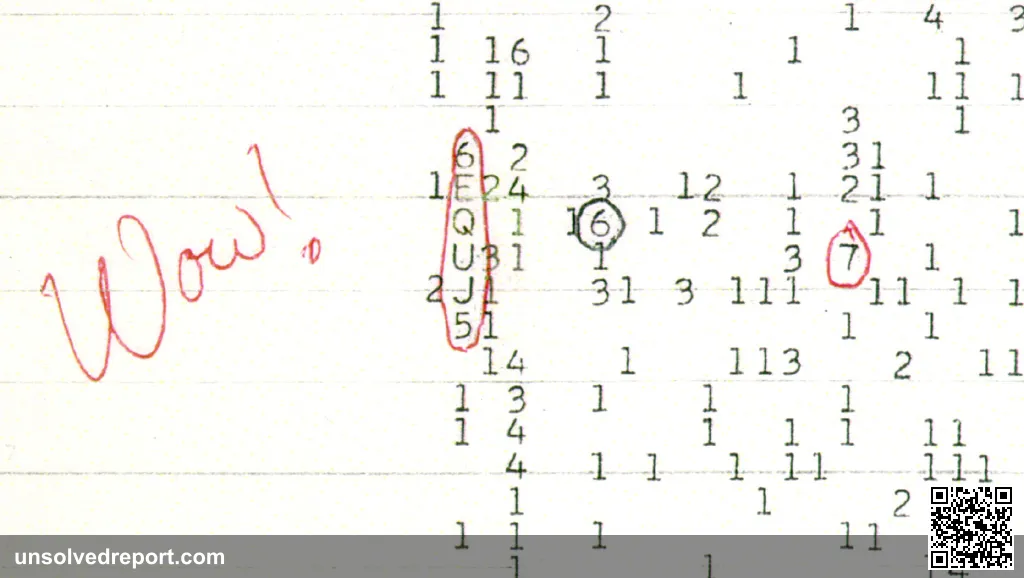
A man runs his finger down a column of numbers. Coffee going cold. Just another stack of printouts from a telescope in the Ohio countryside. Then he stops. One little run of digits and letters is screaming off the page, louder than anything around it. He grabs a red pen, circles it, and writes one word in the margin.
Wow!
That was the night of August 15, 1977. The astronomer was Jerry Ehman. Nearly fifty years later, a team of researchers went back into that same archived data and revised the numbers again — the signal was even stronger, and its frequency wasn't quite where everyone thought. The signal blasted for 72 seconds. Then it was gone. It has never come back. Here's what the record actually shows, and what the newest reanalysis changed.
The 60-Second Brief
> - August 15, 1977, ~22:16 Eastern — the Big Ear telescope in Delaware, Ohio, logs a signal; Jerry Ehman finds it days later reading printouts.
> - 72 seconds — the exact duration a fixed deep-space source should take to cross Big Ear's fixed beam as Earth rotates. The signal matched it precisely.
> - 1420.726 ± 0.005 MHz — the frequency as revised in an August 2025 reanalysis, close to the 1420.406 MHz hydrogen line, the "town square" frequency of the cosmos.
> - 250+ Janskys — the newly revised peak flux density (previous estimates ranged 54–212 Jy), making the signal stronger than long assumed.
> - Zero — confirmed recurrences in nearly 50 years of follow-up searches, including 1995–96 Very Large Array observations and a 1999 Tasmania search.
> - 11 authors, arXiv:2508.10657 — the "Arecibo Wow! II" paper, submitted August 14, 2025, that produced the revised numbers via modern reprocessing of the original archival data.
What we know for sure
Start with the hard stuff. None of this is really argued about.
A telescope built to do one thing: listen
The catcher was a machine called the Big Ear, a flat-field radio telescope run by Ohio State University out near Delaware, Ohio. By the 1970s it had one job: one of the earliest sustained Searches for Extraterrestrial Intelligence — SETI, guided by thinking like the Drake Equation — sweeping the sky for narrow radio tones, the kind a transmitter might pump out. Natural or artificial. Anybody's guess.
It struck on August 15, 1977, around 22:16 Eastern time (03:16 UTC on August 16). And here's the strange detail nobody expects: Ehman didn't hear it happen. He wasn't even there. The machine logged it automatically, and he only found it days later, reading the printouts after the fact. The most famous signal ever caught was a missed phone call.
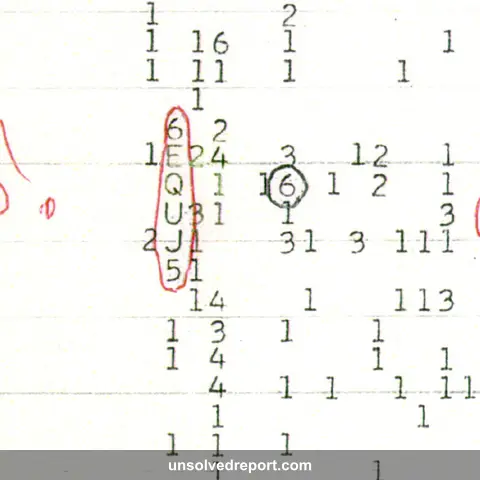
"6EQUJ5" is not an alien message
You've probably seen the code: 6EQUJ5. People love to imagine it's a word in some star language. It isn't. Not even close.
It's just the telescope's shorthand for how loud the signal was, moment by moment. Numbers ran 0 through 9. Then letters picked up the scale — A meant 10, and up it climbed. That peak letter, U, marks an intensity roughly 30 standard deviations above the background noise. Translation: deafening. For that silent corner of the sky, it was a shout in a library. Read the string left to right and you're watching the signal swell up, hit its peak, and fade back down.
Why exactly 72 seconds? This is the good part
Stick with me, because this detail is the whole mystery in miniature.
The Big Ear couldn't turn. It just stared at one fixed spot while the Earth spun underneath it, dragging the sky past its gaze. So picture a real source of radio emission, parked out there in space. As the Earth rotates, that source should slide across the telescope's view in about 72 seconds — fading in over roughly 36 seconds, blazing at the middle, then fading out the other side.
The Wow! signal did exactly that. To the second. It rose, peaked, and fell in the precise shape of something fixed in deep space. Not a plane buzzing overhead. Not a glitch on the ground. Something out there.
The frequency that made everyone's skin prickle
The signal sat close to the hydrogen line, at 1420.406 MHz — the natural song of neutral hydrogen, the most common stuff in the entire universe. (For decades the recorded frequency was cited as roughly 1420.456 MHz; a 2025 reprocessing of the archival data revised it further, to 1420.726 MHz — see the Recency section below.)
Why does that matter? Because for decades, scientists have argued this is the exact channel an alien civilization would pick if it wanted to be heard. Every radio astronomer in the cosmos is already glued to that band. It's the universe's town square. On top of that, the signal was razor-thin — narrowband, under about 10 kHz wide. Nature tends to be messy and broad. Tight signals like that are the fingerprint of a transmitter.
So: right frequency, right shape, right kind of sharpness. Are you leaning forward yet?
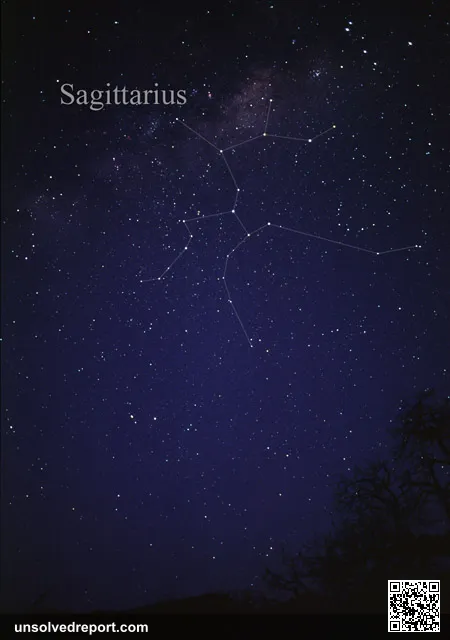
It came from Sagittarius. And it never said another word.
The signal pointed back toward the constellation Sagittarius, near a star group called Chi Sagittarii. And then, silence.
People have looked. Hard. Jerry Ehman went back within months. Astronomer Robert Gray hunted it again and again through the 1980s and 1990s, dragging in heavier gear each time — the far more sensitive Very Large Array in 1995–96, the Mount Pleasant Observatory in Tasmania in 1999. Every single search came up with nothing. A blank sky.
Put it all together. A one-time burst, narrow as a needle, sitting near the hydrogen line, moving exactly like a real star — and then vanishing without a trace. That's why this thing has shrugged off every easy answer for almost half a century.
So why can't we just solve it?
Here's the cruel catch: it only happened once.
That's the wall every scientist hits. There's nothing new to measure — just those 72 seconds of data, now decades old and yellowing. You can't run the experiment again. You can't test a hunch against an event that flatly refuses to repeat itself. Imagine trying to identify a stranger from one blurry photo taken in 1977, knowing they'll never walk past your window again.
The boring suspects, at least, are mostly off the table. The way the signal drifted across the sky rules out earthbound radio chatter, satellites, and aircraft with real confidence — none of them would fake a fixed point in space that cleanly.
So if it wasn't junk from down here, what was it?
The suspects
Now we leave the solid ground and step into the guesswork. These are theories — some sturdy, some shaky. Not verdicts.
The comets that probably weren't
In 2017, a researcher named Antonio Paris floated a tidy idea: maybe clouds of hydrogen gas wrapped around two comets — 266P/Christensen and 335P/Gibbs — happened to drift through the telescope's view and made the signal. Clean. Simple. It hit the headlines fast.
Then the rest of the field tore into it, including people from the original Big Ear team. The comets weren't in the right place at the right time. Comets aren't known to glow brightly at that frequency anyway. And the idea couldn't explain a glaring fact: the telescope had two beams, and only one of them caught the signal. Today this explanation is mostly treated as dead on arrival.
The 2024 idea: a cosmic cloud that flared and went dark
The most careful work in years came from the Arecibo Wow! project at the University of Puerto Rico's Planetary Habitability Laboratory. The team went back into the old archived data and squeezed out new numbers, including a peak brightness that they placed above 250 Janskys — several times stronger than the earlier estimates. Then they offered a mechanism.
Their best guess goes like this. A cold cloud of interstellar hydrogen got "switched on." Something violent and rare blasted it — a magnetar flare or soft gamma repeater, a kind of cosmic explosion — and the cloud suddenly lit up like a struck match. In effect, it may have flashed as a natural cosmic maser, a sort of hydrogen-line laser, glowing for a few moments and then snapping back to black.
They're blunt about what this means: a natural astrophysical phenomenon, not a message. Though even they admit an artificial origin still "cannot yet be ruled out." And one detail tips the scales toward nature — digging through the archives, they found fainter signals that look a lot like the same trick.
And the question you actually came here for
Could it have been them? Another civilization, reaching out?
That's the possibility that made the Wow! signal a legend, and in cold scientific terms, it has never been disproven. But hold on. "Not disproven" is a world away from "shown to be true." There's no evidence of anyone out there — the same silence that drives the Fermi Paradox — just one lonely burst that never repeated. Serious scientists keep aliens in the very last drawer, opened only after every natural explanation has failed. And the newest reanalysis says the natural explanations are still nowhere near used up.
Recency: the August 2025 reprocessing revised the numbers again
On August 14, 2025, Abel Méndez and ten co-authors at the Planetary Habitability Laboratory submitted "Arecibo Wow! II: Revised Properties of the Wow! Signal from Archival Ohio SETI Data" (arXiv:2508.10657) — a follow-up to their 2024 maser-flare paper. Rather than new observations, the team applied modern signal-processing methods to the same original Ohio SETI archival records, correcting a 21-second clock offset and a mislabeled channel in the telescope's filter bank that had gone unnoticed for decades.
The revised numbers: a peak flux density exceeding 250 Janskys (versus the 54–212 Jy range earlier estimates spanned), and a corrected frequency of 1420.726 ± 0.005 MHz — further from the hydrogen line than the long-cited 1420.456 MHz figure. The reprocessing also narrowed the signal's sky position to two candidate fields, centered near right ascension 19h25m02s or 19h27m55s, declination −26°57′. The paper reports the pattern looks naturally "Gaussian," which the authors say argues against an internal software glitch as the source. The team says it still favors an astrophysical origin — not a technical artifact and not, in their assessment, a deliberate transmission.
What this little burst really teaches us
The pull of the Wow! signal isn't that it proves something wild. It's that it sits right on the knife's edge of what we can actually measure. It was real. It was bizarre. And it slipped through our fingers before anyone could nail it down — a quiet reminder of how much of the sky we've never truly listened to.
The smart money, today, says it was an unusual natural flare-up involving the most ordinary element in the universe. Probably. But until somebody, somewhere, catches a second "Wow!", that red circle on a 1977 printout holds its place: real, documented, and still wide open.
And space is full of these loose threads — signals that flash once and vanish, lights we still can't name. The next one might already be sitting in an archive, waiting for someone to run a finger down the page and stop.
The Wow! signal at a glance
Everything below is drawn straight from the record above — the hard measurements on one side, the numbers that made them uncanny on the other.
| Property | Measured / recorded value | Why it mattered |
|---|---|---|
| Detection date | August 15, 1977 | Logged automatically by Big Ear; Ehman found it days later |
| Telescope | Big Ear, Ohio State University, Delaware, Ohio | Fixed flat-field dish running an early sustained SETI survey |
| Peak intensity code | 6EQUJ5 (peak letter "U") | ~30 standard deviations above background noise |
| Transit duration | ~72 seconds | Exactly matches a fixed deep-space source drifting through the beam |
| Original frequency estimate | ~1420.456 MHz | Sits near the 1420.406 MHz hydrogen line |
| Revised frequency (2025) | 1420.726 ± 0.005 MHz | Corrected via reprocessing archival data; further from hydrogen line than earlier cited |
| Bandwidth | under ~10 kHz (narrowband) | Too sharp for natural broadband emission; looks like a transmitter |
| Direction | Sagittarius, near Chi Sagittarii (two candidate fields as of 2025) | The pointing that has never produced a repeat |
| Revised peak brightness (2024–2025) | over 250 Janskys | Several times stronger than earlier 54–212 Jy estimates |
| Recurrences to date | zero | The single fact that keeps the case open |
Weighing the explanations
The Wow! signal has no shortage of stories attached to it. Sorted by how much weight the evidence actually carries, they line up like this — from the theory the field has already discarded to the one that can only be ruled out, never confirmed.
| Explanation | How strong is the evidence | The weak point | What would settle it |
|---|---|---|---|
| Earthbound interference (radio, satellites, aircraft) | Effectively excluded | Nothing terrestrial reproduces a fixed-point 72-second transit that cleanly | Already resolved — the drift shape rules it out |
| Comets 266P/Christensen & 335P/Gibbs (Paris, 2017) | Widely rejected, "dead on arrival" | Comets weren't in position, don't shine at 1420 MHz, and can't explain why only one of Big Ear's two beams caught it | A confirmed cometary hydrogen-line emission at that brightness — never demonstrated |
| Natural hydrogen-line maser flare (Arecibo Wow! I & II, 2024–2025) | Currently the leading account | Still a proposed mechanism, not a captured recurrence; rests on reprocessing of 1977 archival data | Catching a live maser flare, or matching one of the fainter archival look-alikes |
| Extraterrestrial transmitter | Never disproven, but never supported | "Not disproven" is not evidence; no repeat, no corroborating detection | A second signal from the same patch of Sagittarius |
Frequently Asked Questions
Was the Wow! signal ever explained for certain?
No. The leading account — a natural hydrogen-line maser flare, possibly triggered by a magnetar burst — comes from the Planetary Habitability Laboratory's 2024–2025 reanalyses of the original archival data (arXiv:2408.08513 and arXiv:2508.10657). The authors themselves describe it as the most likely explanation, not a confirmed one, and say an artificial origin still "cannot yet be ruled out."
Why hasn't the Wow! signal repeated?
Every organized search since 1977 — including Jerry Ehman's own follow-up, Robert Gray's Very Large Array observations in 1995–96, and a 1999 search from Mount Pleasant Observatory in Tasmania — has come up empty. That single non-repetition is exactly why the case has stayed open for nearly fifty years: there is no second data point to test any theory against.
What does 6EQUJ5 actually mean?
It is not a message. It is Big Ear's shorthand intensity scale, recorded once per ten-second sampling interval as the signal rose and fell: numerals 0–9 and then letters starting at A (=10) for stronger readings. The peak letter "U" corresponds to roughly 30 standard deviations above background noise.
Did the 2025 study change the Wow! signal's frequency?
Yes. Reprocessing the original Ohio SETI archival records with modern methods, the "Arecibo Wow! II" paper (submitted August 14, 2025) corrected a 21-second clock offset and a mislabeled filter-bank channel, revising the frequency to 1420.726 ± 0.005 MHz and the peak flux density to over 250 Janskys, both different from the figures cited for decades.
Could the Wow! signal have been a message from aliens?
It has never been disproven as one, but it has never been supported as one either. There is no corroborating detection, no repeat signal, and no independent evidence of a transmitter at that location. Researchers treat the extraterrestrial explanation as the last option to consider, not the first.
Where did the Wow! signal come from?
It arrived from the direction of the constellation Sagittarius, near the star group Chi Sagittarii. The 2025 reprocessing narrowed this further to two candidate sky fields, centered near right ascension 19h25m02s or 19h27m55s and declination −26°57′.
Original Data: The Wow! Signal Against Two Later SETI Candidate Signals
This article's own table lists the Wow! signal's measured properties, but it doesn't set them against the other narrowband "candidate" signals SETI researchers have chased in the decades since — the 2015 HD 164595 signal and 2019's Breakthrough Listen Candidate 1 (BLC1). The table below compiles each signal's date, frequency, duration, and eventual verdict from several sources, then calculates how many times longer the Wow! signal's recorded duration was than that of HD 164595, the only other signal with a published duration.
| Signal | Date | Frequency | Duration | Recurrence / Verdict | Duration vs. HD 164595 (our calculation) | Source |
|---|---|---|---|---|---|---|
| Wow! signal | August 15, 1977 | 1420.726 MHz (2025 revised figure) | 72 seconds (the full window Big Ear could observe it) | Never repeated in nearly 50 years of follow-up; a 2025 reanalysis says an astrophysical origin is most likely, but no explanation has been confirmed | 36× longer (72 ÷ 2, our calculation) | Wikipedia, Wow! signal; arXiv:2508.10657 |
| HD 164595 signal | May 15, 2015 (media attention from August 2016) | 11 GHz | 2 seconds | Observed once, by one team, at one telescope; the Russian Academy of Sciences later called it of "most probable terrestrial origin" | 1× (baseline) | Wikipedia, HD 164595 |
| Breakthrough Listen Candidate 1 (BLC1) | Detected April–May 2019, announced December 2020 | 982.002 MHz | not published | In October 2021, researchers concluded it is unlikely to be a technosignature because of its similarity to previously detected terrestrial interference | not calculable — no published duration | Wikipedia, Breakthrough Listen; Wikipedia, Breakthrough Listen Candidate 1 |
Of the three, HD 164595 was judged of most probable terrestrial origin and BLC1 was concluded unlikely to be a technosignature, while no explanation for the Wow! signal, terrestrial or otherwise, has been confirmed. The Wow! signal's 72-second recorded duration is also 36 times HD 164595's two-second detection, the only other signal in this comparison with a published duration.
How We Compiled This
- Sources. Wikipedia's "Wow! signal" article and the "Arecibo Wow! II" arXiv paper already cited in this article, plus Wikipedia's articles on HD 164595, Breakthrough Listen and Breakthrough Listen Candidate 1 for the other two candidate signals.
- Definitions. "Duration" is each source's own stated length of the detection event. "Recurrence / Verdict" summarizes each source's own most recent stated conclusion about the signal's likely origin, not this article's own judgment.
- How calculated. Duration ratio = Wow! signal's 72 seconds ÷ HD 164595's 2 seconds = 36.
- Limitations. No signal duration is stated for BLC1 in the sources used, so no duration ratio is calculated for it. The three signals were also detected with different instruments at different frequencies (1420 MHz, 11 GHz, and 982 MHz), so their comparability is limited to timing and eventual verdict, not signal strength or frequency band.
📌 Data status: verified 2026-09-29.
Sources & further reading
- https://en.wikipedia.org/wiki/Wow!_signal
- https://phl.upr.edu/wow
- https://arxiv.org/abs/2408.08513
- https://arxiv.org/abs/2508.10657
- https://phys.org/news/2024-08-wow-deciphered-hydrogen.html
- https://phys.org/news/2025-08-wow-stronger-thought.html
- https://earthsky.org/space/the-wow-signal-seti-hydrogen-line-maser/
- https://astronomynow.com/2017/06/11/comet-claim-for-mysterious-wow-signal-sparks-controversy/
- https://www.livescience.com/59442-astronomers-skeptical-about-wow-signal.html
SETI at 65: One Unexplained Signal, Six Decades of Silence
65 years of SETI: Project Ozma, the Big Ear, a signal that got stronger on reanalysis, and why the silence itself is the strangest data point of all.

1952 Washington DC UFO Incident: 3 Radars, 1 Lost Tape, 74 Years
3 radars tracked it, jets chased it, and in 2026 a lawmaker says MIT has a tape of the Air Force briefing that followed. What the 1952 DC UFO case still can't explain.
Westall UFO at 60: Why 200+ Witnesses Still Won't Recant
60 years after 200+ Australian students watched a UFO land at Westall High, witnesses are still telling the same story. What's the strongest documented explanation?