Bootes Void: 330 Million Light-Years of Almost Nothing
The Bootes Void holds ~60 galaxies where 2,000 should be. DESI's finished 3D map is now testing whether a void this size fits the standard model.
1981. A team of astronomers is mapping the distances to galaxies, expecting more of the usual: galaxies sprinkled across the sky the way stars dust a clear night. Then they turn their attention toward Bootes, the Herdsman. And they find almost nothing.
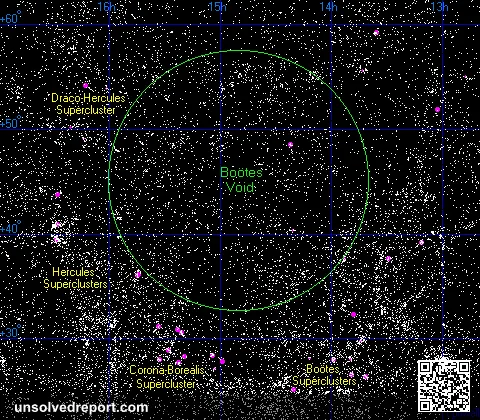
A region of space roughly 330 million light-years across was holding a tiny fraction of the galaxies it should have. The team had blundered into one of the emptiest places anyone has ever found. We call it the Bootes Void.
Here is a line that has chased the void around ever since, attributed to the astronomer Greg Aldering, meant to make the emptiness land in your gut: if the Milky Way had sat at the center of the Bootes Void, we would not have known there were other galaxies until the 1960s. Maybe the quote is word-for-word, maybe it is not. The point holds anyway. The void is so vast and so empty that a civilization living inside it could have spent decades convinced its galaxy was the only one in existence. What follows is what is actually known about the void, what remains debated, and how a survey that just finished mapping the universe is putting it to the test.
> The 60-Second Brief
> - 1981: Robert Kirshner and colleagues stumble onto the void while running a redshift survey never designed to find it.
> - ~330 million light-years: the void's diameter, among the largest confirmed in the observable universe.
> - ~700 million light-years: its distance from Earth, toward the constellation Bootes.
> - ~60 vs. ~2,000: galaxies actually found inside the void versus the number a region of that size would hold at average cosmic density.
> - 1997: Aldering's team, using IRAS satellite data, raises the confirmed count to 53 galaxies, the bulk of today's tally.
> - April 15, 2026: DESI announces it has completed its five-year, 47-million-object 3D map of the universe, the kind of dataset now used to test whether voids this large are a natural outcome of the standard model or a statistical outlier.
Finding a hole by accident
The discovery came out of a redshift survey led by Robert Kirshner and colleagues, who were trying to build a three-dimensional map of the local universe. The trick they relied on is elegant. A galaxy's redshift, the amount its light gets stretched toward longer wavelengths by the expansion of space, doubles as a yardstick for distance. Measure the redshifts of enough galaxies and you can reconstruct not just where they sit on the flat sky, but how far back they go in depth.
When the team plotted their results toward Bootes, a yawning under-dense region opened up in the data. Their 1981 paper in The Astrophysical Journal carried a title that says it plainly: "A million cubic megaparsec void in Bootes." And here is the part that gives the find its bite. It was partly an accident, a byproduct of a survey built for other reasons. Nobody went looking for the emptiness. It ambushed them, which is exactly why it is remembered as a genuine surprise instead of a tidy confirmation of theory.
Follow-up work in the years after sharpened the picture, and it turned out the void is not flawlessly empty. It holds a modest scattering of galaxies, many of them strung along a tube-like filament threading through the middle. The tally lands at roughly 60 galaxies inside a region where the normal density of the universe would predict closer to 2,000. So the Bootes Void is no perfect vacuum. It is a place where galaxies have gone extraordinarily scarce, down to a tenth or less of the cosmic average.
Just how big, just how empty
A few numbers anchor the scale:
- Diameter: about 330 million light-years across, putting it among the largest known voids. Some sources reach for a bigger word and call it a "supervoid."
- Distance: roughly 700 million light-years from Earth, off in the direction of the constellation Bootes.
- Galaxy count: on the order of 60 confirmed galaxies inside, against the roughly 2,000 a comparable, well-populated volume would carry.
It is worth being careful about what "empty" actually means here. The void is under-dense, not stripped of all matter. Diffuse gas drifts through it. Dark matter is there. So are those few dozen galaxies. What stuns you is the contrast with everything around it, not some absolute absence of stuff.
Why voids exist in the first place
Here is the twist that dramatic retellings tend to bury: a void this big is not a mystery at all. It is a prediction. Modern cosmology fully expects the universe to look like this.
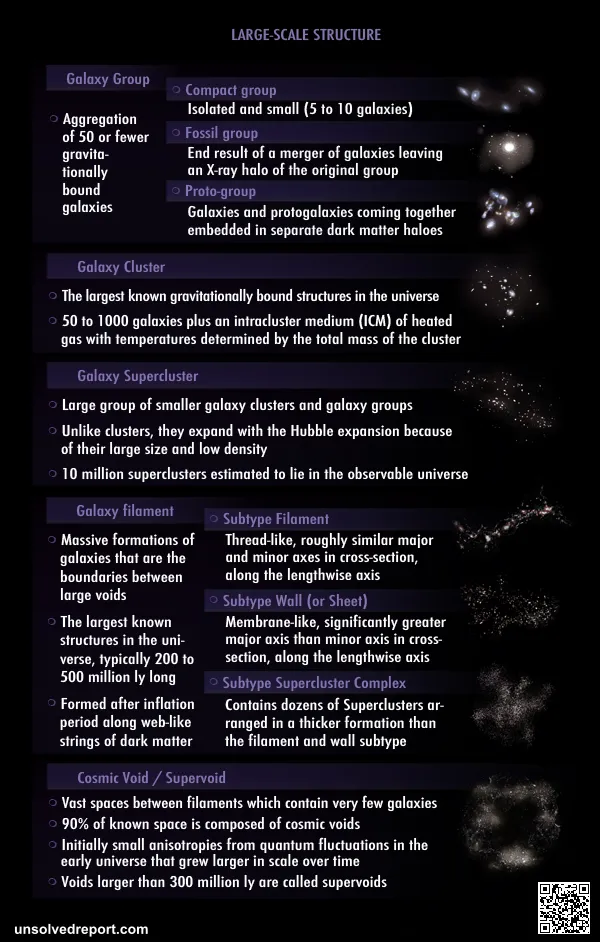
In the standard model, known as Lambda-CDM, the cosmos started out nearly smooth, carrying only faint density ripples stamped into it in the earliest moments. Then gravity went to work. Across billions of years it amplified those ripples. Slightly denser patches pulled in more matter and grew denser still; slightly thinner patches bled matter to their neighbors and grew emptier. The end product is what astronomers call the cosmic web: a spongelike structure of dense filaments and sheets of galaxies wrapped around enormous, nearly hollow bubbles.
The voids are those bubbles. They are not glitches in the picture. They are the natural other half of the filaments, the empty room between the strands. Run a cosmological simulation forward from the early universe, let gravity do its slow work, and voids fall out reliably, big ones included.
So why does the Bootes Void still earn so much attention? Mostly its sheer size, which sits toward the large end of what the models comfortably churn out. A void this big is not impossible under Lambda-CDM, just uncommon, and that makes it a handy stress test for how well our theory of structure formation matches the real sky. Study the biggest voids and you help calibrate the models.
What is nailed down, and what is still up for grabs
It pays to separate the rock-solid from the genuinely open.
Established:
- The Bootes Void is real, confirmed again and again by multiple surveys since 1981.
- It is severely under-dense, carrying far fewer galaxies than average.
- The broad existence of large cosmic voids is well explained by the gravitational growth of structure in Lambda-CDM.
Still discussed:
- Whether the Bootes Void's size is fully typical for the standard model, or whether it sits out on the rare tail of the distribution.
- The fine-grained properties of the few galaxies inside, including the question of whether void galaxies build stars differently because they grow up in relative isolation.
That last question is the kind that keeps researchers busy. Galaxies raised inside voids have almost no neighbors to mingle or merge with. Using big surveys like the Sloan Digital Sky Survey, astronomers have probed whether void galaxies run bluer, hold more gas, or forge stars at different rates than galaxies packed into denser neighborhoods. The differences they find are real but generally modest, which hints that environment nudges galaxies without rewriting what they fundamentally are.
What the void is not
Because the Bootes Void is so dramatic, it tends to attract overreach. A few things to set straight:
- It is not a black hole or a tear in space. It is just a region with very little matter in it. Nothing is being swallowed.
- It is not evidence of alien engineering. There is no scientific footing for that idea, and nothing about the void demands an exotic explanation. Ordinary gravity grinding away over billions of years covers it.
- It does not break physics. If anything, large voids are confirmation that our broad picture of how cosmic structure forms actually works.
The honest mystery, to the degree there is one, is quantitative rather than qualitative. The question is not "how can a void exist?" but "is a void this large fully consistent with the statistics our best models predict?" That is a matter of fine detail, the kind cosmologists chase by stacking many voids across huge surveys and holding them up against simulations.
How do you map nothing?
It sounds backward to talk about measuring a place defined by what is missing from it. But cosmologists have built careful tools for exactly that. The first ingredient is a galaxy survey: a catalog of positions and redshifts for hundreds of thousands, even millions, of galaxies. Projects like the Sloan Digital Sky Survey, and the earlier galaxy redshift surveys before it, took the flat two-dimensional sky and gave it depth, with redshift standing in for distance.
Once you have that map, void-finding algorithms go hunting for regions where the galaxy density plunges well below the cosmic average. Different algorithms draw the boundaries differently. Some grow spheres outward from empty points until they bump into galaxies; others read the geometry of the galaxy distribution itself. That is one reason quoted void sizes wander a bit from study to study. The Bootes Void's headline figure of roughly 330 million light-years comes out of this kind of analysis aimed at a strikingly under-dense patch of sky.
One subtlety to keep in mind: redshift is not a flawless distance measure. Galaxies carry their own motions on top of the overall cosmic expansion, and that smears their apparent positions in depth a little. Astronomers correct for these "redshift-space distortions" when they characterize a void, and those corrections are well understood. None of them make the Bootes Void vanish. They only refine its shape and its edges.
Bubbles all the way out
The Bootes Void is the most famous, but it is far from the only one. The universe is riddled with voids of every size, and together they account for most of its volume. Galaxies, by contrast, crowd into the thin walls and filaments running between them. Zoom out far enough and the cosmos stops looking like a sea of galaxies and starts looking like a froth of bubbles, with galaxies tracing the soap films stretched between them.
That froth-like architecture is precisely what gravity, acting on tiny early-universe ripples, is expected to produce. Other very large under-dense regions have been catalogued across different stretches of sky, and surveys keep turning up more. The takeaway is simple: voids are a generic, expected feature of the cosmos. The Bootes Void is best read not as a unique enigma but as a particularly large and well-studied example of something entirely ordinary.
Why any of it matters
Voids are not just curiosities to gawk at. They are turning into serious cosmological tools. Because a void is under-dense, the way light and matter behave inside it is unusually sensitive to the properties of dark energy and to the laws of gravity on the very largest scales. The expansion history inside a void runs subtly differently from the cosmic average, and the gravitational dent a void carves into space can leave a faint fingerprint on the cosmic microwave background as light passes through.
That last effect ties the study of voids to other frontier questions, including the anomalies hiding in the microwave background itself. Map voids in detail, compare how many there are and how big they grow against the predictions, and you get an independent check on a model that already leans on supernovae, the microwave background, and galaxy clustering.
The Bootes Void, stumbled upon by accident in 1981, turned out to be an early window onto the real architecture of the cosmos: not a uniform sprinkle of galaxies, but a vast, structured web wound around enormous bubbles of near-emptiness. That architecture is one of the genuine triumphs of modern cosmology. And the hole in Bootes was one of the first dramatic hints that the universe is built exactly this way. The next question writes itself. If the biggest voids are this ordinary, what does the rest of the froth still have hidden in it?
The void by the numbers
Everything below is drawn from the sources already cited on this page.
| Property | Figure | Source |
|---|---|---|
| Discovery year | 1981 | Kirshner et al. 1981, ApJ |
| Discovery paper | "A million cubic megaparsec void in Bootes" | Kirshner et al. 1981, ApJ |
| Lead discoverer | Robert Kirshner and colleagues | Wikipedia |
| Diameter | ~330 million light-years | Article body |
| Distance from Earth | ~700 million light-years | Wikipedia |
| Galaxies confirmed inside | ~60 | Wikipedia; article body |
| Galaxies expected at cosmic density | ~2,000 | Article body |
| Constellation | Bootes (the Herdsman) | Article body |
| Governing framework | Lambda-CDM (gravitational growth of structure) | Lambda-CDM |
How the galaxy count was filled in
The often-repeated "roughly 60 galaxies" figure was not the number from the 1981 discovery. It was assembled step by step across follow-up surveys, which is why the void that first looked all but empty is now known to hold a thin population strung along an internal filament. The sequence below is drawn from the NED/Bothun source already cited here.
- 1981 — Kirshner, Oemler, Schechter and Shectman report the void from a redshift survey, giving it an overall scale of roughly 7,500 km/s in redshift velocity. Kirshner et al. 1981, ApJ
- 1987 — A follow-up survey examines 240 bright galaxies across the region; essentially none fall at the void's redshift, sharpening just how under-dense the interior is. NED / Bothun
- 1997 — Aldering and collaborators, drawing on IRAS satellite data, locate 53 galaxies inside the void's boundaries — the bulk of the modern tally, and the work behind the Greg Aldering name attached to the void's most quoted line. NED / Bothun
The through-line is worth holding onto: the count crept upward not because the void filled in, but because deeper surveys could see the faint galaxies that were always there. Even the fuller tally lands at a tenth or less of the cosmic average.
The 2026 update: a finished 3D map puts voids to the test
On April 15, 2026, the Dark Energy Spectroscopic Instrument (DESI) announced it had completed the 3D map of the universe it set out to build five years earlier, ahead of its original schedule. The finished survey covers more than 47 million galaxies and quasars, well past its original goal of 34 million, plus data on 20 million stars, and it now holds roughly six times more cosmological data than every prior large-scale-structure measurement combined. DESI / Mellon College of Science
That matters for a void like Bootes because DESI's own team has already used the instrument to catalog cosmic voids at scale, identifying more than 140,000 voids from its Legacy Survey galaxy sample alone, with a separate public catalog covering its Year 1 Bright Galaxy Sample out to a redshift of 0.24. DESI void catalog / arXiv Datasets this large let cosmologists stack thousands of voids and check, statistically, whether something the size of Bootes is a routine outcome of Lambda-CDM or sits further out on the tail than the models are comfortable with. DESI observations continue through 2028, with the first results from the full five-year dataset expected in 2027, and researchers have flagged that the survey's early data already hinted dark energy might be evolving over time rather than staying constant — a question the completed map is built to settle one way or the other. DESI / Mellon College of Science
Frequently Asked Questions
Is the Bootes Void completely empty?
No. It holds roughly 60 confirmed galaxies, against the roughly 2,000 a region of that size would carry at average cosmic density, plus diffuse gas and dark matter. "Empty" describes an extreme under-density, not a true vacuum.
How was the Bootes Void discovered?
Robert Kirshner and colleagues found it by accident in 1981 while running a redshift survey aimed at mapping the local universe in three dimensions, not searching for voids. Their result appeared in The Astrophysical Journal under the title "A million cubic megaparsec void in Bootes." Kirshner et al. 1981, ApJ
Could a civilization inside the Bootes Void know other galaxies exist?
The often-repeated claim, attributed to astronomer Greg Aldering, is that a civilization at the void's center would not have detected other galaxies until the 1960s. It is a rhetorical illustration of the void's scale rather than a precise calculation, but the underlying point, that the void is vast enough to isolate any observer near its center, is accurate.
Does the Bootes Void disprove the Big Bang or standard cosmology?
No. Large voids like Bootes are a predicted feature of Lambda-CDM, the standard cosmological model, which expects gravity to carve the early universe's density ripples into a web of filaments and voids over billions of years. The open questions concern the void's exact size relative to statistical expectations, not whether voids should exist at all.
Why do astronomers keep studying an already-confirmed void?
Because voids are unusually sensitive probes of dark energy and gravity on the largest scales. Surveys like DESI now catalog voids by the tens of thousands specifically to compare their sizes and abundances against model predictions, turning the Bootes Void from a curiosity into one data point in a much larger statistical test. DESI void catalog / arXiv
Are there other voids as large as Bootes?
Yes. Voids of comparable and even larger scale have been catalogued elsewhere in the sky, and large surveys keep finding more as they map deeper. Voids collectively occupy the majority of the universe's volume, with galaxies confined to the thin filaments and walls between them.
If the biggest voids keep turning out to be ordinary, the more interesting question shifts from Bootes itself to what the rest of the cosmic froth is still holding back — and DESI's completed map is the first dataset built to answer that at scale.
Original Data: How Bootes Void's Volume Stacks Up Against Other Giant Supervoids
No single source lines up the Bootes Void's actual volume against the universe's other record-breaking voids. The table below takes each void's own reported radius or diameter, calculates its volume using the standard sphere formula, and expresses that volume as a multiple of the Bootes Void's — the comparison that shows just how far Bootes sits from actually being the biggest.
| Void | Reported size | Radius used for calculation | Volume (calculated) | Size relative to Bootes Void (calculated) | Distance from Earth | Source |
|---|---|---|---|---|---|---|
| Bootes Void | radius 62 megaparsecs (nearly 200 million light-years) | 62 Mpc | ≈1.0 million Mpc³ (our calculation, (4/3)πr³) | 1× (baseline) | ≈700 million light-years | Wikipedia, "Boötes Void" |
| Giant Void | diameter "300 to 400 Mpc (1 to 1.3 billion light-years)" | 150–200 Mpc | ≈14.1–33.5 million Mpc³ (our calculation) | ≈14×–34× (our calculation) | ≈460 Mpc (1.5 billion light-years) | Wikipedia, "Giant Void" |
| KBC Void / Local Hole | diameter "approximately 2 billion light-years (600 megaparsecs)" | 300 Mpc | ≈113.1 million Mpc³ (our calculation) | ≈113× (our calculation) | n/a — the Milky Way sits inside it | Wikipedia, "Local Hole" |
Scaled up this way, the Bootes Void is a minnow next to the others in this table: the Giant Void could hold on the order of 14 to 34 Bootes-sized voids by volume, and the Local Hole, the vast underdensity our own galaxy sits inside, could hold roughly 113. Bootes earns its fame for being an early, well-studied discovery, not for being the largest void ever confirmed.
How We Compiled This
- Sources. Two independent sources: Wikipedia's separately maintained entries for the Boötes Void, the Giant Void, and the KBC Void/Local Hole, and Sky at Night Magazine, a specialist astronomy publication, for a second figure on the Boötes Void's size.
- Definitions. "Radius used for calculation" is the value a source states directly (Boötes Void: 62 Mpc) or half of a stated diameter (Giant Void, Local Hole). Every void is treated as a sphere for the volume calculation, the same simplifying assumption astronomers use for order-of-magnitude void comparisons.
- How calculated. Volume = (4/3)πr³ in cubic megaparsecs, using each source's own reported radius or diameter. "Size relative to Bootes Void" = that void's calculated volume ÷ the Bootes Void's calculated volume (≈1.0 million Mpc³).
- Limitations. Even the Bootes Void's own size is reported inconsistently: Wikipedia's infobox gives a radius of 62 Mpc (a diameter of roughly 400 million light-years), while Sky at Night Magazine states it "spans an area 330 million lightyears across." This table calculates volume from the more precise Wikipedia figure, which also happens to match the "million cubic megaparsec" figure in the void's own 1981 discovery-paper title; using the smaller 330-million-light-year figure instead would roughly halve the Bootes Void's calculated volume and make the other voids' relative sizes proportionally larger still. Treating irregular, filament-threaded voids as perfect spheres is a simplification that all three sources implicitly share.
📌 Data status: verified 2026-09-29.
Sources & further reading
- Wikipedia - Bootes Void - https://en.wikipedia.org/wiki/Bo%C3%B6tes_Void
- Kirshner et al. 1981, A million cubic megaparsec void in Bootes, The Astrophysical Journal - https://ui.adsabs.harvard.edu/abs/1981ApJ...248L..57K/abstract
- NASA/IPAC Extragalactic Database - The Void in Bootes - https://ned.ipac.caltech.edu/level5/Bothun2/Bothun3_5_3.html
- BBC Sky at Night Magazine - The Bootes Void - https://www.skyatnightmagazine.com/space-science/bootes-void
- Wikipedia - Void (astronomy) - https://en.wikipedia.org/wiki/Void_(astronomy)
- Wikipedia - Lambda-CDM model - https://en.wikipedia.org/wiki/Lambda-CDM_model
- Carnegie Mellon University / Mellon College of Science - DESI Completes Planned 3D Map of the Universe, Will Continue To Explore (April 15, 2026) - https://www.cmu.edu/mcs/news-events/2026/0415-desi-survey
- The era of precision cosmology with voids, arXiv - https://arxiv.org/pdf/2601.14362
Przybylski's Star: The Sky's Most Impossible Light
Przybylski's Star glows with plutonium and promethium, elements that decay in years, not eons. Sixty years on, nobody can explain why they're still there.
Impossibly Early Galaxy Problem: JWST Found What Shouldn't Exist
JWST just found galaxies too big, too bright, and too early to exist under our own laws of physics. Is cosmology broken — or is something stranger going on?
The Cosmological Lithium Problem: Why 2/3 of Big Bang Lithium Is Missing
Big Bang physics predicts triple the lithium the oldest stars actually have. A 2024 interstellar gas measurement just made the gap harder to explain away.