The Cosmological Lithium Problem: Why 2/3 of Big Bang Lithium Is Missing
Big Bang physics predicts triple the lithium the oldest stars actually have. A 2024 interstellar gas measurement just made the gap harder to explain away.
Two-thirds of the universe's oldest lithium is missing, and nobody can find it.
That's not a typo. The same theory that nails how much hydrogen, helium, and deuterium the newborn universe cooked up also tells us how much lithium it should have made. Astronomers went looking, in the most ancient stars they could find, and came up short. Way short: three parts predicted, one part actually there. A 2024 measurement of lithium floating loose in interstellar gas — not locked inside a star at all — has since ruled out the easiest excuse. Here's what the numbers say, who the remaining suspects are, and why nobody has closed the case after more than two decades.
The 60-Second Brief
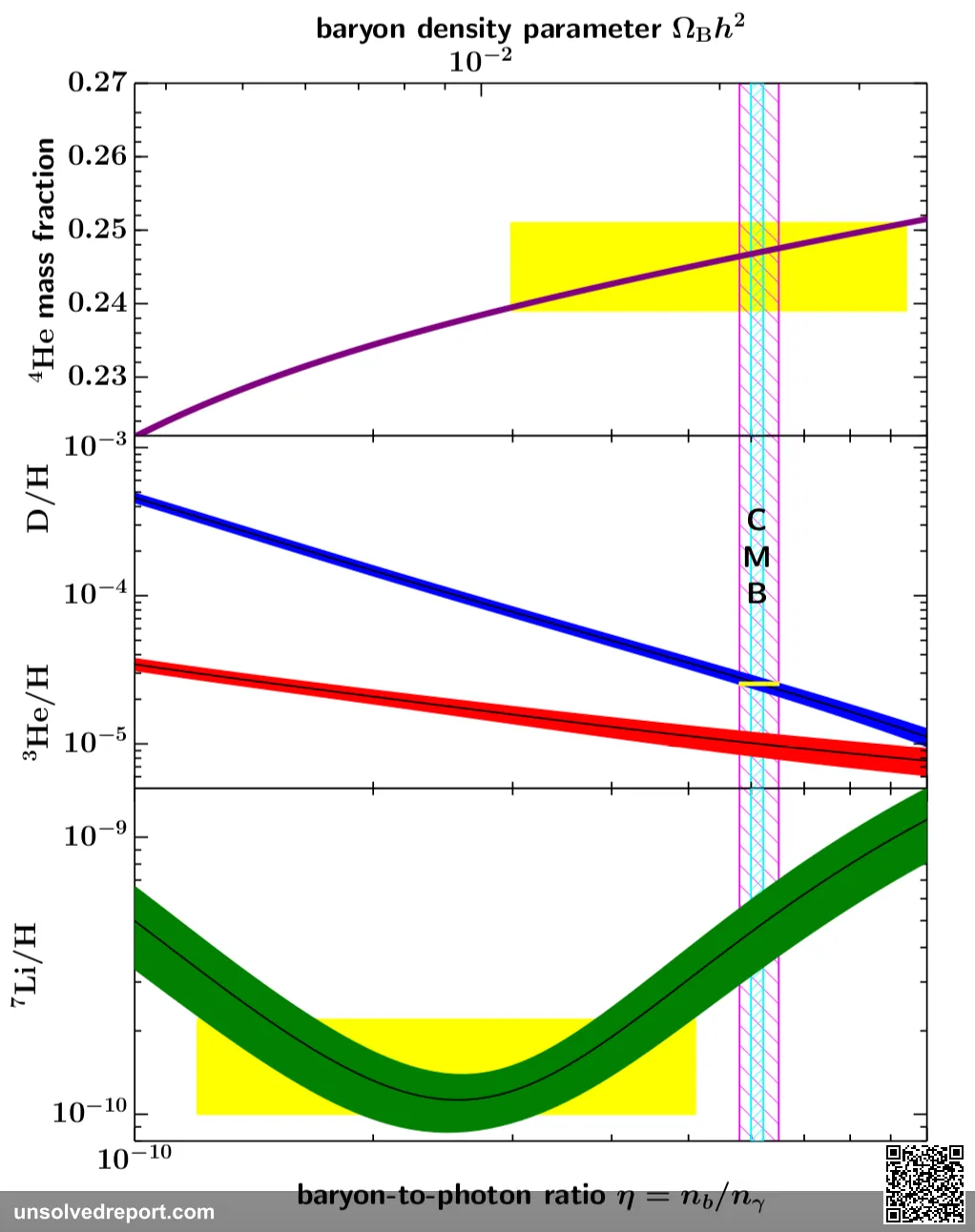
> - Standard Big Bang nucleosynthesis predicts primordial lithium-7 at (7Li/H) = (4.9 ± 0.7) × 10⁻¹⁰.
> - The oldest halo stars (the "Spite plateau," found in the 1980s) show only (7Li/H) ≈ (1.6 ± 0.3) × 10⁻¹⁰ — roughly a factor of 3 short.
> - A 2024 VLT study of the Small Magellanic Cloud's interstellar gas found lithium about 4x lower than Big Bang predictions, with only a 1-in-300 chance that's a statistical fluke.
> - A 2021 University of Tokyo nuclear-physics experiment ("Trojan horse" method) trimmed the predicted lithium yield by only 10 percent — nowhere near enough to close the gap.
> - Three suspects remain on the table: stellar depletion over ~13 billion years, flawed nuclear reaction rates, and undiscovered physics during the universe's first minutes.
> - The problem has been open since the 1980s discovery of the Spite plateau and remains unresolved as of the field's most recent (September 2025) review.
What we know for sure
Rewind to the first few minutes after the Big Bang. The whole universe is a furnace, hot and dense enough to weld light atomic nuclei together, a process called Big Bang nucleosynthesis, or BBN for short. Here's what makes BBN so powerful: there's almost nothing left to fudge. Once the Planck satellite nailed down exactly how much ordinary (baryonic) matter exists by reading the cosmic microwave background, BBN turned into a "zero-parameter theory." Feed it that one number, and it spits out how much of each light element the early universe should have forged (Astronomy & Astrophysics, 2025).
For most of those elements, it's a stunning win. Measure the deuterium and helium-4 floating around the cosmos, and the numbers line up with theory almost perfectly (A&A, 2021). Deuterium matches to within a few percent. This is one of the load-bearing pillars of Big Bang cosmology, the kind of agreement that makes physicists trust the whole framework.
Then there's lithium-7. The black sheep.
| Element | BBN prediction vs. observation | Agreement |
|---|---|---|
| Deuterium | Matches to within a few percent | Excellent |
| Helium-4 | Matches within uncertainties | Excellent |
| Lithium-7 | Predicted ≈3x observed | Factor-of-3 gap |
Plug in the CMB-measured baryon density, and standard BBN predicts a primordial lithium-7 abundance of about (7Li/H) = (4.9 ± 0.7) × 10⁻¹⁰ (A&A, 2025, citing Yeh et al. 2021 and Fields & Olive 2022). Clean. Confident. Now we just have to go check it.
How do you check the lithium left over from the Big Bang? You hunt for the oldest, most chemically pristine stars in the Milky Way's halo, ancient relics like the star that seemed older than the universe that have barely been touched by later cosmic chemistry. In the 1980s, François and Monique Spite found something striking: warm, metal-poor halo stars nearly all carry the same lithium level, no matter what else differs about them. A flat line across the sky. The field named it the "Spite plateau." Because these stars congealed from gas that had hardly been enriched by younger stellar generations, their lithium should be close to the original Big Bang stock. And where does that plateau sit? At a logarithmic abundance of roughly A(Li) ≈ 2.2, which works out to (7Li/H) ≈ (1.6 ± 0.3) × 10⁻¹⁰ (A&A, 2025).
Now line the two numbers up. Theory says 4.9. The ancient stars say 1.6. Theory predicts roughly three to four times more lithium-7 than is actually there (Wikipedia summary of the literature; A&A, 2025). The field just calls it "the factor of three." Astrophysicist Andreas Korn of Uppsala University puts the observed shortfall at "a factor of two to three below big bang nucleosynthesis predictions" (Astronomy Now, March 2025). And before you reach for the easy out, the measurement errors are nowhere near big enough to paper over the gap. The discrepancy dwarfs the uncertainties many times over. This isn't sloppy data. It's a real hole.
Why nobody has solved it
So why hasn't someone just fixed this? Because every obvious suspect has been hauled in for questioning, and not one of them closes the gap alone.
Think of it as a three-way standoff. The culprit could be (1) the nuclear physics fed into BBN, (2) the way stars cling to or quietly burn off their lithium across billions of years, or (3) some unknown physics lurking in the early universe itself (A&A, 2025). And here's the cruel part: the other light elements give cosmologists nowhere to hide. Try to tweak the recipe to suppress lithium, and you almost always wreck the gorgeous deuterium and helium predictions in the process. Those are non-negotiable. They work too well to break.
So the missing lithium isn't some loose thread you can yank without unraveling a sweater that already fits. That tension, that you can't fix one number without breaking three others, is the whole reason this thing is still alive and still generating papers in 2025.
The leading suspects
Three main explanations are on the table. None is confirmed. Read each as a contender, not a verdict.
| Suspect | Core claim | Biggest weakness |
|---|---|---|
| Stellar depletion | Stars formed with full BBN lithium, slowly burned/buried it over ~13 Gyr | Spite plateau is too flat and uniform for messy, star-to-star depletion |
| Nuclear rates | A mismeasured reaction in the BBN chain inflates the predicted yield | Best experimental fix (2021) closed only ~10% of the gap |
| New physics | Decaying dark matter, sterile neutrinos, or drifting constants suppressed lithium during BBN | Must fix lithium alone without disturbing deuterium/helium — a narrow needle to thread |
Suspect 1: The stars ate it. This is the cautious, currently-favored bet. The pitch goes like this: the Spite plateau stars really did form with the full Big Bang ration of lithium, then slowly destroyed or buried it over some 13 billion years. Lithium is fragile stuff, it burns at relatively low temperatures, so processes like atomic diffusion (heavier elements sinking gently beneath a star's surface under gravity) and turbulent mixing could gradually scrub away the surface lithium we measure (IOPscience, ApJ 2012). There's a tantalizing clue in the globular cluster NGC 6397, where slightly more evolved stars show different lithium and iron levels than their less-evolved neighbors, exactly the fingerprint diffusion would leave (A&A, 2009). Some models can even start from the BBN value of A(Li) ≈ 2.7 and grind it down to the observed plateau, but only by hand-tuning a suspiciously specific dose of turbulence to get there (MNRAS, 2015). And there's the nagging catch: the plateau is eerily flat and tight. Real depletion is usually messy, varying star to star, which is hard to reconcile with such perfect uniformity.
Suspect 2: The nuclear rates are wrong. BBN's lithium yield rides on a chain of nuclear reactions, much of it funneled through beryllium-7, which later decays into lithium-7. If even one of those reaction rates were measured wrong, the prediction would shift. So physicists went and checked. In 2021, a team led by Seiya Hayakawa and Hidetoshi Yamaguchi at the University of Tokyo's Center for Nuclear Study pulled off a "Trojan horse" trick, smuggling a neutron into a beryllium-7 beam hidden inside a deuteron, to measure the reaction where beryllium-7 plus a neutron flips into lithium-7 plus a proton (Phys.org, 2021). The payoff? It trimmed the predicted lithium by all of 10 percent (ScienceDaily, 2021). A genuine refinement, sure, but a factor of three this is not. Experiment after experiment like this keeps squeezing the room for a tidy nuclear-physics fix.
Suspect 3: Something brand new in the early universe. Here's where it gets fun. If neither the stars nor the nuclear rates can swallow the whole gap, maybe the answer is physics beyond the Standard Model, operating during BBN itself — the same kind of crack that the galaxies showing up too early in the universe might also be exposing. The proposals read like a wishlist of the exotic: decaying or annihilating dark-matter particles, hypothetical long-lived supersymmetric particles, sterile neutrinos, even fundamental constants that drifted in the universe's first minutes (A&A, 2021). What makes these so seductive is that a lithium-only anomaly is precisely the kind of crack where genuinely new physics might be peeking through. But they're also the least pinned-down of the bunch: any such model has to thread an impossibly fine needle, fixing lithium while leaving deuterium and helium perfectly intact. For now, this remains speculation, an open hand of maybes rather than an answer.
The 2024 twist: lithium missing from gas that never touched a star
The strongest argument for Suspect 1 has always been simple: stars are complicated, so blame the stars. But in late 2024, a team using the Very Large Telescope in Chile measured lithium in the interstellar gas of the Small Magellanic Cloud — gas drifting between stars, never processed inside one (Astronomy Now, March 2025). They found lithium there running about four times lower than Big Bang predictions, with only a 1-in-300 chance the result is a statistical accident. That matters because interstellar gas has no mechanism to destroy lithium the way a star's interior can: it's too sparse for the fusion or diffusion processes stellar-depletion models lean on. If lithium is missing from gas that was never inside a star, "the stars quietly ate it" stops being able to explain the whole gap on its own — strengthening the case that at least part of the deficit is baked into the early universe itself, whether through nuclear physics or new physics. The finding is a data point sharpening the puzzle, not a solution to it, and it has not settled which of the three suspects is responsible.
Looking further ahead, a proposed European Space Agency mission called HAYDN would use asteroseismology to measure how much lithium stars actually destroy in their interiors, potentially disentangling Suspect 1 from the rest — though the mission remains a proposal with no confirmed launch date (Astronomy Now, March 2025).
So where does that leave things? The honest read is that some combination of effects is still the front-runner, but the 2024 interstellar measurement has made "it's just stellar depletion" a harder sell than it was a few years ago. Nobody has won the field outright.
Frequently Asked Questions
What is the cosmological lithium problem?
It's the mismatch between how much lithium-7 the Big Bang should have produced, according to Big Bang nucleosynthesis theory calibrated against the cosmic microwave background, and how much lithium-7 is actually found in the oldest stars in the Milky Way's halo. Theory predicts (7Li/H) = (4.9 ± 0.7) × 10⁻¹⁰; the oldest stars show only (1.6 ± 0.3) × 10⁻¹⁰ (A&A, 2025).
How big is the discrepancy, exactly?
Roughly a factor of three, sometimes described as a factor of two to three depending on the sample of stars used (Astronomy Now, March 2025). It is far larger than the measurement uncertainties on either side, so it isn't explained by observational error.
What is the Spite plateau?
It's the near-constant lithium abundance that François and Monique Spite discovered in the 1980s across warm, metal-poor halo stars. Because these stars formed from gas barely touched by later stellar chemistry, the plateau is treated as a fossil record of the Big Bang's original lithium output.
Could the stars just be destroying their own lithium?
That's the leading hypothesis: atomic diffusion and turbulent mixing over roughly 13 billion years could bury or burn surface lithium, and there's supporting evidence from the globular cluster NGC 6397 (A&A, 2009). But a 2024 VLT measurement found lithium similarly depleted in interstellar gas that was never inside a star, which undercuts a stellar-only explanation (Astronomy Now, March 2025).
Could new nuclear physics explain the gap?
A 2021 University of Tokyo experiment directly remeasured one of the key reactions in the BBN chain and found the predicted lithium yield should be revised down by about 10 percent (ScienceDaily, 2021) — a real correction, but far short of the factor-of-three gap.
Does the lithium problem point to dark matter or new physics?
It might. Proposed fixes include decaying or annihilating dark matter particles, sterile neutrinos, and drifting fundamental constants during the first minutes after the Big Bang (A&A, 2021). None of these models has been confirmed, and each has to avoid disturbing the otherwise-perfect deuterium and helium predictions.
The universe made the lithium. The old stars refuse to show it. And the gap between those two sentences is still, genuinely, an open question, the kind that quietly waits for whoever decides to crack it next.
Original Data: How Much the "Factor of Three" Undersells the Lithium Gap
No single source lines up the field's official predicted-vs-observed lithium figures against the metallicity-dependent picture of just how much worse the shortfall gets in the most iron-poor stars. The table below compiles the exact predicted and observed abundances from the Particle Data Group's own Big Bang Nucleosynthesis review alongside the metallicity-range figures reported in a 2025 science-journalism account of the same field, then computes the implied predicted-to-observed factor where the source itself only gives a fraction.
| Sample | Lithium abundance vs. BBN prediction | Implied predicted-to-observed factor | Source |
|---|---|---|---|
| Spite plateau stars, [Fe/H] ≈ −2.8 to −1.5 | Predicted (4.72 ± 0.7) × 10⁻¹⁰; observed (1.6 ± 0.3) × 10⁻¹⁰ | 3.1 (stated directly by source; a 4.4σ discrepancy) | Particle Data Group, "Big-Bang Nucleosynthesis" review |
| "Medium iron levels" halo stars | About one-quarter of the BBN-predicted amount | 4 (1 ÷ 0.25, our calculation) | Astronomy Now, March 2025 |
| "Extremely low iron levels" halo stars | Less than one-twentieth of the BBN-predicted amount | more than 20 (1 ÷ 0.05, our calculation) | Astronomy Now, March 2025 |
Two independent sources, using different samples and methods, put the well-behaved Spite-plateau gap at a factor of roughly 3 to 4 — but the same 2025 reporting on the most iron-poor halo stars shows the shortfall growing far worse, to more than 20 times less lithium than predicted, meaning the "factor of three" headline describes only the tamest part of the sample now measured, not its full range.
How We Compiled This
- Sources. Two independent sources: the Particle Data Group's official "Big-Bang Nucleosynthesis" review (Fields, Molaro & Sarkar, revised August 2021, part of the Particle Data Group's Review of Particle Physics), and Astronomy Now's March 2025 article covering the current state of the lithium problem.
- Definitions. "Predicted-to-observed factor" is how many times larger the BBN-predicted lithium abundance is than what is actually observed in a given stellar sample. The PDG review states its factor (3.1) directly; the Astronomy Now figures are reported as fractions of the predicted amount ("one-quarter," "less than one-twentieth"), which this table inverts to get a factor.
- How calculated. For "medium iron levels," 1 ÷ 0.25 = 4 (our calculation). For "extremely low iron levels," the source's "less than one-twentieth" gives 1 ÷ (1/20) = 20, so the true factor is more than 20 (our calculation).
- Limitations. The PDG review and Astronomy Now describe different, not perfectly matched, metallicity ranges ("[Fe/H] ≈ −2.8 to −1.5" versus the vaguer "medium" and "extremely low" iron levels), so the three rows are not a single continuous dataset — they illustrate the same trend (worse depletion at lower metallicity) using two independently reported sets of figures rather than one unified study.
📌 Data status: verified 2026-09-29.
Sources & Further Reading
- Astronomy & Astrophysics (2025), "The cosmological lithium problem" — aanda.org
- Astronomy & Astrophysics (2021), "Primordial nucleosynthesis with varying fundamental constants" — aanda.org
- Monthly Notices of the Royal Astronomical Society (2015), "Lithium evolution in metal-poor stars" — academic.oup.com
- The Astrophysical Journal (2012), "Atomic Diffusion and Mixing in Old Stars III: NGC 6397" — iopscience.iop.org
- Astronomy & Astrophysics (2009), "Lithium in the globular cluster NGC 6397" — aanda.org
- Phys.org (2021), "Researchers account for some of the lithium missing from our universe" — phys.org
- ScienceDaily (2021), "Closing the gap on the missing lithium" — sciencedaily.com
- Astronomy Now (March 2025), "The Lithium Problem" — astronomynow.com
- "Cosmological lithium problem" overview — Wikipedia
Coronal Heating Problem: The Sun Breaks Its Own Rules of Heat
The Sun's surface is 10,000°F. Its corona hits 2 million. Walk away from a fire, get colder — unless it's the Sun. Scientists still can't fully explain why.
Bootes Void: 330 Million Light-Years of Almost Nothing
The Bootes Void holds ~60 galaxies where 2,000 should be. DESI's finished 3D map is now testing whether a void this size fits the standard model.
Przybylski's Star: The Sky's Most Impossible Light
Przybylski's Star glows with plutonium and promethium, elements that decay in years, not eons. Sixty years on, nobody can explain why they're still there.