Coronal Heating Problem: The Sun Breaks Its Own Rules of Heat
The Sun's surface is 10,000°F. Its corona hits 2 million. Walk away from a fire, get colder — unless it's the Sun. Scientists still can't fully explain why.
Stand near a campfire and back away. You get cooler. Every step out, less warmth on your face. That is the iron rule of heat, the one you learned without anyone teaching it to you: the farther from the fire, the colder you are.
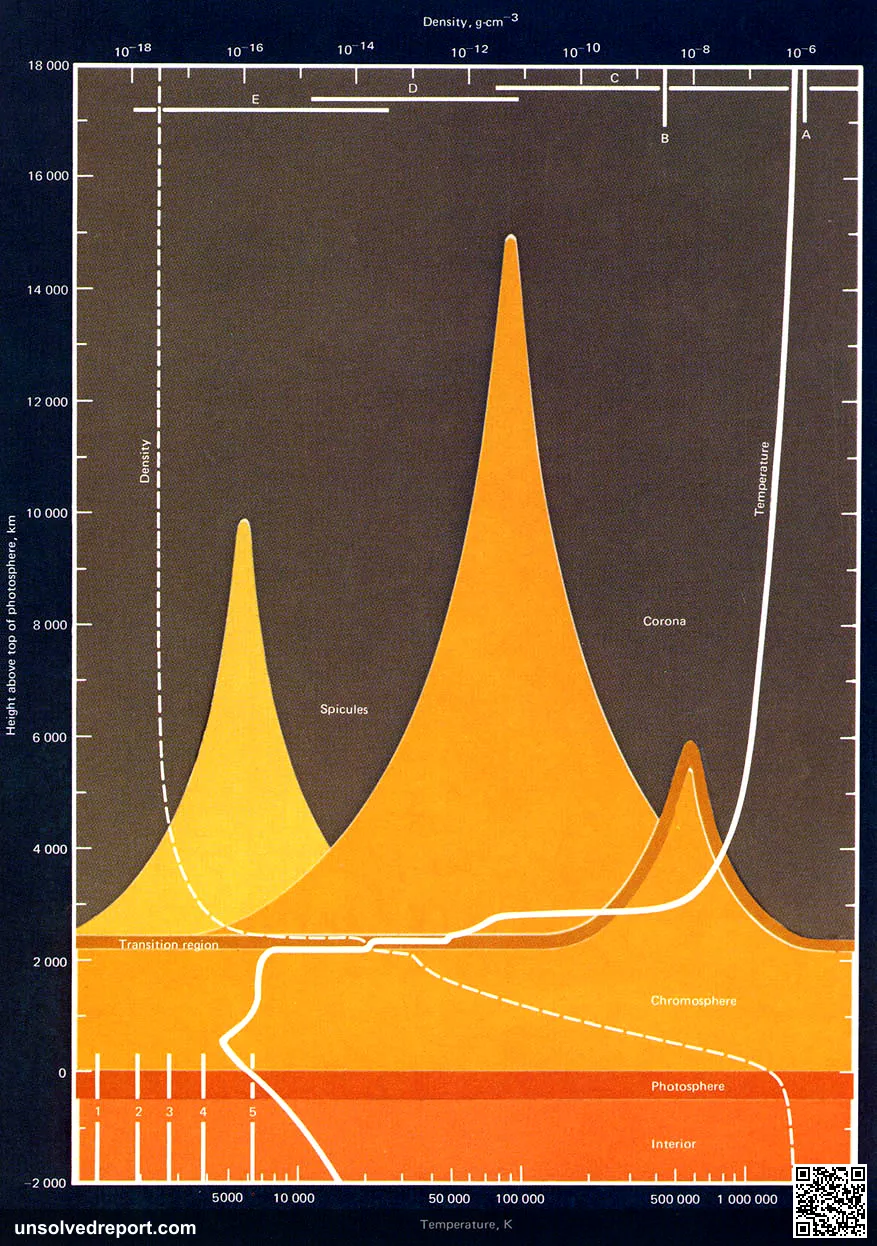
The Sun shatters that rule in your face. Its visible surface simmers at roughly 10,000 degrees Fahrenheit — hot, but a number you can almost picture. Then float up into the wispy outer atmosphere hovering above it, the corona, and the temperature doesn't drop. It explodes — past a million degrees. Walk away from the furnace, and somehow you get hundreds of times hotter.
That should be impossible. Physicists have been staring at it since the 1800s, and they've given the impossibility a name: the coronal heating problem. It is still, by their own admission, one of the most stubborn unsolved questions in astrophysics. On December 24, 2024, NASA's Parker Solar Probe skimmed just 3.8 million miles above the solar surface, flying through the corona itself to find out how it gets so hot (NASA).
> The 60-Second Brief
> - The Sun's visible surface sits at about 6,000 Kelvin (roughly 10,000°F); the corona above it regularly reaches 1 to 3 million Kelvin, around 300 times hotter.
> - A mysterious green line spotted during the 1869 total solar eclipse was blamed on an unknown element, "coronium," for about seventy years.
> - In the early 1940s, Bengt Edlén, building on Walter Grotrian's 1939 insight, showed the line came from iron stripped of 13 electrons (Fe XIV), proof of million-degree gas.
> - In 2014, NASA's EUNIS sounding rocket caught plasma at about 10 million Kelvin, the strongest evidence yet for tiny "nanoflare" explosions.
> - A July 2024 University of Michigan analysis found Parker Solar Probe's magnetic "switchbacks" are unlikely to be the main heat source; a September 2024 Nature Astronomy study traced them to magnetic reconnection.
> - On December 24, 2024, Parker Solar Probe passed 3.8 million miles from the solar surface at 430,000 miles per hour, faster than any human-made object before it.
What we know for certain
The temperature gap isn't some rounding error or fuzzy measurement. It's enormous, and it's been confirmed for decades. NASA pegs the Sun's surface — the photosphere — at about 6,000 Kelvin, roughly 10,000°F. The corona above it "regularly reaches temperatures of 1 to 3 million Kelvin," which works out to something like 300 times hotter than the surface sitting directly beneath it (NASA Goddard). That backwards arrangement is real, measured, and stubbornly consistent.
But here's a fair question: how could anyone possibly know the temperature of a glowing halo 93 million miles away? The answer is one of the loveliest pieces of detective work in the history of science.
It starts with a ghost. During the total solar eclipse of 1869, observers caught a bright green line glowing in the corona's spectrum — a fingerprint that matched no element on the periodic table. For the next seventy years, scientists shrugged and chalked it up to a mystery substance they named "coronium," a brand-new element that lived only in the Sun's halo. Tidy. Wrong.
The ghost was finally exorcised in the early 1940s. Swedish spectroscopist Bengt Edlén, building on a crucial 1939 insight from German astrophysicist Walter Grotrian, proved the green line was no exotic element at all. It was plain old iron — but iron stripped of thirteen of its electrons (Fe XIV). And that's the part that should make the hair stand up on your neck. Tearing an atom that naked takes a staggering amount of energy. The only way to do it is to heat the gas past a million degrees (Frontiers in Astronomy and Space Sciences; Encyclopedia.com on Edlén). The finding was so counterintuitive that the scientific community didn't swallow it right away. Later measurements left no room for doubt.
So this part is settled, locked, beyond argument. The corona truly is millions of degrees, and it sits on top of a surface that is, by comparison, cool — a star that still won't fully give up what it's made of or how it runs. The energy has to come from below — the Sun's churning interior and its knotted magnetic fields. The riddle isn't whether the heat is there. It's how that energy crosses the surface and slams into the thin corona above.
The question nobody can answer yet
Strip it to one sentence: where does the corona's heat come from, and how does it get delivered?
And here's the twist that makes this mystery so maddening — it is not that scientists are clueless. It's the opposite. They have several well-built, physically sound suspects in the lineup. The unsolved part is figuring out which one is doing most of the work, and where, and when. The corona is a near-perfect vacuum laced with ferocious magnetic fields, and that magnetism is almost certainly the courier carrying the energy up. The trouble is that the crime happens on scales too tiny and too fast for today's instruments to catch in the act across the whole Sun. One review didn't mince words: heating the corona to hundreds of times the surface temperature is "one of the most perplexing and unresolved problems in astrophysics to date."
Don't picture wild guesses here. The leading theories are hard quantitative physics, each with real observations tugging in its favor. That's exactly what makes this so tantalizing — we are close enough to see the rough shape of the answer, but not close enough to name a winner.
The suspects in the lineup
Suspect 1: Nanoflares — strong case, no conviction. Think of the Sun's surface as freckled with countless tiny magnetic explosions, each a "nanoflare," the runt cousin of the monster flares that make the news. The idea came from physicist Eugene Parker: surface motions braid and tangle the Sun's magnetic field lines tighter and tighter until they snap, reconnect in a sudden burst, and dump heat into the corona. The best evidence yet landed in 2014, when NASA's EUNIS sounding rocket picked up a faint glow from plasma sizzling at about 10 million Kelvin — far hotter than the corona's average, precisely the calling card you'd expect from brief, violent nanoflare bursts. Lead author Jeff Brosius called it "the strongest evidence yet for the presence of nanoflares" (NASA Goddard, published in The Astrophysical Journal, 2014). Powerful — but still not proof that nanoflares do the bulk of the heating everywhere.
Suspect 2: Waves, especially Alfvén waves — strong case, no conviction. The rival idea says the magnetic energy rides upward as waves instead of explosions. Alfvén waves — ripples that race along magnetic field lines, predicted by Nobel laureate Hannes Alfvén — can be kicked up by the convective boiling beneath the surface, climb into the corona, and surrender their energy there as heat. Plenty of solar physicists pin the whole mystery on two prime suspects: wave heating and magnetic reconnection (Sky at Night Magazine). And here's the wild part — NASA's Parker Solar Probe flies straight through the corona, carrying instruments built for exactly one job: catching these waves red-handed.
Suspect 3: Maybe it's both, working as a team — the view gaining ground. A growing camp argues that nanoflares and waves were never rivals at all, but two threads of the same story. The very same magnetic reconnection that sets off a nanoflare can also fling out Alfvén waves, which then heat the surrounding plasma even more. Perhaps each simply takes the lead in different places, or different moments. Partners, not competitors.
The suspect recent data is quietly waving off. Parker Solar Probe also turned up something strange: dramatic S-shaped kinks in the solar wind's magnetic field, nicknamed "switchbacks" — not unlike the 40-degree kink Voyager found in the magnetic field far beyond the solar wind's reach. For a while, some hoped these were the smoking gun. Then a July 2024 analysis led by the University of Michigan found switchbacks themselves are unlikely to be the main heating culprit — though, tellingly, the researchers added that the wave processes forming those switchbacks could still pump heat in closer to the Sun (Michigan Engineering News). Then a separate September 2024 study in Nature Astronomy traced switchbacks back to magnetic reconnection at the Sun's chromospheric network boundaries, which only strengthened reconnection's role in the bigger picture (Nature Astronomy). The honest read: switchbacks look less like the answer and more like a clue — and the field still doesn't have the data to crown a single mechanism.
So here is where we stand. The corona is one of those rare mysteries you can practically reach out and touch — a spacecraft is plunging through it right now, this very second, as your eyes move across this sentence. And still the final tally stays open. That's the quiet thrill of the coronal heating problem. It's not even the Sun's only outstanding contradiction — ask the faint young Sun paradox how a dimmer, younger star kept Earth from freezing over. The Sun has been pouring its strange, upside-down warmth over us for billions of years, and only now are we close enough to lean in and ask it, face to face: how do you do that trick?
It hasn't answered yet. But for the first time, we're close enough to hear it whisper.
Parker Solar Probe's Christmas Eve Dive
The closest look anyone has ever had came on December 24, 2024. That day Parker Solar Probe swept just 3.8 million miles from the Sun's surface, moving at 430,000 miles per hour, faster than any human-made object has ever traveled. For days around the pass, the spacecraft was out of contact, skimming through the corona and recording data. Late on December 26, a beacon tone reached Earth: it had survived and was working normally (NASA).
The point of all that risk is exactly this mystery. Flying through the corona lets the probe take measurements that help scientists work out how the region gets so hot, where the solar wind comes from, and how particles get flung to half the speed of light. Its heat shield was built to take 2,600 degrees Fahrenheit, while the corona around it can top 1 million degrees Fahrenheit. The December pass was the first of several at that distance, with more planned for March 22 and June 19, 2025 (NASA). Its wide-field camera, WISPR, also sent back the closest images of the Sun ever taken (NASA).
Frequently Asked Questions
Has the coronal heating problem been solved?
No. Scientists have strong candidates, chiefly wave heating and magnetic reconnection, but they haven't pinned down which does most of the work, or where and when. The answer plays out on scales too small and too fast for today's instruments to watch across the whole Sun (Sky at Night Magazine).
How hot is the Sun's corona compared with its surface?
The corona regularly reaches 1 to 3 million Kelvin. The visible surface below it, the photosphere, sits at about 6,000 Kelvin, or roughly 10,000°F. That makes the corona roughly 300 times hotter than the surface directly beneath it (NASA Goddard).
How did scientists find out the corona is so hot?
By reading its light. A green line seen in the corona during the 1869 eclipse was first blamed on a made-up element called "coronium." In the early 1940s, Bengt Edlén, building on Walter Grotrian's 1939 work, showed it came from iron missing thirteen electrons, which only happens in gas hotter than a million degrees (Frontiers in Astronomy and Space Sciences).
What are nanoflares?
Nanoflares are tiny, very frequent magnetic explosions, the small cousins of the big solar flares that make the news. The idea, from physicist Eugene Parker, is that tangled magnetic field lines snap and reconnect, dumping heat into the corona. In 2014, NASA's EUNIS rocket detected plasma at about 10 million Kelvin, which lead author Jeff Brosius called "the strongest evidence yet for the presence of nanoflares" (NASA Goddard).
What are solar switchbacks, and do they heat the corona?
Switchbacks are sharp S-shaped kinks in the solar wind's magnetic field, found by Parker Solar Probe. A July 2024 analysis led by the University of Michigan concluded they are unlikely to be the main source of coronal heat, though the wave processes that form them could still add heat closer to the Sun (Michigan Engineering News).
How close has Parker Solar Probe gotten to the Sun?
On December 24, 2024, it flew 3.8 million miles from the solar surface, the closest any spacecraft has come. It was traveling at 430,000 miles per hour, faster than any other human-made object (NASA).
Original Data: The 48-Year Progression of Sun-Approach Records
No single source lines up every "closest approach to the Sun" record in one place. The table below compiles the distance and speed figures from the three record-setting moments — Helios 2's 1976 mark, Parker Solar Probe's 2018 record-breaking flyby, and its December 2024 dive — and calculates how much closer and faster each one got.
| Record | Date | Distance from Sun's surface | Speed | Change from previous record | Source |
|---|---|---|---|---|---|
| Helios 2 perihelion (record set) | 17 April 1976 | About 27 million miles (0.29 AU / 43.432 million km) | 153,453 mph (246,960 km/h) | — | NASA Science / Guinness World Records |
| Parker Solar Probe breaks both records | 29–30 October 2018 | 25,072,700 miles | 155,959 mph (250,992 km/h) | About 1.93 million miles closer (7.1% closer) and 2,506 mph faster (1.6% faster) than Helios 2's 1976 marks (our calculation) | Guinness World Records |
| Parker Solar Probe's closest pass yet | 24 December 2024 | 3.8 million miles | 430,000 mph | About 21.3 million miles closer (a distance roughly 6.6 times shorter) and 274,041 mph faster (about 2.8 times faster) than the October 2018 mark (our calculation) | NASA |
Laid out this way, the pattern is stark: the same probe that nudged past a 42-year-old record by a few percent in 2018 came back six years later and blew past its own mark by a factor of several times over, both in how close it flew and how fast it was moving when it got there.
How We Compiled This
- Sources. NASA's official Helios 2 mission page for the 1976 record; Guinness World Records' October 2018 article documenting Parker Solar Probe breaking both the distance and speed records Helios 2 had held; and NASA's own December 2024 mission update for the Christmas Eve perihelion.
- Definitions. "Distance from Sun's surface" uses each source's own reported closest-approach distance for that specific event. "Speed" uses each source's peak relative-velocity figure for that pass. Helios 2's 1976 figures are listed once, as the baseline both later records are measured against.
- How calculated. Distance and speed differences were found by subtracting each earlier record's figure from the newer one; percentage and multiple-of comparisons were then calculated from those differences (e.g., 25,072,700 − 3,800,000 = 21,272,700 miles; 25,072,700 ÷ 3,800,000 ≈ 6.6).
- Limitations. Helios 2's NASA page states its distance in astronomical units and kilometers, converted there to "about 27 million miles" — a rounded figure, not the more precise decimal miles available for Parker Solar Probe's 2018 pass, so the 1976-to-2018 percentage change is only as precise as that rounding. Guinness World Records, not a NASA mission log, is the source for the 2018 distance and speed figures.
📌 Data status: verified 2026-09-29.
Sources & Further Reading
- NASA Goddard, "Best Evidence Yet for Coronal Heating Theory Detected by NASA Sounding Rocket" — https://www.nasa.gov/content/goddard/best-evidence-yet-for-coronal-heating-theory/
- Frontiers in Astronomy and Space Sciences, "Commentary: Discovery of the Sun's million-degree hot corona" — https://www.frontiersin.org/journals/astronomy-and-space-sciences/articles/10.3389/fspas.2018.00009/full
- Encyclopedia.com, "Edlén, Bengt" — https://www.encyclopedia.com/science/dictionaries-thesauruses-pictures-and-press-releases/edlen-bengt
- University of Michigan Engineering News, "The corona is weirdly hot — Parker Solar Probe rules out one explanation" (July 2024) — https://news.engin.umich.edu/2024/07/the-corona-is-weirdly-hot-parker-solar-probe-rules-out-one-explanation/
- Nature Astronomy, "The origin of interplanetary switchbacks in reconnection at chromospheric network boundaries" (September 2024) — https://www.nature.com/articles/s41550-024-02321-9
- Sky at Night Magazine, "Solving the Coronal Heating Problem, the Sun's biggest mystery" — https://www.skyatnightmagazine.com/space-science/coronal-heating-problem
Bootes Void: 330 Million Light-Years of Almost Nothing
The Bootes Void holds ~60 galaxies where 2,000 should be. DESI's finished 3D map is now testing whether a void this size fits the standard model.
Przybylski's Star: The Sky's Most Impossible Light
Przybylski's Star glows with plutonium and promethium, elements that decay in years, not eons. Sixty years on, nobody can explain why they're still there.
Impossibly Early Galaxy Problem: JWST Found What Shouldn't Exist
JWST just found galaxies too big, too bright, and too early to exist under our own laws of physics. Is cosmology broken — or is something stranger going on?