Carthage's Tophet: Sacrificed Babies or a Misread Cemetery?
20,000 burnt infant urns sit beneath Tunis. Ritual child sacrifice to the gods, or a cemetery for babies who died naturally? Scientists can't agree.
Thousands of small urns. Each one holds the burnt bones of a baby. They sit packed together inside a walled enclosure beneath a quiet corner of modern Tunis, and they have sat there, in some cases, for more than two and a half thousand years. This is one of the most unsettling places archaeology has ever uncovered. For over two thousand years, the Carthaginians have worn a grim label, pinned on them by their Greek and Roman enemies: a people who burned their own infants to please the gods. But here's the strange part. A growing number of scholars look at those same urns and ask a very different question. Did the ash and bone inside them come from sacrifice — or from the ordinary, crushing heartbreak of a baby who simply didn't survive? In 2024, bones from a second, much later Tunisian tophet turned up sick children and no trace of violence — a new clue, not a verdict. The honest answer is that nobody can close the case.
> The 60-Second Brief
> - Excavators put the burials at about 20,000 urns, spread over an estimated 6,000 square metres in the Salammbô district of Carthage.
> - The precinct was used for roughly six centuries, from its oldest layers around 750–600 BCE until Rome burned Carthage in 146 BCE.
> - A 2010 study of 348 urns holding 540 individuals found at least 20% were prenatal and concluded the remains do not support systematic infant sacrifice.
> - The rival 2013 reading hinges on a few weeks: deaths in the first days of life look natural, deaths clustered at one to two months look like a planned offering.
> - 4 major ancient historians — Herodotus, Thucydides, Polybius and Livy — never mention systematic child sacrifice at Carthage.
> - A September 2024 study of 12 cremated young people from the tophet at Zita, Tunisia, found 9 with changes consistent with scurvy and none with signs of violence at death.
What We Know For Certain
Start with what isn't in dispute. The site is real, it's huge, and it's been dug with care. It sits in the Salammbô district of Carthage, right beside the ancient Punic ports — the same Tunisian coastline that later swallowed cargo like the Mahdia shipwreck — and the sacred precinct we now call the "tophet" stayed in use for roughly six centuries. Its oldest layers go back to around 750-600 BCE; its final chapter closed when Rome burned the city to the ground in 146 BCE (Wikipedia, Carthage tophet). How many urns are down there? Excavators put the number on the order of 20,000, scattered across thousands of square meters — one of the largest burial grounds we know of from the entire Phoenician-Punic world, a trading network that also left behind hoards like the Phoenician-linked gold of El Carambolo in southern Spain (Biblical Archaeology Society).
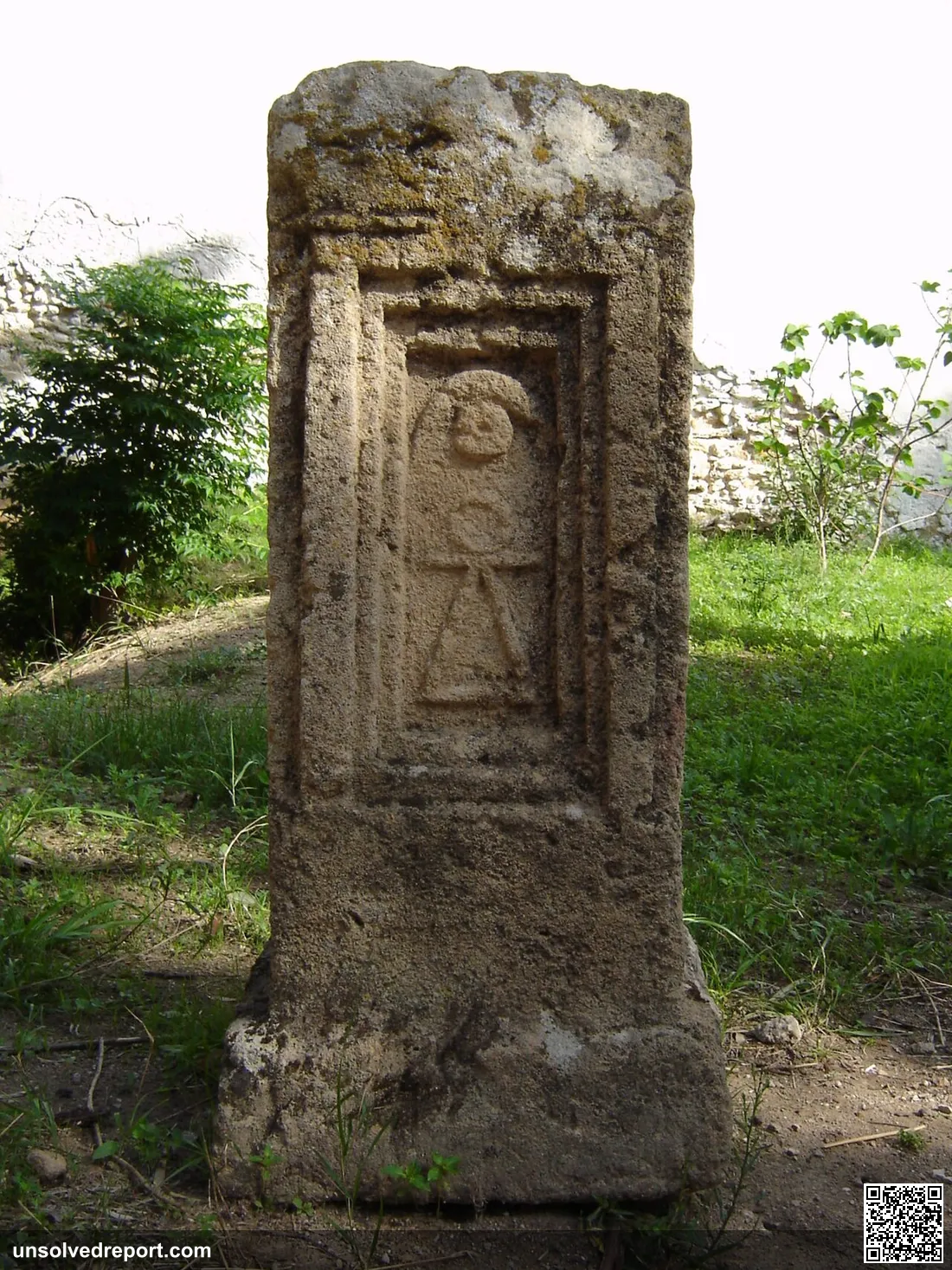
Each deposit follows a pattern. An urn, buried in the ground, ringed by stones, packed with burnt bone — and many of them marked above the surface by a carved stone slab, a stela (Wikipedia). When researchers lifted the lids, they found the cremated remains of very young humans. And in a number of urns, something else: the bones of young animals, lambs or kids (Children and Youth in History, George Mason University). Many of those stelae carry the same kind of inscription, over and over, dedicating the offering to two of the great Punic gods — Baal Hammon and the goddess Tanit (Biblical Archaeology Society).
Then there's a single word that has done an enormous amount of arguing for everyone. A handful of inscriptions use a Punic term, molk (or mlk), which several specialists read as a technical word for a particular kind of offering or vow (Wikipedia). It turns up in related Phoenician settings too, and for a long time it has been the anchor for one side's case: that this was a sanctuary for ritual offerings, not a normal graveyard.
The ancient writers had plenty to say as well — though every last one of them was an outsider, and most of them despised Carthage. The Greek historian Diodorus Siculus, writing in the first century BCE and leaning on an earlier writer named Kleitarchos, described Carthaginians laying children into the arms of a bronze statue of Kronos, the bodies then rolling down into a fire (History Skills). Plutarch piled on, claiming parents stood by without weeping while music covered the cries; the later Christian apologist Tertullian leveled the same charge (roger-pearse.com source roundup). And here's the catch worth holding onto: several major ancient historians who had every reason to dwell on Carthage — Herodotus, Thucydides, Polybius, Livy — say nothing at all about systematic child sacrifice (Wikipedia). It's the same kind of interpretive standoff that surrounds the Lady of Elche, an Iberian bust with a possible Punic influence of its own, where the physical evidence still won't settle the argument either.
The One Question Nobody Can Answer
This is where solid fact slips into genuine uncertainty. Everyone agrees on the easy part: the urns hold cremated infants. What nobody can prove beyond dispute is why those infants died. Were they killed in a ritual and then laid to rest in a sanctuary? Or did they die the way so many babies died in the ancient world — of natural causes, the brutal perinatal mortality of the age — and earn a special religious burial precisely because they were so heartbreakingly young?
The whole fight comes down to something tiny and terribly fragile: the burnt, shrunken teeth and bones inside the urns. Fire warps bone and muddies any estimate of age, and here even a few weeks swing the entire story. Picture the difference. If most of these infants died in their first days of life, the pattern reads like ordinary newborn death. But if the deaths cluster a little later — say one to two months — then critics of the natural-death reading argue the timing fits a planned offering, carried out some weeks after birth. The maddening part? The very same charred sample has been measured by rival teams who walked away with opposite answers. That is exactly why this stays one of the most stubbornly unresolved debates in Mediterranean archaeology (Antiquity / Cambridge Core).
Three Ways to Read the Bones
Theory 1: A sanctuary built for infant sacrifice (the old view, now with modern science behind it). Archaeologists Lawrence Stager and Joseph Greene argued for years that this was a place of ritual killing. Their evidence: the dedicatory inscriptions, the deliberate way the urns are arranged, and those sacrificial animal bones sitting right alongside the infants. A team including Patricia Smith, Stager, Greene, and Gal Avishai then went into the cremated remains themselves and concluded the age-at-death pattern backed "the interpretation of the Phoenician Tophets as ritual sites set aside for infant sacrifice," defending that reading head-on against its critics in 2013 (Antiquity / Cambridge Core). That same year, a second Antiquity article — "Phoenician Bones of Contention," by Paolo Xella, Josephine Quinn, Valentina Melchiorri, and Peter van Dommelen — pulled the inscriptions, the ancient texts, and the dug-up evidence together to argue that ritual infant offering is simply the best overall explanation for the whole tophet phenomenon (academia.edu listing of Xella et al. 2013). This is interpretation, built on the inscriptions and a contested reading of the bone data.
Theory 2: A children's cemetery, not an altar. A University of Pittsburgh-led team including Jeffrey Schwartz studied the skeletons and the teeth and reached the flat opposite conclusion: "skeletal remains from Punic Carthage do not support systematic sacrifice of infants" (PubMed Central, Schwartz et al. 2010). On their reading, the urns held the very young who died of natural causes — infectious disease, or just the frailty of being newborn — with an age range that matches the high perinatal mortality recorded in some pre-modern societies. In this telling, the tophet was a burial ground reserved for infants and fetuses, and the sacrifice story is mostly enemy propaganda, dressed up and amplified by later writers. This too is interpretation, built on a competing reading of the very same bones.
Theory 3: Maybe it was both. There's a middle path, raised inside the scholarly back-and-forth, and it has a certain quiet logic. Over six centuries, the precinct may have served more than one purpose: some infants offered in vows or rituals, others simply laid there because they had died young and this was the place set aside for the very young. The mix of human and animal remains, plus the fact that the explicit molk term shows up so rarely, leaves room for practices that drifted and changed over time rather than one fixed, uniform rite (Antiquity / Cambridge Core). This one is speculation — a plausible synthesis, not a settled consensus.
So here's what makes the Carthage tophet so impossible to look away from: the evidence is everywhere, and it still won't speak plainly. You can hold the urns in your hands. You can read the dedications. You can count the bones one by one — and you still can't agree on the human story behind them. Whether this was a place of ritual death, a tender resting place for lost babies, or some shifting blend of both across six hundred years, it leaves us with a hard lesson. Be careful how you trust the words an ancient people's enemies wrote about them. And remember just how much a few grams of burnt bone can still flatly refuse to tell.
The Tophet at a Glance
| Question | What the record shows | Source |
|---|---|---|
| Where is it? | The Salammbô district of Carthage (modern Tunis), beside the ancient Punic ports | Wikipedia |
| How long was it used? | Roughly six centuries: oldest layers c. 750–600 BCE, ending with Rome's destruction of the city in 146 BCE | Wikipedia |
| How many burials? | On the order of 20,000 urns, across an estimated 6,000 square meters | Wikipedia |
| What is inside the urns? | Cremated remains of very young humans; some urns also hold the bones of young animals (lambs or kids) | Children and Youth in History, GMU |
| Who were the dedications to? | Stelae repeatedly dedicate the offering to Baal Hammon and the goddess Tanit | Biblical Archaeology Society |
| The key disputed word | Molk (mlk), on a handful of inscriptions, read by several specialists as a technical term for a kind of offering or vow | Wikipedia |
| Who accused Carthage? | Diodorus Siculus (1st century BCE, drawing on Kleitarchos), Plutarch, and Tertullian — all outsiders and mostly hostile | History Skills; roger-pearse.com |
| Who stayed silent? | Herodotus, Thucydides, Polybius, and Livy — major historians with every reason to mention it — say nothing about systematic child sacrifice | Wikipedia |
Weighing the Two Readings, Side by Side
No new facts here — just an honest audit of where each camp is strong, where each is thin, and what could actually settle it.
| Sacrifice sanctuary (Smith, Stager, Greene & Avishai 2013; Xella et al. 2013) | Infant cemetery (Schwartz et al. 2010) | |
|---|---|---|
| Strongest evidence | Dedicatory inscriptions to Baal Hammon and Tanit, the molk term, deliberate urn arrangement, and sacrificial animal bones deposited alongside infants (Antiquity; Xella et al. 2013) | Skeletal and dental analysis concluding the remains "do not support systematic sacrifice of infants," with an age range matching high perinatal mortality in some pre-modern societies (PubMed Central) |
| Weak point | The age-at-death pattern it leans on comes from cremated bone — and fire warps bone, muddying every age estimate | Must still account for the dedicatory inscriptions, the molk term, and the animal offerings mixed in with the infants |
| The literary record | Diodorus, Plutarch, and Tertullian describe the rite — but all were enemies or critics of Carthage | Herodotus, Thucydides, Polybius, and Livy never mention it — but silence is not proof |
| What would move the needle | An age-at-death method for burnt infant remains that rival teams accept: the article's core problem is that the same charred samples have yielded opposite answers, and a swing of a few weeks — death in the first days versus at one to two months — flips the story from ordinary newborn mortality to a planned offering (Antiquity) | Same |
The third reading — that over six centuries the precinct did both jobs, receiving vowed offerings and ordinary infant dead alike — sidesteps the deadlock, but at a cost: it is the hardest version to falsify, and it remains a plausible synthesis rather than a demonstrated conclusion.
From Sacred Precinct to Scholarly Battleground: A Chronology
The urns were in the ground for over two millennia before anyone started arguing about them. Here is how the site went from active sanctuary, to buried ruin, to the center of a fight that is still running.
- c. 750–600 BCE — The tophet's oldest layer, the so-called Tanit I phase, is laid down in the Salammbô district of Carthage (Wikipedia).
- 146 BCE — Rome burns Carthage to the ground; the tophet's six centuries of use end with the city (Wikipedia).
- 1st century BCE — Diodorus Siculus, drawing on the earlier writer Kleitarchos, describes children placed in the arms of a bronze statue of Kronos and rolled into a fire (History Skills; roger-pearse.com).
- 1921 CE — The "priest stele" surfaces in clandestine digging, and the site comes to light; Paul Gielly and François Icard, civil servants stationed in Tunisia, buy in and excavate through autumn 1922 (Wikipedia).
- 1925–1927 — Francis Willey Kelsey and Donald Benjamin Harden lead the first American excavation campaign; Kelsey's death in 1927 ends it (Wikipedia).
- 1934–1936 — Father Gabriel-Guillaume Lapeyre excavates neighboring areas of the precinct (Wikipedia).
- 1947 — Pierre Cintas, digging after the war, discovers the "Cintas chapel," containing ceramics from the 7th century BCE (Wikipedia).
- 1976–1979 — Excavations under the aegis of the American Schools of Oriental Research and Lawrence Stager establish the site's continuous six-century use and the figure of some 20,000 urns (Wikipedia).
- 2010 — Jeffrey Schwartz and colleagues publish their skeletal study concluding the remains "do not support systematic sacrifice of infants" (PubMed Central).
- 2013 — The counterattack lands in Antiquity: Smith, Stager, Greene and Avishai defend the sacrifice reading of the bone data (Antiquity), and Xella, Quinn, Melchiorri and van Dommelen argue in "Phoenician Bones of Contention" that ritual offering best explains the whole tophet phenomenon (Xella et al. 2013). The deadlock has held ever since.
2024: A Smaller Tunisian Tophet Adds a Clue
In September 2024, a team led by Jessica Cerezo-Román published a close study of cremated remains from a different, far later sanctuary: the Neo-Punic tophet at Zita, Tunisia, where burials were laid down between roughly 50–30 BCE and 100 CE (Antiquity / Cambridge Core). The sample is small — 12 individuals, seven of them infants under two — but the bones tell a hard story. Nine showed changes consistent with scurvy, nine carried markers of anemia, two bore signs of respiratory infection, and not one showed trauma around the time of death.
The authors concluded that systemic health problems likely contributed to these deaths, and that the careful collection and placement of the burnt bone pointed to respectful burial rather than proof of ritual killing. It cannot settle Carthage — Zita is centuries younger and a tiny fraction of the size — but it puts real, sick children into a tophet, and that is exactly the picture the cemetery camp has been arguing for.
Frequently Asked Questions
Did the Carthaginians really sacrifice their children?
Nobody can say for certain. The dedications to Baal Hammon and Tanit, the animal offerings mixed in with the infants and a disputed age-at-death pattern have convinced one camp of scholars that the tophet was a sacrifice sanctuary. The other camp reads the very same bones as babies who died naturally, and the argument has stood at a deadlock since 2013 (Antiquity / Cambridge Core).
How many burials are in the Carthage tophet?
About 20,000 urns, according to excavation estimates. They lie across roughly 6,000 square metres, laid down in successive layers over about six centuries of continuous use (Wikipedia, Carthage tophet).
What does the word "tophet" mean?
It is a borrowed biblical name, not a Carthaginian one. "Tophet" originally designated a place near Jerusalem that became synonymous with hell, and archaeologists later applied it to these Punic infant precincts (Wikipedia, Carthage tophet).
Why do some scientists think it was just a cemetery?
Because the skeletons point that way to them. Jeffrey Schwartz's team examined 348 urns holding 540 individuals and found that at least 20% were prenatal, with an age range that matches the high infant mortality of pre-modern societies. They concluded the remains "do not support systematic sacrifice of infants" (PubMed Central, Schwartz et al. 2010).
Which ancient writers accused Carthage of child sacrifice?
The main accusers were the Greek historian Diodorus Siculus, writing in the first century BCE, along with Plutarch and the Christian writer Tertullian. Diodorus described children placed in the arms of a bronze statue and rolled into a fire — but every one of these writers was an outsider, and most were hostile to Carthage (History Skills).
Can you visit the Carthage tophet today?
Yes. The precinct is part of the Archaeological Site of Carthage, a UNESCO World Heritage Site, it is open to the public and is a standard stop on tours of ancient Carthage in the Salammbô district of Tunis (Wikipedia, Carthage tophet).
Original Data: Carthage's Tophet Against the Two Other Best-Documented Punic Tophets
No single source puts Carthage side by side with the other major Phoenician-Punic tophets on the same page. The table below compiles the founding date, animal-remains share, and age-at-death findings that separate studies have published for Carthage, Motya, and Tharros — the three sites where the fetched sources give hard figures rather than just naming the site.
| Tophet site | First established | Animal remains (as reported) | Age-at-death finding (as reported) | Source |
|---|---|---|---|---|
| Carthage (Tunisia) | Tanit I phase, "750 B.C.-600 B.C." | 31% of urns contained lambs; separately, animal remains made up about 30% of total remains in the 7th–6th centuries BCE, falling to about 10% by the 4th century BCE | About 80% of the human remains are from newborn babies or fetuses | Wikipedia, "Carthage tophet"; Wikipedia, "Tophet"; World History Encyclopedia, "Tophet" |
| Motya (Sicily) | "first used from the mid-7th century BCE" (World History Encyclopedia); Wikipedia's "Tophet" entry separately dates the settlement to the 9th century BCE with stone markers appearing "around 600 BCE" | not reported in the sources fetched for this table | not reported in the sources fetched for this table | World History Encyclopedia, "Tophet"; Wikipedia, "Tophet" |
| Tharros (Sardinia) | 9th century BCE, with stone markers appearing "around 600 BCE" | 47% of urns contained lambs | About 98% of the remains were from babies younger than three months old | Wikipedia, "Tophet"; World History Encyclopedia, "Tophet" |
Read across the three sites, no two studies measured the same thing the same way, but the numbers that do exist point the same direction: at both Carthage and Tharros, animal remains sit alongside human ones in a substantial minority of urns (31% and 47% respectively), and where an age breakdown exists, it skews overwhelmingly toward the very youngest infants — 80% newborn or fetal at Carthage, 98% under three months at Tharros.
How We Compiled This
- Sources. Two independent sources: Wikipedia's general "Tophet" entry, which compiles figures across multiple Phoenician-Punic sites, and World History Encyclopedia's "Tophet" entry, a separately written non-Wikipedia reference source; Wikipedia's site-specific "Carthage tophet" entry supplies the Tanit I founding date.
- Definitions. "Animal remains" figures are not the same measurement across sources: Wikipedia's "31% of urns contained lambs" and "47% of urns contained lambs" count urns with lamb bone specifically, while World History Encyclopedia's "30%" and "10%" figures for Carthage count animal remains as a share of total remains across two different centuries. Both are reported here as each source states them, not merged into one number.
- How calculated. No arithmetic beyond copying each source's own published percentage and date; this table compiles rather than computes, since the figures for each site come from different studies with different methods.
- Limitations. Motya has no animal-remains or age-at-death figures in the sources fetched for this table, so those cells are marked "not reported" rather than estimated. The two sources disagree slightly on Motya's founding period (9th century BCE per Wikipedia's general "Tophet" page vs. "mid-7th century BCE" per World History Encyclopedia for when the tophet itself was "first used") — both figures are given rather than picking one. These figures describe different Punic-world tophets from the one this article focuses on, so none of them changes any fact already stated about Carthage elsewhere in this article.
📌 Data status: verified 2026-09-29.
Sources and Further Reading
- Schwartz et al., "Skeletal Remains from Punic Carthage Do Not Support Systematic Sacrifice of Infants" (PLoS ONE, via PubMed Central, 2010)
- Smith, Stager, Greene & Avishai, "Cemetery or sacrifice? Infant burials at the Carthage Tophet" (Antiquity, 2013)
- Xella, Quinn, Melchiorri & van Dommelen, "Phoenician Bones of Contention" (Antiquity, 2013)
- Biblical Archaeology Society, "At Carthage, Child Sacrifice?"
- Children and Youth in History, "Tophet of Carthage" (George Mason University)
- Wikipedia, "Carthage tophet" (overview of site, dating, and debate)- Cerezo-Román et al., "The life and death of cremated infants and children from the Neo-Punic tophet at Zita, Tunisia" (Antiquity, September 2024)
- History Skills, "Carthage child sacrifice"

Cahokia: The American City That Outgrew London, Then Vanished
Cahokia once out-grew London. Then 20,000 people quietly vanished, no war, no fire, no famine. Every leading theory has collapsed. What really happened?
Dhar Tichitt: 4,000 Years Ago, West Africa Built 500 Stone Towns—Then Emptied Them
Hundreds of dry-stone towns rose in Mauritania by 2200 BC, then went silent by 300 BC. New 2026 radiocarbon dates are finally testing why — and where the builders went.
Carnac Stones: 3,000 Megaliths That Beat Stonehenge
Over 3,000 megaliths line up across Brittany, older than Stonehenge by over 1,000 years. A 2025 dig finally dated them, but their purpose is still unknown.