El Dorado: The Golden Man Nobody Can Find
El Dorado was never a city — it was a man dipped in gold dust. So why did armies die hunting the wrong myth for 400 years? The real story is stranger.
The greatest treasure hunt in history was chasing something that never existed. For nearly five centuries, two words — "El Dorado" — have meant a lost city paved in gold, hidden somewhere in the South American interior. Men starved in jungles looking for it — Percy Fawcett among them, swallowed whole by the same obsession. Novelists and filmmakers built whole worlds on it. And the whole time, the truth was hiding in plain sight: El Dorado was never a place. It started as a person. A ceremony. And one small, breathtaking object that now sits behind glass in Bogotá. In December 2024, that object was reunited on display with the rest of what was buried alongside it. The real story is stranger than the myth that ate it.
> The 60-Second Brief
> - The Muisca Raft, found in 1969 near Pasca, is just 19.5 centimeters long and dates to roughly 1295-1410 CE.
> - The ritual belonged to the Muisca people, who had worked gold for roughly 2,000 years around present-day Bogotá.
> - Lake Guatavita sits at about 3,000 meters elevation, some 57 kilometers northeast of Bogotá.
> - In 1911, a British company drained most of the lake chasing gold — and found only a modest haul before the mud set like cement.
> - In 1965, Colombia declared the lake a protected area, closing the door on four centuries of salvage attempts.
> - In December 2024, Bogotá's Museo del Oro reopened its gallery, displaying the raft alongside the objects found with it 55 years earlier.
What We Actually Know
Start with the name. El Dorado is Spanish for "the gilded one" — the golden man. When sixteenth-century colonists first said it, they were not pointing at a city. They were pointing at a king whose body had been coated in gold dust during a ceremony (Britannica; Wikipedia: El Dorado). Only later did the name drift — from the man, to an imagined kingdom, and finally to a fabled city of gold that pulled armies to their deaths.
The ceremony was real. It belonged to the Muisca people, who lived on the high plateau around present-day Bogotá and had been working gold for roughly two thousand years (World Archaeology). The oldest surviving written account comes from the chronicler Gonzalo Fernández de Oviedo, set down around 1541. He described how powdered gold was pressed onto a resin-anointed body "from the soles of his feet to his head" (Wikipedia: El Dorado). Nearly a century later, in his 1636 history known as El Carnero, the Colombian-born writer Juan Rodríguez Freyle gave the fullest version of all — the gold-dusting as a crowning rite that every new Muisca zipa, or paramount chief, had to pass through (Wikipedia: El Dorado; Cambridge / Latin American Antiquity).
Now picture the moment those accounts describe. The new ruler is carried out on a raft to the middle of a sacred lake. There, he and his attendants hurl offerings of gold and emeralds into the water — and then he plunges in, the gold washing off his skin and sinking down as a gift to the god believed to live beneath the surface (Wikipedia: Lake Guatavita). The lake at the heart of the ritual is Lake Guatavita: a nearly perfect circle of water sitting at roughly 3,000 meters of elevation in the Cundinamarca department, about 57 kilometers northeast of Bogotá (Wikipedia: Lake Guatavita) — not unlike the gold said to rest beneath Lake Titicaca further south in the Andes.
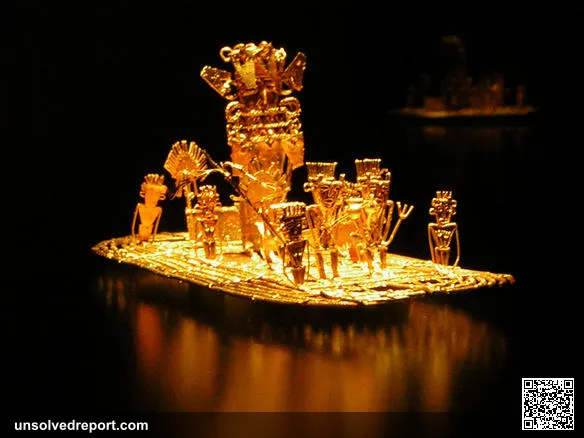
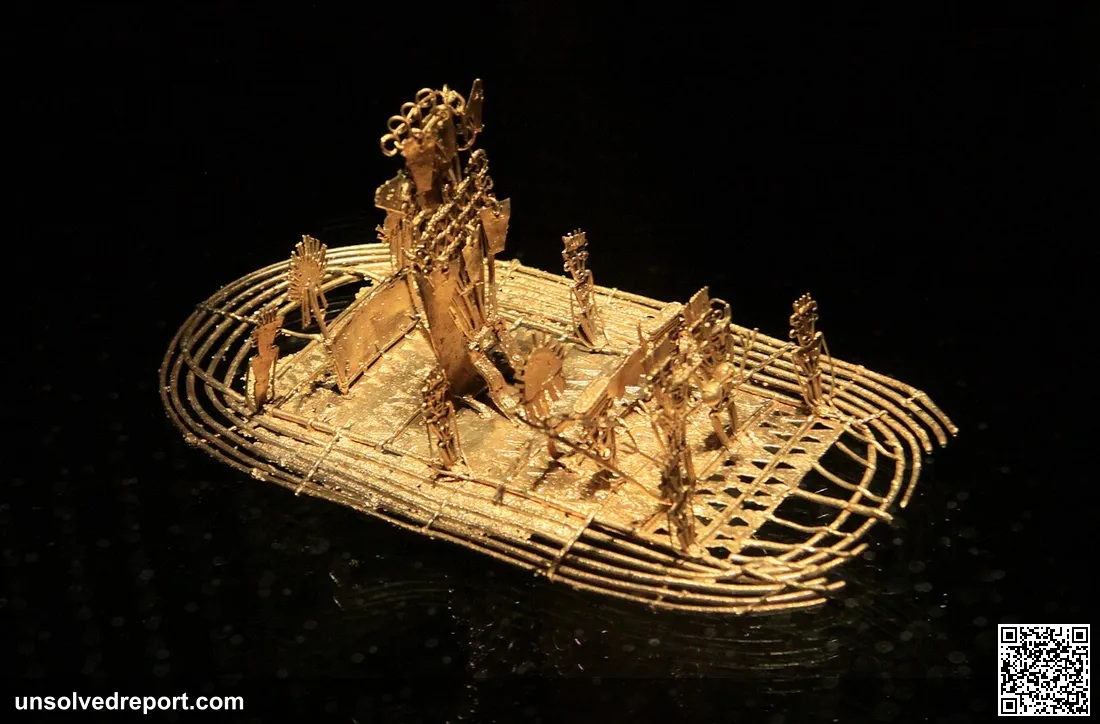
And then there is the object that turns the whole legend solid. In 1969, in a cave near Pasca, Cundinamarca, someone found a stunning little gold artifact now called the Muisca Raft (Wikipedia: Muisca Raft; Smarthistory). It is tiny — about 19.5 centimeters long — yet it freezes the entire scene in miniature: a raised chieftain at the center, ringed by smaller attendants and oarsmen. It was cast in one piece by the lost-wax method from tumbaga, an alloy of gold, silver, and copper, and radiocarbon dating of charcoal left from the casting puts its making between roughly 1295 and 1410 CE (Wikipedia: Muisca Raft). Today it is one of the crown jewels of the Museo del Oro in Bogotá — a collection of more than 55,000 pre-Hispanic gold pieces (World Archaeology).
Here is where it all went wrong. The Spanish heard about a king dipped in gold and a lake full of treasure, and their imaginations ran straight off a cliff. They pictured endless wealth — a city of it — and launched centuries of doomed expeditions, from Gonzalo Pizarro's 1541 march to Sir Walter Raleigh's 1595 voyage (Wikipedia: El Dorado). It was the same fever that later sent treasure hunters chasing 750 tons of vanished Inca gold into the Andes. They were chasing a metaphor with shovels.
December 2024: the raft comes home to a fuller story
For over fifty years, the Muisca Raft sat on display largely alone, separated from the ceremonial objects it was actually found with. That changed on December 19, 2024, when Bogotá's Museo del Oro reopened its fourth-floor gallery with a revamped exhibition uniting the raft with the rest of its original cache: a seated figurine, fragments of animal skulls, a ceramic container, and golden stretchers, all pulled from the same ceramic vessel in the Pasca cave back in 1969 (The City Paper Bogotá). Seeing the raft alongside the objects it was buried with does something the raft alone never could — it turns a solitary masterpiece back into what it always was: a complete, deliberate offering, not a lone curiosity plucked from a cave.
The Question Nobody Can Answer
So how much gold is actually down there? Nobody knows. That is the real mystery — not where El Dorado is, but how much truth is sitting at the bottom of Lake Guatavita, and how literally we should take the ceremony at all.
Consider who wrote the story down. The accounts that hand us the El Dorado ritual came from Spaniards, decades after conquest had already shattered the Muisca world — and sometimes from secondhand whispers. Scholars treat these sources as valuable but cracked, warped by the very gold-fever they helped spark. Modern researchers point out that the Spanish chronicles of the sixteenth and seventeenth centuries inflated Guatavita's fame as the supreme Muisca shrine, feeding genuine history and embellished myth in the same breath (Cambridge / Latin American Antiquity).
The lake, for its part, has beaten everyone who tried to wring an answer out of it by force. Around 1545, the conquistador Hernán Pérez de Quesada reportedly put laborers to work bailing the water out with vessels — months of effort for only a modest scoop of gold (Colombia Reports). In 1580, the Bogotá entrepreneur Antonio de Sepúlveda cut a notch into the crater rim and actually dropped the water level by about 20 meters, before the channel collapsed and killed workers (El Tiempo; World History Encyclopedia). He had struck an agreement with King Philip II of Spain to drain the lake, and a royal fifth of the gold he recovered went to the Crown, but the lake kept the rest of its secrets (Sociedad Geográfica de Colombia). The boldest attempt of all came in the early 1900s, when a British venture called Contractors Limited, led by engineer Hartley Knowles, drained most of the lake. By about 1911 the bed lay bare — and then the trap sprang. The soft mud baked into a crust like cement, and what they pulled out was meager (Colombia Reports; World History Encyclopedia). Some of the objects recovered from Guatavita were later auctioned in London, and a number ended up in the British Museum, where Muisca votive offerings sit today (World History Encyclopedia).
Then, in 1965, the Colombian government declared the lake a protected area — slamming the door on four centuries of salvage and leaving its floor untouched by modern archaeology (Wikipedia: Lake Guatavita). So the central question just sits there, open: what is really down in that water, and do the surviving chronicles describe a routine coronation, a rare event, or something the retelling smeared beyond recognition?
So What's the Truth Down There?
The vast hidden hoard (the legend everyone wants). The most stubborn belief is that the lake still cradles a colossal fortune of Muisca gold — the same wishful thinking behind so many famous lost treasures still missing. It is also speculation, and the evidence cuts the other way. Four centuries of drainage attempts all came up with relatively little, and the protected lakebed has never had a proper excavation — so the dream of staggering treasure stays exactly that: unproven.
A modest but real offering (what most experts think). Most researchers do accept that the Muisca dropped votive offerings — gold tunjos and ornaments — into sacred lakes. The recovered artifacts back it up, and the chronicles line up uncannily well with the Muisca Raft itself (Cambridge / Latin American Antiquity). In this reading, the ceremony was an act of devotion, not a treasure dump — and the legend's "fortune" was always more symbolic than literal.
Where the lake itself came from. For generations, popular stories blamed Guatavita's eerily round shape on a meteorite strike. Geologists have since thrown that out, along with the volcano and the plain-sinkhole ideas; the current best guess is a sinkhole formed as underground salt deposits dissolved away (Wikipedia: Lake Guatavita). One honest wrinkle: published figures for the lake's maximum depth don't even agree from source to source — a small sign of how much basic data about this place is still up for grabs.
One thing, though, is beyond doubt: the artistry. The golden raft survived. No drainage scheme ever swallowed it. It still shows the ceremony exactly the way its makers chose to remember it — a king sailing out toward the water. The richest thing El Dorado ever produced may simply be that: a single, palm-sized masterpiece. Hold that thought the next time someone tells you a legend is just a lie. Sometimes it's a memory that outlived everyone who tried to dig it up.
Frequently Asked Questions
Was El Dorado ever a real city?
No. El Dorado began as "the gilded one," a Muisca king whose body was coated in gold dust during a coronation ritual; the idea of a golden city grew later, invented by Spanish colonists chasing the legend (Britannica).
What is the Muisca Raft?
It's a small gold artifact, about 19.5 centimeters long, found in a cave near Pasca in 1969, depicting the El Dorado ceremony in miniature with a raised chieftain surrounded by attendants. Radiocarbon dating places its creation between roughly 1295 and 1410 CE (Wikipedia: Muisca Raft).
Has anyone actually found gold treasure at the bottom of Lake Guatavita?
Some, but far less than the legend suggests. Four separate drainage and salvage efforts between the 1540s and 1911 recovered scattered ornaments rather than a fortune, and the lake has been a protected, unexcavated site since 1965 (Colombia Reports).
Where can you see the Muisca Raft today?
It's the centerpiece of the Museo del Oro (Gold Museum) in Bogotá, part of a collection of more than 55,000 pre-Hispanic gold pieces. In December 2024, the museum reopened it in a new gallery alongside the other objects originally found with it in the Pasca cave (The City Paper Bogotá).
Why is Lake Guatavita perfectly round?
Popular legend blamed a meteorite, but geologists have ruled that out along with a volcanic origin; the current best explanation is that it's a sinkhole formed as underground salt deposits dissolved away (Wikipedia: Lake Guatavita).
Why did the Spanish search for El Dorado for centuries?
They heard accounts of a king dusted in gold and a lake full of offerings and assumed there had to be an entire city of gold behind it, launching expeditions from Gonzalo Pizarro's 1541 march to Sir Walter Raleigh's 1595 voyage that never found any such place (Wikipedia: El Dorado).
Original Data: Lake Guatavita's Depth Against the Sepúlveda Channel's 20-Meter Drop
No source puts Lake Guatavita's published maximum depth next to the water-level drop reported for the Sepúlveda drainage canal and calculates what share of that depth the drop represents. The table below does that arithmetic.
| Metric | Figure | Source |
|---|---|---|
| Lake Guatavita's maximum depth | 125 m (410 ft) | Wikipedia, "Lake Guatavita" |
| Surface area | 19.8 hectares (49 acres) | Wikipedia, "Lake Guatavita" |
| Water-level drop achieved by the Sepúlveda drainage canal | 20 meters (the source: "Logró bajar el nivel veinte metros" — he managed to lower the level twenty meters) | El Tiempo |
| Share of the lake's maximum depth that drop represents | 16% (20 ÷ 125, our calculation) | — |
The 20-meter drop is about a sixth of the lake's published maximum depth, leaving about 105 of 125 meters, by this arithmetic. This compares the drop to the maximum depth only; it says nothing about what share of the lake's volume was exposed.
How We Compiled This
- Sources. Wikipedia's "Lake Guatavita" article, for the lake's maximum depth and surface area, and the Bogotá newspaper El Tiempo's account of the Sepúlveda drainage canal's 20-meter water-level drop.
- Definitions. "Share of maximum depth" compares the water-level drop achieved to the lake's deepest point.
- How calculated. Share of depth = 20 m ÷ 125 m × 100 = 16%.
- Limitations. The drop is compared with the maximum depth, not with the lake's volume, which depends on the shape of the basin and is not given in the sources.
📌 Data status: verified 2026-09-29.
Sources and Further Reading
- Smarthistory: Muisca Raft
- Wikipedia: Muisca Raft
- Wikipedia: El Dorado
- Wikipedia: Lake Guatavita
- Britannica: El Dorado
- Latin American Antiquity (Cambridge Core): El Dorado Offerings in Lake Guatavita
- World Archaeology: Bogotá's Gold Rush
- World History Encyclopedia: Muisca Votive Offerings, Lake Guatavita
- Colombia Reports: Guatavita Lake and the gold rush
- The City Paper Bogotá: Muisca Raft returns with offering to care for the world (December 2024)

Famous Lost Treasures Still Missing: New Digs, Old Fortunes, No Gold
Fresh 2025-2026 digs are underway for the Amber Room and the Nazi gold train. Twelve famous lost treasures still missing — what's proven, what's legend.
Beale Ciphers: The $60M+ Code Nobody Has Cracked in 141 Years
One Beale cipher decoded, one fortune still buried. The location code has stumped everyone since 1885 — real $60M+ treasure or genius hoax? Here's the proof.
Bactrian Gold: 20,600 Pieces, No Independent Count Since 2004
A 1978 Afghan dig yielded 20,600 gold pieces that survived three wars in a secret vault. No outside party has counted them since April 2004 — here's why.