Bactrian Gold: 20,600 Pieces, No Independent Count Since 2004
A 1978 Afghan dig yielded 20,600 gold pieces that survived three wars in a secret vault. No outside party has counted them since April 2004 — here's why.
Autumn, 1978. A team is digging into a low, unremarkable mound in northern Afghanistan, and then a spade catches the light. Gold. Not a stray coin or two — thousands of pieces. A crown that folds flat. Clasps thick with jewels. Daggers sleeping in sheaths of turquoise. Within months the country will be at war, and all of it will slip out of sight, swallowed by rumor for a generation. The fact that you can stand in a museum today and look at any of it is one of the great survival stories in archaeology. And it still hides a question nobody has answered.
> The 60-Second Brief
> - 1978: Viktor Sarianidi's Soviet-Afghan team opens six burial mounds at Tillya Tepe, near Sheberghan, Afghanistan.
> - ~20,600 objects recovered in gold, silver, ivory, and semiprecious stone — Wikipedia separately notes the National Geographic Society's post-recovery catalogue lists 22,000 objects as complete.
> - 1988–1989: The hoard is moved into a Central Bank vault in Kabul; the hiding place stays secret through the 1990s civil war and Taliban rule (1996–2001).
> - April 2004: A locksmith saws into keyless safes in front of ~30 officials; every one of the 20,600+ pieces is found intact.
> - 2008–2009: The touring exhibition draws crowds at three U.S. museums, including New York's Metropolitan Museum of Art.
> - Since April 2004: no outside, itemized count of the hoard has been published — the last independently witnessed inventory is now 22 years old.
What We Actually Know
Start with the place. They call it Tillya Tepe — "Hill of Gold" — near Sheberghan in Jowzjan Province. The digging began in 1978 under a Soviet archaeologist named Viktor Ivanovich Sarianidi — the same excavator who would later uncover the lost civilization buried along the Oxus River — leading a joint Soviet-Afghan team (Wikipedia, "Tillya Tepe"; National Geographic). Under the hill lay six burial mounds: five women and one man, laid to rest somewhere between the 1st century BCE and the 1st century CE — that narrow window after the Greco-Bactrian Kingdom collapsed and before the Kushan Empire rose (Wikipedia).
Now the part that stops you. Count the objects and you land at roughly 20,600 — gold, silver, ivory, and semiprecious stone, the turquoise and carnelian and lapis lazuli all glinting back at the diggers (Wikipedia; Smithsonian Magazine). Sarianidi himself reached for the highest comparison he could find: this, he said, hit like Howard Carter cracking open Tutankhamun's tomb in 1922 (Smithsonian).
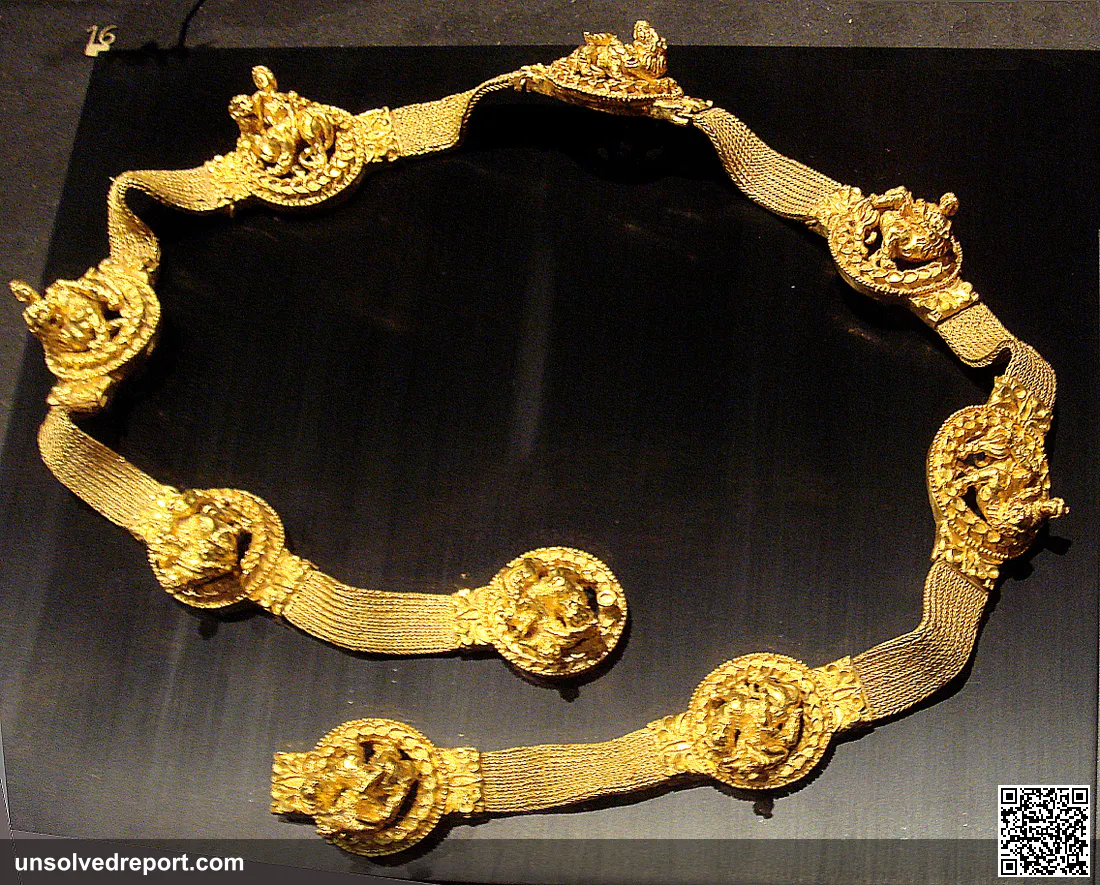
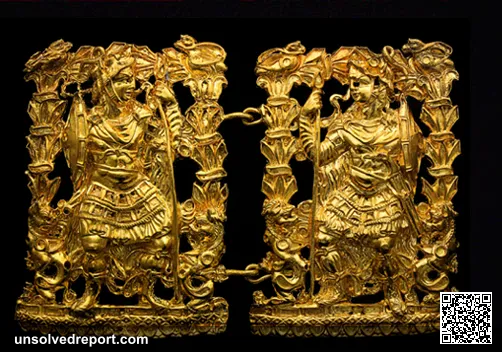
But the real wonder isn't the pile. It's the mix. Look closely and you see the whole ancient world crammed into a single grave — what scholars call "high cultural syncretism," Hellenistic and Scythian and Chinese and Indian elements all braided together (Wikipedia). Take the folding crown from Tomb VI. Five tree-shaped ornaments slid out of gold tubes, so the entire headpiece could come apart and pack away — a crown built for people who lived on the move (Queensland Museum blog; Edinburgh University Press, Afghanistan journal). Or the showstopper pair of pendants: a "Dragon Master," a mythical figure gripping two winged beasts, worked from gold, turquoise, garnet, carnelian, and pearl (Queensland Museum blog). Scattered among the bodies were coins — one struck for the Roman emperor Tiberius, another for the Parthian king Mithradates II — and those little discs helped pin down the dates (Wikipedia).
So who were these people, buried under so much wealth? The best guess scholars offer: nomadic elites, most likely the Yuezhi — the very people who would go on to found the Kushan Empire — though some argue for Saka (Scythian) or Eastern Parthian roots instead (Wikipedia).
And then history slammed the door. In 1979, about a year after Sarianidi's first dig, the Soviet Union invaded Afghanistan (National Geographic). The gold was carried to the National Museum of Afghanistan in Kabul. But as the fighting deepened, a quieter operation began. Around 1988-1989, the treasure was slipped out of the museum and locked into an underground vault at the Central Bank, beside the presidential palace, under the eye of museum director Omara Khan Masoudi (Smithsonian; National Geographic). A tiny circle of museum and bank staff made a pact: not a word about where it was hidden, not until peace came back.
Then came the years that should have destroyed it. Through the 1990s civil war and the Taliban era, the National Museum was gutted — looted again and again, hit by rockets, its human-shaped artifacts smashed on purpose. The people who knew what was in the vault said nothing, even under pressure. And here's the moment the whole story turns on: when Taliban officials prowling the bank vaults reached a sealed door and asked what was behind it, a guardian waved them off — and the gold was never opened (Smithsonian; Task & Purpose).
It came back from the dead after the Taliban fell. By April 2004, around 30 officials crowded into Kabul's Central Bank, with the National Geographic Society agreeing to take inventory of the hoard (Smithsonian). The catch: no keys would open the safes. A locksmith had to slice into one with a circular saw. Archaeologist Fredrik Hiebert was standing right there, and he later admitted what he dreaded: "I could just imagine opening the safe to find a big, hot lump of melted gold" (Smithsonian). The safe swung open. Every piece was intact. From 2007 on, much of it went on tour as "Afghanistan: Hidden Treasures From the National Museum, Kabul," drawing crowds at the Asian Art Museum of San Francisco, the Museum of Fine Arts, Houston, and New York's Metropolitan Museum of Art (Smithsonian).
The Question Still Hanging
Here's what nobody can close the book on: where is the Bactrian gold right this minute — and has anyone outside the room actually checked?
When the Taliban retook Kabul in August 2021, reporting says most of the hoard was still in the city, sitting in that same Central Bank vault by the presidential palace (Task & Purpose; Eurasianet). UNESCO has pointed to those central bank vaults as where the treasure is kept (The Daily Star). After that, the accounts stop agreeing. Some early reports had the new authorities announcing that the gold had been "misplaced" — and that they were hunting for it (Task & Purpose). Then in 2023, former National Museum director Mohammad Fahim Rahimi told Independent Persian he had personally laid eyes on the treasure and believed every item was intact and safely stored (reported via secondary coverage). But notice what's still missing — the one thing every earlier chapter eventually delivered: a full, transparent, independently confirmed count. Without it, the gold's safety rests on someone's word, not on an open door anyone can walk through.
Reading Between the Lines
What follows are interpretations, plainly labeled as such — not settled fact.
Theory 1: It's safe and unverified, not lost. The simplest read of the evidence is the dullest one: the hoard is exactly where it's been for decades, in the Central Bank vault, and the "missing" talk was just noise from a chaotic handover of power, not an actual vanishing. The 2023 inspection backs that up — though it hangs on a single official's word.
Theory 2: "Misplaced" was a word chosen on purpose. Some observers suspect the vague talk of searching for the gold served political ends on more than one side — or simply came from officials who honestly didn't yet know what was behind the vault door. That's speculation, nothing firmer.
Theory 3: The real threat isn't a thief — it's a furnace. Melt the Bactrian gold down and it's worth a fortune in raw bullion, which is why commentators have long feared the danger isn't a display case but a crucible. It's the exact nightmare Hiebert spoke aloud in 2004. No credible evidence says it has happened.
Here's the one thing you can count on: the pattern. The Bactrian gold has been written off as lost at least twice, and both times it came back — kept alive by a handful of people who decided their culture was worth their lives. Carved outside the National Museum is the line they lived by: "A nation stays alive when its culture stays alive" (UK government FCDO blog). So the world waits again, watching that sealed door, for the next time someone opens it and counts.
Tillya Tepe at a Glance
| Question | What the cited sources say | Source |
|---|---|---|
| Where is the site? | Tillya Tepe ("Hill of Gold"), near Sheberghan, Jowzjan Province, northern Afghanistan | Wikipedia; National Geographic |
| Who dug it, and when? | 1978, joint Soviet-Afghan team under Viktor Ivanovich Sarianidi | Wikipedia |
| How many burials? | Six — five women and one man | Wikipedia |
| How many objects? | Roughly 20,600 pieces in gold, silver, ivory, and semiprecious stone | Wikipedia; Smithsonian |
| How old are the graves? | 1st century BCE – 1st century CE; coins of Tiberius (struck 16–21 CE) and Mithridates II (123–88 BCE) anchor the dating | Wikipedia |
| Who was buried there? | Nomadic elites — most likely Yuezhi (the future Kushans); Saka or Eastern Parthian identities also argued | Wikipedia |
| Where is the gold said to be now? | The Central Bank vault in Kabul, beside the presidential palace | Task & Purpose; The Daily Star |
| When was the last independent, witnessed opening? | April 2004, with a National Geographic Society inventory | Smithsonian |
The Vault Record: A Dated Chronology
Every claim below traces to a source already cited in this article. Notice where the trail is thick — and where it thins to a single voice.
- 1978 — Sarianidi's Soviet-Afghan team opens the mound at Tillya Tepe and recovers the hoard (Wikipedia; National Geographic).
- 1979 — The Soviet Union invades Afghanistan; the gold goes to the National Museum in Kabul (National Geographic).
- 1988–1989 — The treasure is quietly moved into an underground Central Bank vault under museum director Omara Khan Masoudi; a small circle swears secrecy (Smithsonian; National Geographic).
- 1990s–2001 — The National Museum is looted and rocketed through the civil war and Taliban years; Taliban officials reach the sealed vault door but never open it (Smithsonian; Task & Purpose).
- April 2004 — Around 30 officials watch a locksmith saw into the keyless safes; Fredrik Hiebert is present as every piece is found intact, and the National Geographic Society takes inventory (Smithsonian).
- October 2008 – September 2009 — The U.S. leg of "Afghanistan: Hidden Treasures From the National Museum, Kabul" runs at the Asian Art Museum of San Francisco (Oct 24, 2008 – Jan 25, 2009), the Museum of Fine Arts, Houston (Feb 22 – May 17, 2009), and the Metropolitan Museum of Art (Jun 23 – Sep 20, 2009) (Smithsonian).
- August 2021 — The Taliban retake Kabul; reporting places most of the hoard still in the Central Bank vault (Task & Purpose; Eurasianet).
- After August 2021 — Early reports say the new authorities called the gold "misplaced" and were searching for it (Task & Purpose).
- 2023 — Former museum director Mohammad Fahim Rahimi tells Independent Persian he has personally seen the treasure and believes it intact (reported via secondary coverage).
Weighing the Three Readings
Set the theories above against the record, and here is how each actually holds up — no new facts, just the weight of what's already on the table.
"Safe but unverified" — strongest on evidence, weakest on proof. It fits the whole documented pattern: twice before (1989–2004), the gold sat silent in the same vault and emerged whole. The 2023 eyewitness account points the same way. The weakness is structural: since April 2004 there has been no witnessed, itemized count by outside parties — everything after 2021 rests on official statements. What would settle it: a repeat of exactly what happened in 2004 — an opening with independent observers and a published inventory. Worth noting, too, that even the baseline number is not perfectly fixed: the standard figure is about 20,600 objects, while Wikipedia records the National Geographic Society's post-recovery catalogue as complete at 22,000 objects (Wikipedia) — a reminder that "intact" only means something against a published list.
"'Misplaced' was deliberate" — plausible, but unfalsifiable as reported. The only evidence is the wording of early post-2021 statements (Task & Purpose); no source cited here documents intent behind them. Confusion during a chaotic handover explains the same facts with fewer assumptions. Only the officials involved could resolve this one.
"The furnace" — real as a motive, unsupported as an event. Bullion value makes melting the standing worst case — it is literally the fear Hiebert voiced in 2004 (Smithsonian) — but no cited source reports any evidence it has occurred. The same remedy answers it: open the vault, count against the 2004 inventory, in front of witnesses.
The Museum Around the Vault: A 2026 Update
No source found in this research specifically reports a fresh count, inspection, or sighting of the Bactrian gold itself in 2025 or 2026 — the 2023 Rahimi account, cited above, remains the most recent word on the hoard specifically. But the institution that holds it has kept issuing its own numbers. As of a May 17, 2026 Xinhua report timed to International Museum Day, the National Museum of Afghanistan in Kabul says it houses more than 60,000 historical artifacts overall, that it took in over 5,290 relics and restored more than 3,430 pieces over the preceding five years, that Afghan police intercepted 142 artifacts being smuggled abroad in the past year, and that visitor numbers — around 21,000, including roughly 6,750 foreign nationals — rose compared to prior years (Xinhua). None of those figures name the Bactrian gold; they describe the museum's general collection and security posture, not the vault. Read them as context for how the institution is operating, not as evidence about the hoard itself — that gap is exactly the "Reading Between the Lines" question above.
Frequently Asked Questions
Is the Bactrian gold on display anywhere right now?
Not as far as the sources here document. The last confirmed public showing was the 2007–2009 international tour, "Afghanistan: Hidden Treasures From the National Museum, Kabul," which closed its U.S. leg at the Metropolitan Museum of Art in September 2009 (Smithsonian). No source found here documents another public exhibition of the hoard since.
How much is the Bactrian gold worth?
None of the sources cited in this article give a reliable appraisal figure for the hoard itself, and this article does not estimate one. Commentators have pointed to its raw bullion value as a theoretical melt-down risk — the fear Fredrik Hiebert voiced in 2004 — but that is a concern about motive, not a dollar valuation (Smithsonian).
Did the Taliban ever find or open the vault?
Twice, by the record here, and neither time did they open the sealed gold. During the first Taliban era (1996–2001), officials reached the vault door and were turned away without incident (Smithsonian; Task & Purpose). After the 2021 return to power, early reporting described the new authorities calling the gold "misplaced" and searching for it, rather than reporting they had opened and inventoried it (Task & Purpose).
Why does the object count vary between 20,600 and 22,000?
Wikipedia records both figures from different points in the hoard's documentation: roughly 20,600 is the commonly cited total, while the National Geographic Society's catalogue compiled after the 2004 recovery lists 22,000 objects as complete (Wikipedia). No source consulted here explains the exact reconciliation between the two numbers, which is itself part of why a fresh, published count would matter.
Who currently controls access to the vault?
The sources here name the Central Bank vault beside the presidential palace in Kabul as the hoard's last confirmed location, under the control of Afghanistan's central banking and museum authorities as of the reporting available (Task & Purpose; The Daily Star). No source found here names a specific individual currently holding vault access under the post-2021 government.
The vault has outlasted a Soviet occupation, a civil war, and two Taliban administrations without anyone outside a tight circle confirming what's behind that door. The pattern says it will hold again. The pattern is not a count.
Original Data: Tillya Tepe Against Three Other Famous Ancient Gold Hoards
No single source lines up Tillya Tepe's roughly 20,600-object haul against other major ancient gold discoveries by object count, discovery year, and where each is kept today. The table below compiles those figures from the Wikipedia entries for Tillya Tepe, the Oxus Treasure, the Issyk kurgan "Golden Man," and Bulgaria's Panagyurishte Treasure, plus a current-location detail on the Bactrian gold.
| Hoard | Culture / period | Discovered | Number of gold objects | Current repository | Source |
|---|---|---|---|---|---|
| Tillya Tepe ("Bactrian Gold") | Nomadic elite (Yuezhi/Saka), 1st c. BCE – 1st c. CE | 1978 | ~20,600 (National Geographic Society's post-recovery catalogue lists 22,000) | Central Bank vault, Kabul, per UNESCO | Wikipedia, "Tillya Tepe"; The Daily Star |
| Oxus Treasure | Achaemenid Persian | c. 1877–1880 | ~180 surviving gold/silver pieces, plus ~200 coins (early reports suggest up to ~1,500 coins originally) | The British Museum, London | Wikipedia, "Oxus treasure" |
| Issyk kurgan ("Golden Man") | Saka (Scythian) | 1969 | More than 4,000 gold items | Kazakh Museum of Archaeology, Almaty, and the State Museum of Gold and Precious Metals, Astana | Wikipedia, "Issyk kurgan" |
| Panagyurishte Treasure | Thracian (Odrysian) | 1949 | 9 gold vessels (total 6.164 kg / 13.59 lb) | Regional Archaeological Museum, Plovdiv, Bulgaria | Wikipedia, "Panagyurishte Treasure" |
By object count, Tillya Tepe dwarfs the other three: its ~20,600 pieces are roughly 114 times the Oxus Treasure's 180 surviving pieces (20,600 ÷ 180, our calculation) and about 5 times the Issyk kurgan's 4,000-plus items (20,600 ÷ 4,000, our calculation). But it's also the only hoard of the four not sitting in a public museum gallery — the Oxus Treasure, the Issyk finds, and the Panagyurishte vessels are all on permanent physical display, while the Bactrian gold's location is attested only by a bank vault and an outside institution's word.
How We Compiled This
- Sources. Five pages, each fetched directly for this table: the Wikipedia articles "Tillya Tepe," "Oxus treasure," "Issyk kurgan," and "Panagyurishte Treasure," plus The Daily Star's reporting on Afghan central bank vaults, which cites UNESCO on the Bactrian gold's location.
- Definitions. "Number of gold objects" follows each source's own whole-hoard count. Tillya Tepe's ~20,600 figure includes silver, ivory, and semiprecious-stone pieces alongside gold, not gold alone; the Oxus Treasure separates surviving metalwork (gold and silver) from its coin count; Panagyurishte is reported as both a 9-vessel count and a total weight.
- How calculated. The two ratios in the reading paragraph divide Tillya Tepe's published object count by each comparison hoard's published count, using only the whole numbers each source states.
- Limitations. These four totals aren't a strict apples-to-apples set — they mix "objects recovered" (Tillya Tepe, Issyk) with "objects surviving today" (Oxus, where much of the original hoard was melted for bullion) and a weighed count (Panagyurishte). Tillya Tepe's current location is the least certain of the four: Wikipedia states the treasure is "apparently missing" since the Taliban's August 2021 return to power, while Task & Purpose reports its whereabouts are unknown, and The Daily Star cites UNESCO placing it in the central bank's vaults. This table follows the same cautious framing as the rest of this article rather than asserting either extreme.
📌 Data status: verified 2026-09-29.
Sources & further reading
- https://www.nationalgeographic.com/history/history-magazine/article/discoveries-bactrian-gold-afghanistan-silk-road
- https://www.smithsonianmag.com/arts-culture/lost-found-7605081/
- https://en.wikipedia.org/wiki/Tillya_Tepe
- https://www.euppublishing.com/doi/10.3366/afg.2020.0045
- https://blog.qm.qld.gov.au/2013/10/15/the-gold-of-tillya-tepe-and-the-discovery-of-the-bactrian-hoard/
- https://eurasianet.org/afghanistan-nation-protects-storied-bactrian-treasure
- https://taskandpurpose.com/news/afghanistan-ancient-treasure-taliban/
- https://www.thedailystar.net/news/asia/south-asia/news/afghan-central-banks-10-billion-stash-not-all-within-reach-taliban-2155141
- https://dfid.blog.gov.uk/2012/11/21/a-nation-stays-alive-when-its-culture-stays-alive/
- https://english.news.cn/20260517/a7cb7a314f1a4d14980552e54a98d65e/c.html
Childeric's Golden Bees: A King's Hoard Lost in One Night
300 golden bees buried with a Frankish king in 1653 vanished in one night in 1831. Only two survived. So what happened to the rest of Childeric's treasure?
The Copper Scroll: 64 Gold Caches, Zero Found in 73 Years
A scroll of pure copper lists 64 sites of buried gold from the Dead Sea caves. Tons of treasure, never found in 73+ years. A 2026 theory changes the story.
The Lost Dutchman Mine: Arizona's Deadliest Gold Hunt
A dying prospector hid 48 pounds of gold and named no map. For 130 years, Arizona's Superstition Mountains have swallowed the people chasing the rest.