The Copper Scroll: 64 Gold Caches, Zero Found in 73 Years
A scroll of pure copper lists 64 sites of buried gold from the Dead Sea caves. Tons of treasure, never found in 73+ years. A 2026 theory changes the story.
Most of the Dead Sea Scrolls are soft, perishable things: sheets of leather and papyrus crowded with psalms, prophecies, and the house rules of an ancient community. One scroll breaks the pattern completely. Someone hammered it out of nearly pure copper, thin as parchment, and rolled it up like metal paper — and what they punched into that metal isn't a prayer at all. It's a list. Cache after cache of gold and silver, tucked into cisterns, tombs, aqueducts, and dry riverbeds, across twelve columns of clipped, cryptic Hebrew. Add up the weights at face value and you're looking at tons of precious metal — and in 2026, a new scholarly theory is rewriting who buried it and why.
> ### The 60-Second Brief
> - 64 separate treasure caches listed across the scroll, naming a place and a quantity for each.
> - Found March 1952 in Cave 3 at Qumran, on the northwestern shore of the Dead Sea — by archaeologists, not Bedouin shepherds.
> - The only Dead Sea Scroll written on metal: copper alloyed with roughly 1% tin.
> - One single entry alone lists 900 talents of silver.
> - Cut open in 1955–56 by engineer H. Wright Baker at the Manchester College of Technology.
> - 73+ years later, not one cache has ever been confidently located — but a May 2026 theory reassigns the treasure to a war chest for the Bar Kokhba revolt (132–136 CE).
No poetry. No theology. Just places and amounts, carved into a material chosen, it seems, to outlast everyone who might read it. For more than seventy years, one question has refused to die: is this a map to something real?
What we actually know
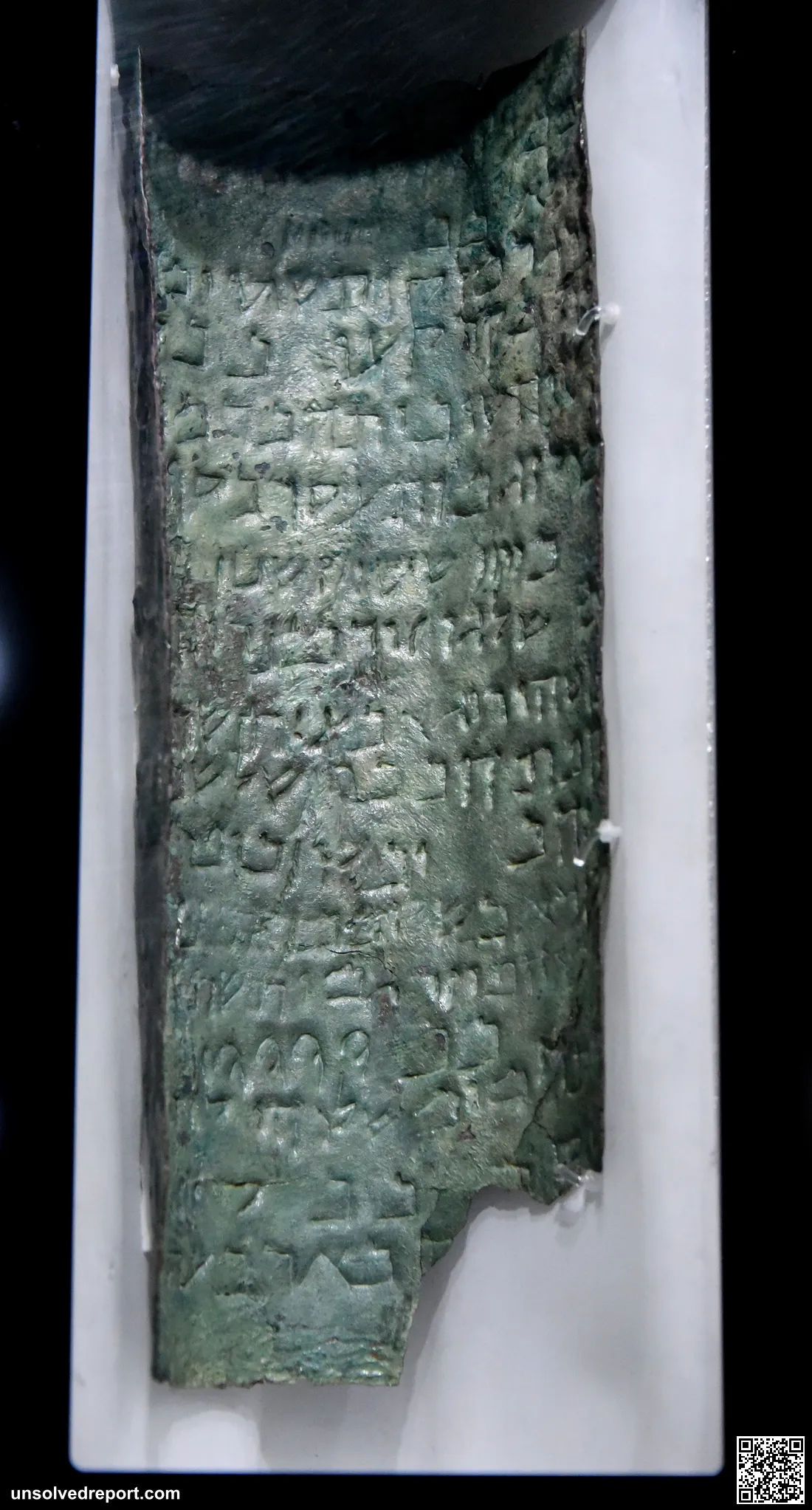
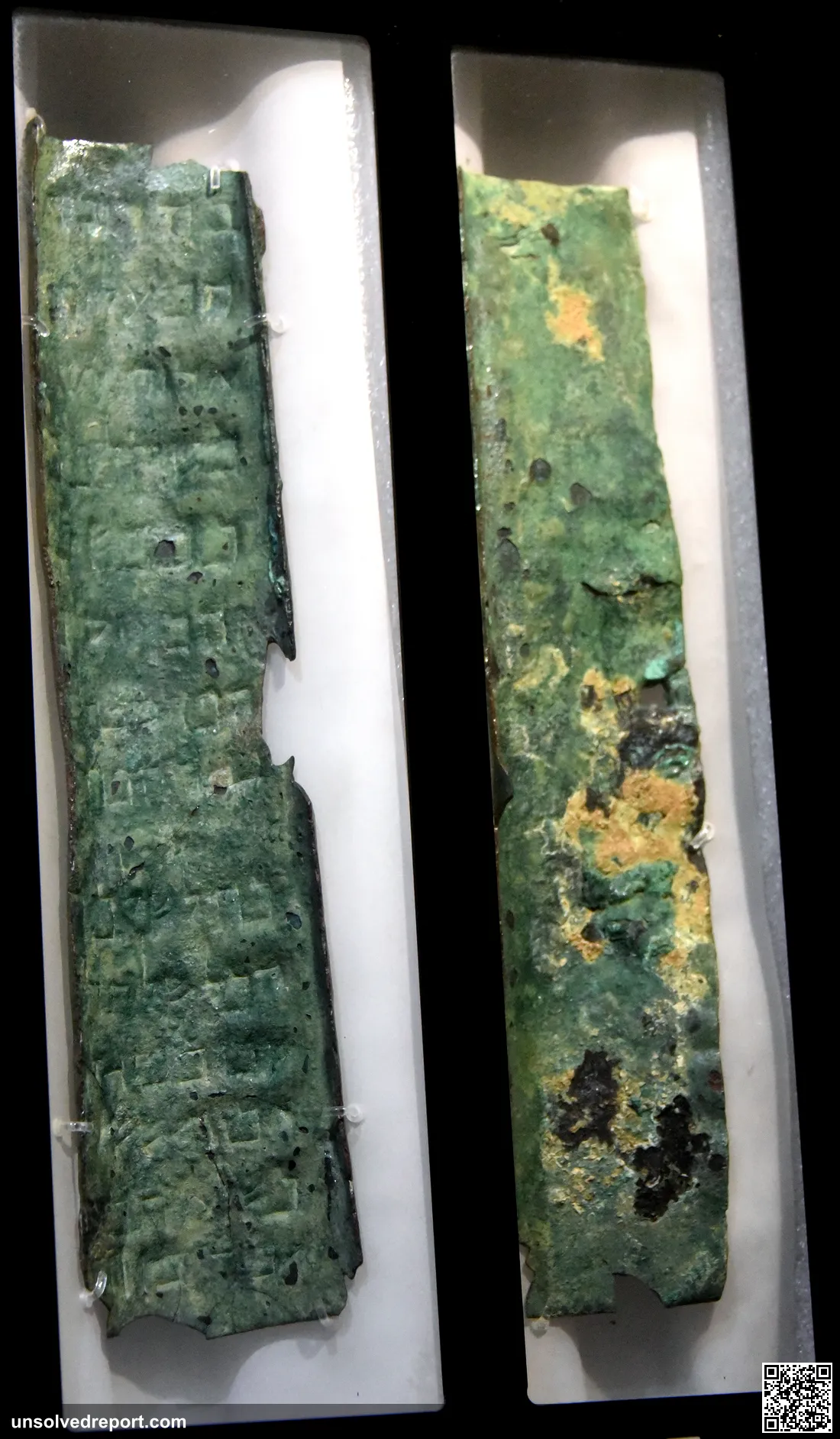
Start with the cave. In 1952, an archaeological team digging the back of Cave 3 at Qumran, on the northwestern shore of the Dead Sea, found it. That detail matters more than it sounds. Most of the famous scrolls turned up in the hands of Bedouin shepherds; this one was pulled from the ground by archaeologists who knew exactly where they stood (Wikipedia). It came out as two separate rolls of oxidized green metal.
And metal is the strange part. Of all the Dead Sea Scrolls, this is the only one written on it — not leather, not papyrus, but thin sheets of copper, alloyed with a touch of tin and riveted into a single strip, the letters punched and incised straight into the surface (Biblical Archaeology Society). Think about the effort. Nobody picks the hardest possible medium for a throwaway note. That choice alone hints the writer wanted this to survive.
So what's on it? Roughly 64 separate stashes of buried gold, silver, and other valuables. Each entry names a place and a quantity — and the quantities, read literally, pile up into a staggering hoard of precious metal (Britannica). There are no maps, no coordinates. Just landmarks and place-names, the kind a local would recognize at a glance.
Reading it was its own ordeal. The corroded metal simply would not unroll without shattering, so in 1955–56 they did the only thing left: they cut it open. On the advice of scholar John Marco Allegro, the Jordanian authorities shipped the scroll to the Manchester College of Technology, where engineer H. Wright Baker took a fine circular saw and sliced it into curved strips you could finally lay flat and read (Wikipedia). Those sawn sections are how the scroll exists to this day.
Today it lives in Jordan. After years at the Citadel's archaeological museum, the Copper Scroll moved into the collection of the Jordan Museum in Amman, where it sits as one of the institution's standout pieces (The Jordan Museum).
And here's the kicker. After decades of expeditions, surveys, and scholarly arguing, not one cache in the scroll has ever been confidently found. Not a single stash matched to a real discovery, not a single lost place-name pinned down for sure (Smithsonian Magazine). Tons of gold, written in stone — well, in copper — and not an ounce recovered.
The question that won't go away
Strip away the noise and the mystery is almost childishly simple: does the Copper Scroll point to real treasure that was really buried? Or is it something else entirely — a literary game, a symbolic text, a ledger of riches that never existed the way it claims?
The frustrating thing is that the scroll won't help you decide, and in that sense it's a cousin to the Beale Ciphers, another buried-gold puzzle nobody has ever cracked. Its directions sound precise — confident, even — but they're useless to anyone reading today. They lean on landmarks that any first-century local would have known by heart and that mean nothing to us now. A typical entry gives you a feature near some named site, a distance to pace off, a depth to dig. The catch? The named sites are mostly gone. We don't know where they were. Two thousand years of erosion, building, and conquest have wiped out every reference point the writer assumed his reader would share. He wrote for someone standing in his world. That world is dust.
So scholars split. One camp, tracing back to the early view linked with John Allegro, took the inventory at its word — a real record of real wealth, possibly tied to the Temple in Jerusalem. Another camp, led by the scroll's first official editor, Józef Milik, called it essentially folklore: a roll-call of legendary or imagined treasures, not a working map to anything. Decades on, the debate has sharpened without settling. The amounts, the medium, the flat bookkeeper's tone all pull toward something real. The missing places and the stubborn absence of a single recovered coin pull just as hard the other way.
Four ways to read it (and not one is proven)
Everything below is a competing guess. None has been confirmed. Treat each as a proposal someone is still arguing for, not a verdict.
Theory 1: Temple treasure, hidden before Rome arrived
The long-standing view: the scroll records valuables tied to the Jerusalem Temple, stashed away ahead of the Roman destruction of the city in 70 CE — the same "hidden before the enemy arrived" plot that shows up centuries later in the Templar treasure legend. Picture priests or officials racing to hide sacred metals and vessels before the soldiers came — and logging every hiding spot on durable copper so the wealth could be recovered later. Supporters point to the sheer scale of the amounts and the formal, ledger-like feel of the text. Critics fire back that the numbers may be wildly inflated, and that nothing outside the scroll actually links it to the Temple.
Theory 2: The Qumran community's own wealth
The scroll turned up among the Qumran caves, so some researchers tie it to the community usually associated with that site — often identified with the Essenes. On this reading, the inventory might record donations, communal funds, or assets the group gathered. The snag is obvious once you say it out loud: that community is generally described as living modestly, even austerely, which fits awkwardly with a list of tons of gold and silver. The connection between the scroll's contents and the people next door has never been proven.
Theory 3: A legend cast in metal
A long-running view treats the whole thing as folklore — not a practical map but a catalogue of fabled buried wealth, committed to copper for reasons we've simply lost. This was broadly Józef Milik's position. Its strength is elegant: it explains, in one stroke, why nothing has ever been found. Its weakness is just as plain — why would anyone go to the brutal trouble of preparing copper sheets and punching letters into them to record a work of fiction?
Theory 4: Real gold, looted long ago
The fourth option splits the difference. The caches were real — but they were emptied centuries ago, recovered by people who knew the locations, or plundered during the chaos of the first and second centuries CE. That would explain everything at once: a genuine inventory and a vanished hoard. The trouble is that this theory is almost impossible to test. Treasure carried off in antiquity leaves no trace, which means the idea can be neither confirmed nor knocked down.
The 2026 twist: a war chest for the last Jewish revolt
In May 2026, archaeologist Shimon Gibson of the University of North Carolina at Charlotte published a fifth reading that directly challenges the Temple-treasure theory above — pushing the timeline six decades later than most prior accounts assumed (Haaretz).
Gibson's objection to the classic Temple story is blunt: if priests had successfully hidden 64 caches of sacred wealth before 70 CE, they presumably would have hidden the golden menorah too — yet Rome captured it and paraded it on the Arch of Titus. That mismatch, he argues, points away from a pre-70 CE Temple hiding spree and toward a different, later crisis.
His alternative: the scroll is a financial record of donations gathered to fund the Bar Kokhba revolt (132–136 CE), the second major Jewish uprising against Rome. Gibson describes it, in Haaretz's paraphrase, as something like "a 2,000-year-old Excel sheet" — with supporters' identifying details engraved onto copper around 133–134 CE specifically to shield donors from Roman reprisal as the revolt intensified. Many contemporaries reportedly viewed Bar Kokhba as a messianic figure who might trigger a final, prophesied battle, which Gibson connects to apocalyptic expectations found elsewhere in the Dead Sea Scrolls.
Not every specialist agrees on the details. Joan Taylor, who worked alongside Gibson to revisit Cave 3Q and pinpoint the scroll's original find-spot using archival material from the 1952 dig, favors a related but distinct reading: that the entries record tithes owed to surviving Temple priests, kept in anticipation of the Temple eventually being rebuilt once Rome was gone — not war funding as such.
One detail from that same research may explain why the scroll has always frustrated readers: it references a second, still-undiscovered scroll — supposedly hidden at a site called Kohlit — that was meant to hold the corroborating details the Copper Scroll itself leaves out. If that companion document exists and is ever found, it could be the first real evidence that turns any of the five theories from a guess into a fact (Haaretz).
It's worth being precise about what this new work does and doesn't change: it adds a fifth, dated, named theory and a pinpointed find-spot inside Cave 3Q — it does not locate any of the 64 caches themselves, and none of Gibson's or Taylor's claims have displaced the older Temple, Qumran-community, legend, or looted-long-ago readings as settled fact. All five remain competing proposals.
Why it still grips people
The Dead Sea Scrolls, recovered from caves near Qumran from the late 1940s onward, rewrote the study of ancient texts — they handed scholars a window into Jewish life and literature right around the turn of the era. And inside that collection — right alongside history's other unexplained ancient mysteries — the Copper Scroll is the odd one out. It isn't scripture. It isn't a hymn. It's a completely different kind of document, and its survival on metal makes it one of the most physically distinctive ancient texts anyone has ever found.
Which is exactly why the empty-handed treasure hunt stings so much. The scroll is real. The text is legible. The instructions were plainly meant to be followed — by someone. What's missing isn't the document. It's the world the document was written for: the local knowledge that turned its directions into something you could actually walk. Every expedition slams into the same wall. You can't dig at a landmark nobody can find.
The Copper Scroll at a glance
Because the scroll's story is scattered across excavation, laboratory, and museum, here are the load-bearing facts in one place — every figure below is drawn from the sources cited above.
| Detail | What the record says |
|---|---|
| Designation | 3Q15 — the fifteenth item from Qumran Cave 3 |
| Found | Cave 3 at Qumran, on the northwestern shore of the Dead Sea, by an archaeological team (not Bedouin), in 1952 — March 14, 1952 per Wikipedia (Wikipedia) |
| Material | The only Dead Sea Scroll on metal: copper alloyed with roughly 1% tin, letters punched and incised into the surface (Biblical Archaeology Society, Wikipedia) |
| Contents | Roughly 64 separate stashes of gold, silver, and other valuables, each entry naming a place and a quantity (Britannica) |
| A sample entry's scale | One single cache is listed at 900 talents of silver (Wikipedia) |
| How it was read | Too corroded to unroll; cut open in 1955–56 by engineer H. Wright Baker at the Manchester College of Technology, on John Marco Allegro's advice (Wikipedia) |
| Where it is now | The Jordan Museum, Amman, after years at the Citadel's archaeological museum (The Jordan Museum) |
| Caches recovered to date | None confidently matched to a real find (Smithsonian Magazine) |
| 2026 theory | Shimon Gibson proposes the scroll funded the Bar Kokhba revolt (132–136 CE), engraved c. 133–134 CE; Joan Taylor favors a tithes-to-priests reading; both pinpointed the scroll's exact find-spot in Cave 3Q (Haaretz, May 7, 2026) |
Weighing the five readings
The theories above aren't equally testable. It helps to separate what each one explains well from the gap that keeps it from being proven — and to ask what evidence, if it ever surfaced, would actually settle it.
- Temple treasure hidden before 70 CE. Fits: the staggering scale of the amounts and the formal, ledger-like tone suit an institutional hoard rather than a private one. Weakness: nothing outside the scroll ties it to the Jerusalem Temple, the numbers — like the 900-talent entry — may be inflated, and Gibson's 2026 menorah objection cuts directly against it. What would resolve it: an external text or an excavated cache that names the Temple and matches a scroll entry. None exists.
- The Qumran community's own wealth. Fits: proximity — the scroll came out of the same cave complex as the community usually identified with the Essenes. Weakness: that community is described as living austerely, which sits badly beside a list of tons of gold and silver. What would resolve it: evidence linking the scroll's inventory to the group's finances, which has never been produced.
- A legend cast in metal. Fits: it explains, in one stroke, why not a single cache has ever been found — Milik's whole point. Weakness: it can't explain why anyone would hammer copper sheets and punch letters into them to record a fiction. What would resolve it: proof that the place-names are invented rather than lost — impossible to obtain once the landmarks are gone.
- Real gold, looted long ago. Fits: reconciles a genuine inventory with a vanished hoard. Weakness: treasure carried off in antiquity leaves no trace, so the claim is effectively unfalsifiable. What would resolve it: nothing available — which is precisely the problem.
- Bar Kokhba war chest / priestly tithes (Gibson & Taylor, 2026). Fits: explains the golden-menorah discrepancy that undercuts the pre-70 CE Temple theory, and fits the scroll's donor-protection framing. Weakness: it's a newly published proposal that hasn't yet been tested against the wider field, and Gibson and Taylor themselves disagree on whether the money was for war or for future Temple tithes. What would resolve it: discovery of the companion scroll the text itself points to, reportedly hidden at Kohlit — still unfound.
The common thread: the deciding evidence in every case is a fixed location. Until one of the scroll's lost place-names is pinned to real ground — or that second scroll at Kohlit surfaces — all five readings stay exactly where they are: arguable, and unproven.
Maybe the gold was buried and is still out there. Maybe it funded a doomed rebellion and was spent long before anyone could dig it up. Maybe it never existed outside one writer's imagination. The Copper Scroll is a map whose territory has vanished, and it's that absence, not any rumored hoard, that keeps pulling scholars back to Cave 3Q — one more entry in the long list of famous lost treasures the world still can't find.
Frequently Asked Questions
Has any treasure from the Copper Scroll ever been found?
No. Despite more than 73 years of expeditions, surveys, and modern search technology, not a single one of the scroll's 64 listed caches has been confidently matched to a real discovery (Smithsonian Magazine).
Why is the Copper Scroll written on metal instead of parchment?
It's the only Dead Sea Scroll made this way, and no source explains the choice with certainty. The scroll is copper alloyed with roughly 1% tin, with letters punched and incised into the surface rather than written in ink (Biblical Archaeology Society) — a durable medium that many researchers read as a sign the author intended the record to outlast more perishable materials, though that remains an inference, not a stated fact in the text itself.
Who found the Copper Scroll and when?
An archaeological team discovered it in Cave 3 at Qumran, near the northwestern shore of the Dead Sea, in 1952 — March 14, 1952, according to Wikipedia's account. Unlike many other Dead Sea Scrolls, it was excavated by archaeologists rather than found by Bedouin shepherds (Wikipedia).
What is the new 2026 theory about the Copper Scroll?
Archaeologist Shimon Gibson proposed in research reported by Haaretz on May 7, 2026, that the scroll records donations funding the Bar Kokhba revolt (132–136 CE) rather than pre-existing Temple treasure, engraved around 133–134 CE to protect donors from Roman reprisal. His colleague Joan Taylor offers a related but distinct reading, favoring tithes held for a future rebuilt Temple. Both pinpointed the scroll's exact find-spot within Cave 3Q using archival material (Haaretz).
Where is the Copper Scroll now?
It is held at the Jordan Museum in Amman, Jordan, after previously being displayed at the Citadel's archaeological museum in the same city (The Jordan Museum).
Is the treasure in the Copper Scroll definitely real?
Nobody knows for certain. Four long-standing theories — genuine Temple treasure, the Qumran community's own wealth, a symbolic legend, or real gold looted long ago — remain unproven and untested against each other, and the 2026 Bar Kokhba theory adds a fifth competing possibility rather than resolving the question (Wikipedia).
Original Data: One Cache Today vs. the Whole Scroll's 1960 Estimate
No source puts these two numbers side by side: what the scroll's single largest cache would fetch at today's silver price, versus what the entire scroll's treasure was estimated in 1960 to be worth, adjusted for inflation.
| Figure | Value or weight as published | Converted to today's dollars | Source |
|---|---|---|---|
| Largest single cache in the scroll (900 talents of silver) | "30.05 tons/868,000 troy ounces" | $53,312,560 (868,000 troy oz × $61.42 per troy oz, our calculation) | Wikipedia, "Copper Scroll"; JM Bullion live silver spot price, Oct 5, 2026 |
| Entire scroll's estimated total value, 1960 assessment | "estimated in 1960 that the total would top $1,000,000 U.S." | $11,316,892 (US CPI-adjusted: $1,000,000 × 334.980 ÷ 29.600, our calculation) | USC Dornsife West Semitic Research Project; in2013dollars.com U.S. inflation calculator |
| Ratio (our calculation) | — | The single largest cache's silver-only melt value today is about 4.7× the inflation-adjusted value of the 1960 estimate for the entire scroll (53,312,560 ÷ 11,316,892 ≈ 4.71, our calculation) | — |
Run through a plain CPI calculator, "$1,000,000 in 1960" becomes about $11.3 million today — less than a quarter of what just one of the scroll's listed caches would be worth if melted down at the Oct 5, 2026 silver price.
How We Compiled This
- Sources. Wikipedia's "Copper Scroll" article (for the 900-talent entry's stated modern-weight conversion), the USC Dornsife West Semitic Research Project's Copper Scroll page (for the original 1960 valuation estimate), in2013dollars.com's U.S. inflation calculator (for CPI index figures), and JM Bullion's live silver spot price.
- Definitions. "Melt value" means value based purely on the weight of precious metal at the current market spot price, with no premium for rarity, age, or historical significance. "CPI-adjusted value" scales the 1960 dollar estimate by the ratio of the U.S. Consumer Price Index in 2026 to the index in 1960.
- How calculated. Melt value = 868,000 troy ounces × $61.42 per troy ounce = $53,312,560 (JM Bullion spot price as of Oct 5, 2026, 10:22 PM EDT). CPI-adjusted value = $1,000,000 × (334.980 ÷ 29.600) = $11,316,892, matching the $11,316,891.89 in2013dollars.com publishes for that conversion. Ratio = $53,312,560 ÷ $11,316,892 ≈ 4.71.
- Limitations. The USC page says it is difficult to assess the scroll's value because it is not certain what the scroll's weights are equivalent to, and describes the 1960 figure as an estimate that the total "would top" $1,000,000 — so the 1960 figure is a floor, and the two numbers are not necessarily like for like. The 900-talent-to-tons conversion depends on which definition of "talent" is used. Silver spot prices change continuously; the figure used here is a single-day snapshot.
📌 Data status: verified 2026-09-29.
Sources & further reading
- https://en.wikipedia.org/wiki/Copper_Scroll
- https://www.biblicalarchaeology.org/daily/biblical-artifacts/dead-sea-scrolls/the-copper-scroll/
- https://www.britannica.com/topic/Copper-Scroll
- https://jordanmuseum.jo/en/copper-scroll
- https://www.smithsonianmag.com/history/the-copper-scroll-and-the-dead-sea-treasure
- https://dornsife.usc.edu/wsrp/copper-scroll/
- https://www.haaretz.com/archaeology/2026-05-07/ty-article/the-mysterious-copper-scroll-and-the-end-of-days/0000019d-fce2-dda2-adff-ffefc6d50000
The Lost Dutchman Mine: Arizona's Deadliest Gold Hunt
A dying prospector hid 48 pounds of gold and named no map. For 130 years, Arizona's Superstition Mountains have swallowed the people chasing the rest.
Pereshchepina Treasure: 800 Objects, One Unproven Royal Grave
75kg of gold and silver, 800+ objects, one boy's stubbed toe in 1912 — is the Pereshchepina Treasure really Khan Kubrat's grave? The evidence still splits historians.
12 Lost Treasures the World Has Never Found
A king's jewels eaten by the tide. A room of amber that blinked out of history. Twelve real fortunes that left a paper trail, then simply vanished.