The Lost Dutchman Mine: Arizona's Deadliest Gold Hunt
A dying prospector hid 48 pounds of gold and named no map. For 130 years, Arizona's Superstition Mountains have swallowed the people chasing the rest.
October 1891. An old man is dying in a Phoenix home, and the people nursing him reach under his bed. Their hands close on a candle box. They drag it out — and by one local account, inside sits roughly 48 pounds of gold ore so rich that the assayer who later studied it called it the finest he had ever seen (Apache Junction Public Library).
Here's the maddening part. The dying man — a German immigrant named Jacob Waltz — never told a single living soul where that gold came from. He carried the answer down with him.
More than 130 years later, nobody has proven they found the source. And a few of the people who went looking? They never came home — the same grim math that has haunted hunts for Dutch Schultz's buried millions and countless other American treasures that swallowed their seekers whole.
This is the legend of the Lost Dutchman mine — the most famous lost mine in American history, and a near-perfect lesson in how a fistful of hard facts can curdle into a century of obsession. So let's do the one thing almost nobody bothers to do with this story. Let's pull the documented truth apart from the tales people just love to tell.
> The 60-Second Brief
> - In October 1891, associates found roughly 48 pounds of gold ore hidden under dying prospector Jacob Waltz's bed.
> - Waltz died on October 25, 1891, without ever revealing where the gold came from.
> - On August 11, 1892, Julia Thomas and the Petrasch brothers set out to find the mine, but the search collapsed after about three weeks.
> - A national account of the legend ran in the San Francisco Chronicle on January 13, 1895, launching it beyond Arizona.
> - Treasure hunter Adolph Ruth vanished in the Superstitions in the summer of 1931; his skull, found roughly six months later, had two holes consistent with a gunshot.
> - The Superstition Mountains were built by volcanic activity roughly 25 million years ago — geology that scientists say makes a rich gold vein there unlikely.
What We Actually Know
Start with the man, because the man was real.
Jacob Waltz was a German-born prospector. "Dutchman" wasn't an insult or a mix-up — it was just 19th-century American slang for a German, mangled out of the word Deutsch. He settled near Phoenix, held a homestead, and died on October 25, 1891, cared for at the end by an acquaintance named Julia Thomas (Wikipedia; Arizona State Parks). Even the year he was born wriggles a little: his tombstone says 1808, while records point to a Jacob Walz born in Württemberg in 1810 (Wikipedia).
The hunt began almost before the dirt settled on his grave. According to the Apache Junction Public Library, Julia Thomas and two brothers, Rhinehart and Hermann Petrasch, marched out of Phoenix on August 11, 1892, chasing the mine Waltz had supposedly described on his deathbed. They camped in Needle Canyon for about three weeks. Then it all came apart — the search collapsing under sheer exhaustion and dwindling supplies. The Arizona Weekly Gazette ran the story on September 1, 1892, under a headline that says everything: "A Queer Quest" (Apache Junction Public Library).
Empty-handed but unwilling to let go, Thomas reportedly sat down afterward and drew maps from memory — probably the very first maps anyone ever made to the Dutchman's mine. Then a journalist named Pierpont C. Bicknell published an account in the San Francisco Chronicle on January 13, 1895, and just like that the strange little campfire story leapt from the desert to a national audience (Apache Junction Public Library).
And then comes the part that turns a treasure tale into something darker. This hunt has a body count.
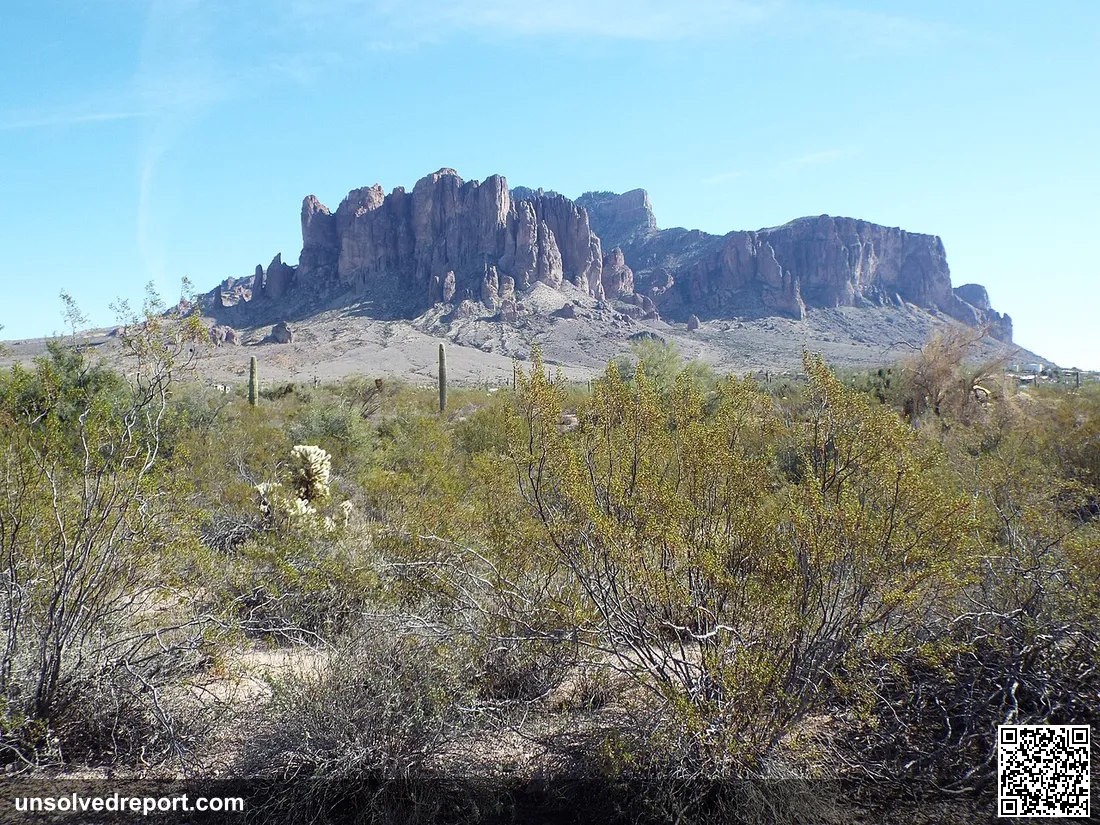
The most famous death belongs to Adolph Ruth. An amateur treasure hunter, he walked into the Superstition Mountains in the summer of 1931 — and simply vanished. About six months later, searchers found his skull. And not just anyone examined it: Aleš Hrdlička, the Smithsonian's respected physical anthropologist, studied the bone and noted two holes in it consistent with a gunshot (Wikipedia; Apache Junction Public Library). The story detonated across the country, and a regional yarn hardened into genuine American legend. And make no mistake about the setting — the rugged Superstition Wilderness east of Phoenix is truly deadly country. Arizona authorities note that searchers have died out there across the decades (Arizona State Parks).
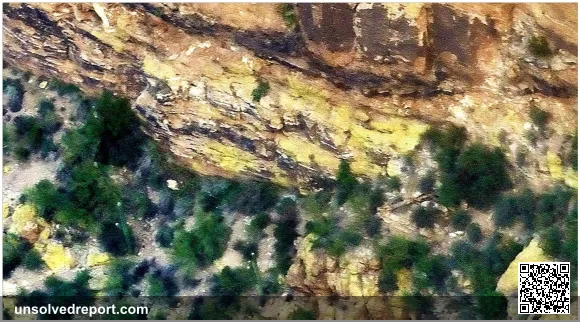
One more fact, and it matters more than it sounds. Those mountains were born from fire. Arizona State Parks describes the Superstitions as "the result of intensive volcanic activity" — welded tuff, dacite, basalt, and other igneous rock, piled up by ancient eruptions and caldera collapse roughly 25 million years ago (Arizona State Parks). Hold onto that detail. It's about to cause trouble.
The Question Nobody Can Answer
Strip away every retelling and one stubborn mystery is left standing in the dust: if there was no mine, where did Jacob Waltz's gold actually come from?
Because the gold was real. Real enough to fight over. After Waltz died, a man named Richard Holmes claimed the candle box, Julia Thomas disputed it, and a local court reportedly sided with Holmes — who promptly turned around and sold the ore in Phoenix (Apache Junction Public Library). So yes, a high-grade stash of gold absolutely existed — not unlike the unexplained cache unearthed in California's Saddle Ridge Hoard, where the gold was undeniable long before anyone could explain where it came from. The trouble is what it proves.
Now watch that fiery geology come back to bite. Volcanic rock like the kind that built the Superstitions is not the classic home for a monster gold vein, and the leading scientific view says these particular mountains are an unlikely place to find one (Wikipedia). But it's not a flat no. Arizona State Parks itself admits that "a few gold deposits pocket the surrounding areas," and the nearby Goldfield district really did produce gold (Arizona State Parks).
Sit with that contradiction for a second. Rich ore in a dead man's hands. Hostile rock in the hills he wandered. That tension is the whole reason this case simply will not close.
The Theories (And Why None of Them Stick)
Everything below is informed speculation and folklore — not settled fact. Treat each one as a maybe, never a verdict.
The Peralta legend
The most romantic version hands Waltz's gold to a wealthy Mexican family, the Peraltas, who supposedly worked rich Superstition mines in the 1840s — right up until an 1848 expedition was ambushed by Apaches at a place now grimly named the Massacre Grounds (Arizona State Parks). It's a gorgeous, blood-soaked story. There's just one problem. The documented Peralta mining operation actually traces back to Valencia County, California, in the 1860s — not Arizona at all — which hints that the whole Arizona Peralta legend may be later embroidery sewn onto a much thinner thread (Wikipedia).
The "stash from somewhere else" theory
A colder, quieter reading shows up in the local histories: maybe Waltz never owned a working mine at all. Old-time prospectors were known to squirrel away a private reserve of high-grade ore to outlast the lean years, and some researchers suggest the candle-box gold could have come from somewhere else entirely — possibly even ore quietly carried off from a mine that was already running (Apache Junction Public Library). None of that is proven, and pinning the word "thief" on any real person would be unfair — it's the same unresolved accounting problem that still shadows South Africa's Kruger Millions. The point is simpler, and a little deflating: a pocket of rich gold doesn't require a secret mine behind it.
The "it was never lost" theory
Researcher John D. Wilburn floated maybe the most ironic idea of all. He argued that Waltz's described location actually matches the Bulldog Gold Mine near Goldfield, Arizona — meaning the famous "lost" mine might not be lost at all. It might have been sitting there in plain sight the whole time, just operating under a different name (Wikipedia).
So what really happened to Adolph Ruth?
That shattered skull launched a century of murder talk. Two holes, a gunshot — case closed, right? Not so fast. Ruth was 66 years old, in frail health, and limping through brutal terrain on a cane (Wikipedia). Foul play is one possibility. A simple, lonely accident — followed by scavengers doing what scavengers do — is another. The evidence went cold long ago, so both stay just theories, and we name no suspects.
Here's the honest verdict. The Lost Dutchman mine survives precisely because it lives in that thin, electric strip where the facts run out and the imagination takes over — the same strip where a pile of unsolved Beale Ciphers has kept codebreakers chasing buried gold for two centuries. There was a real Dutchman. Real gold. Real searches. Real graves. Whether there was ever a mine at all is the one thing nobody has managed to dig up — and somewhere out in that volcanic maze, the question is still waiting for whoever's foolish, or brave, enough to ask it next.
Frequently Asked Questions
Was the Lost Dutchman Mine ever actually found?
No. More than 130 years after Jacob Waltz died without naming its location, nobody has produced verified proof of the mine itself, only the gold ore he left behind. Multiple groups over the decades have claimed to have found it, but none of those claims has been confirmed by any mining authority or geological expert (Wikipedia).
Who was Jacob Waltz, the "Dutchman"?
He was a German-born prospector — "Dutchman" being 19th-century slang for a German, from Deutsch — who settled near Phoenix and died on October 25, 1891. Records suggest he was born Jacob Walz in Württemberg around 1810, though his tombstone gives 1808 (Wikipedia).
What happened to Adolph Ruth in the Superstition Mountains?
Ruth, an amateur treasure hunter, walked into the Superstitions in the summer of 1931 and disappeared. About six months later, searchers found his skull, and Smithsonian physical anthropologist Aleš Hrdlička identified two holes consistent with a gunshot, though Ruth was also 66, in frail health, and hiking rough terrain on a cane, so accident and foul play both remain unproven possibilities (Apache Junction Public Library).
Is there real physical evidence behind the Lost Dutchman legend?
Yes — the gold itself. After Waltz's death, a candle box containing roughly 48 pounds of high-grade gold ore was recovered and later sold, and a dispute over who owned it went to a local court. That proves rich ore existed in Waltz's possession; it doesn't prove a mine produced it (Apache Junction Public Library).
Does the geology of the Superstition Mountains support a hidden gold mine?
Not easily. The range formed from volcanic activity roughly 25 million years ago, and the mainstream scientific view is that this kind of volcanic rock is an unlikely home for a major gold vein. Arizona State Parks does note, however, that a few gold deposits pocket the surrounding area, including the nearby Goldfield mining district (Arizona State Parks).
Is the Peralta family legend behind the Lost Dutchman Mine true?
It's unproven and likely embellished. The popular version has the Peralta family mining the Superstitions in the 1840s before an Apache ambush, but the documented Peralta mining operation actually traces to Valencia County, California, in the 1860s, suggesting the Arizona version may be later storytelling layered onto a thin historical thread (Wikipedia).
Original Data: What Waltz's Candle-Box Gold Would Be Worth Today, Two Different Ways
The Apache Junction Public Library gives a specific dollar value for the gold in Waltz's candle box, and Wikipedia gives the pre-war fixed price for gold in force before 1934. No source has combined those two figures with today's inflation data and today's gold price to see how differently the two methods value the same 48 pounds of ore.
| Metric | Figure | Source |
|---|---|---|
| Estimated value of the candle-box gold (the page places the episode at Waltz's death in 1891) | $4,800 | Apache Junction Public Library |
| Weight of the ore, converted to troy ounces | approximately 700.0 troy oz ("about forty-eight pounds of high-grade gold ore"; 48 lb × 14.5833 troy oz/lb, our calculation) | Apache Junction Public Library |
| Implied pure gold content, at the pre-war fixed $20.67/troy oz price | approximately 232.2 troy oz ($4,800 ÷ $20.67, our calculation) | Wikipedia, "Gold standard" |
| That gold's share of the ore's total weight | approximately 33.2% (232.2 ÷ 700.0, our calculation) | — |
| $4,800 (1891) adjusted for general U.S. inflation to today | $176,693 | in2013dollars.com U.S. inflation calculator |
| Value of that same ~232.2 troy oz of gold at today's spot price | approximately $961,447 (232.22 × $4,140.23 per troy oz, our calculation) | JM Bullion live gold spot price, Oct 5, 2026, 22:29 EDT |
| Ratio: gold-price value ÷ inflation-adjusted value | approximately 5.4× (961,447 ÷ 176,693, our calculation) | — |
Converting the $4,800 through general inflation gives $176,693 today. Valuing the same ore's implied gold content at today's gold price gives about $961,000, more than five times higher. The difference follows from the arithmetic: $20.67 to $4,140.23 per troy ounce is about 200 times higher, while the CPI figures used (9.1 in 1891 and 334.98 in 2026) are about 36.8 times higher.
How We Compiled This
- Sources. Apache Junction Public Library's "Waltz's Gold Mine" page, for the $4,800 estimate and ore weight; Wikipedia's "Gold standard" article, for the pre-war fixed $20.67-per-ounce gold price; in2013dollars.com's U.S. inflation calculator; and JM Bullion's live gold spot price.
- Definitions. "Implied pure gold content" estimates how many troy ounces of actual gold the $4,800 valuation represented, using the $20.67 fixed price.
- How calculated. Ore weight in troy ounces = 48 lb × 14.5833 (the number of troy ounces in one avoirdupois pound). Implied gold content = $4,800 ÷ $20.67 per troy oz. Inflation-adjusted value = $4,800 × (CPI 2026 ÷ CPI 1891) = $4,800 × (334.980 ÷ 9.100), matching the $176,692.75 in2013dollars.com publishes. Gold-price value = implied gold content (troy oz) × $4,140.23 per troy oz (JM Bullion, Oct 5, 2026). Ratio = gold-price value ÷ inflation-adjusted value.
- Limitations. The "implied pure gold content" calculation assumes the $4,800 estimate was a valuation of the gold at $20.67 per ounce, which the library page does not state; the true gold content could differ. The 33.2%-gold-by-weight figure is a derived estimate, not a figure stated in any source. Gold spot prices change continuously; the figure used here is a single-day snapshot.
📌 Data status: verified 2026-09-29.
Sources & Further Reading
- Arizona State Parks, "Legend of the Lost Dutchman" and "Science"
- Apache Junction Public Library, "The Origin of the Lost Dutchman Mine Story," "Waltz's Gold Mine," and "Legacy of Adolph Ruth"
- Wikipedia, "Lost Dutchman's Gold Mine" (useful overview; verify load-bearing claims against primary sources)
Pereshchepina Treasure: 800 Objects, One Unproven Royal Grave
75kg of gold and silver, 800+ objects, one boy's stubbed toe in 1912 — is the Pereshchepina Treasure really Khan Kubrat's grave? The evidence still splits historians.

12 Lost Treasures the World Has Never Found
A king's jewels eaten by the tide. A room of amber that blinked out of history. Twelve real fortunes that left a paper trail, then simply vanished.
The San Jose Galleon: The Billion-Dollar Wreck Nobody Can Claim
The San Jose galleon sank in 1708 loaded with gold and emeralds nobody has recovered. Four rivals are now fighting over it — here's fact vs. hype.