10 Lost Cities the Earth Swallowed Whole
A Saharan gold hub. A drowned Egyptian port. A town buried alive by a volcano — with no bodies. Real lost cities, and the questions nobody can answer.
Every great city thinks it'll last forever. Then the harbor clogs with mud. The rivers wander off. The trade moves on, the climate sours, or the sea just rises and slides over the streets one quiet night. And here's the part that should unsettle you: cities don't simply die. Some vanish so completely that a capital of tens of thousands shrinks into a rumor — a name on an old map, a smear of broken pottery under a sand dune — until one day a farmer's plow snags on something hard, or a diver's lamp swings across a face carved in stone.
Not one of the places below is a legend. Every single one has been dug up, mapped, dated, or hauled off the seabed by archaeologists. And the mysteries clinging to them are every bit as real as the ruins. Why would people walk away from a city while the wells were still full of water? How does a metropolis as big as anything in Bronze Age Mesopotamia leave behind a script that nobody, in over a century of trying, can read? Why does one ruin carry the scars of a disaster science still can't fully name? Twelve lost cities, swallowed by time — including one where archaeologists are still pulling fresh finds out of the ground in 2026 — and the genuine questions that keep researchers down on their knees in the dirt.
> The 60-Second Brief
> - Cahokia held an estimated 10,000 to 20,000 people by around 1100 CE, then emptied within roughly two centuries.
> - Thonis-Heracleion was rediscovered in 2000, submerged about four miles off Egypt's coast.
> - Mohenjo-daro may have held 40,000 people around 2500 BCE, and its script has never been deciphered.
> - Petra's water system supported a city of perhaps 20,000 people; a major earthquake struck in 363 CE, and the wider world forgot the site until 1812.
> - Akrotiri was buried by a Thera eruption around 1600 BCE with zero human remains found inside.
> - In May 2026, Archaeological Survey of India excavations at Vijayanagara (Hampi) uncovered a drainage system and Jain temple remains — proof this list isn't just history, it's active fieldwork.
1. Cahokia: the metropolis that emptied itself
Just east of where St. Louis stands today, the largest city in all of pre-Columbian North America once roared with life. By around 1100 CE, Cahokia spread across several square miles and held an estimated 10,000 to 20,000 people. At its center rose Monks Mound — an earthen pyramid with a base bigger than the Great Pyramid of Giza. Read that again. A hand-piled mountain of dirt, its footprint larger than Giza's, sitting in the American Midwest.
And then, in roughly two centuries, it was almost completely empty.
Nobody knows why. Drought, flooding, deforestation, political collapse, disease — every theory has its defenders. But the people who built it left no writing. So they never told us which of those forces finally swept the great plaza clean.
2. Thonis-Heracleion: the port that drowned
For centuries, scholars wrote this Egyptian port off as a myth — a city stitched together out of old Greek texts. Then, in 2000, divers found it. The real thing, lying beneath Aboukir Bay about four miles off today's coastline. And this was no backwater. Thonis-Heracleion was the mandatory gateway for all seaborne trade entering Egypt, studded with colossal statues, temple ruins, and dozens of sunken ancient ships.
So how does an entire city slip under the Mediterranean? The likely answer is a brutal mix: rising seas, earthquakes, and the unstable clay underfoot turning to liquid and giving way beneath the buildings. The exact order of events — and the timing — is still being pieced together off the seafloor.
3. Mohenjo-daro: the city we can't read
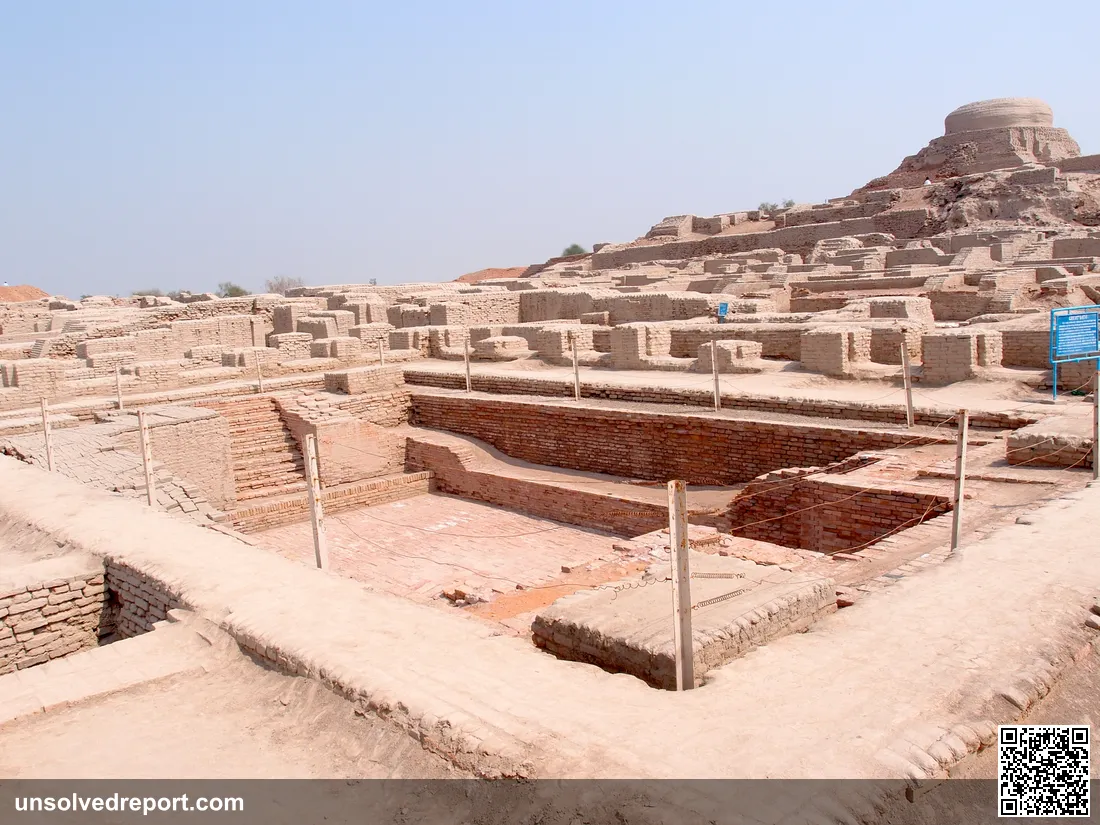
Around 2500 BCE, in what's now Pakistan, one of the great cities of the Indus Valley Civilization hummed with life. Mohenjo-daro had brick streets on a grid, sophisticated drainage, and a famous Great Bath. It may have held 40,000 people — a true rival to the cities of Mesopotamia and Egypt.
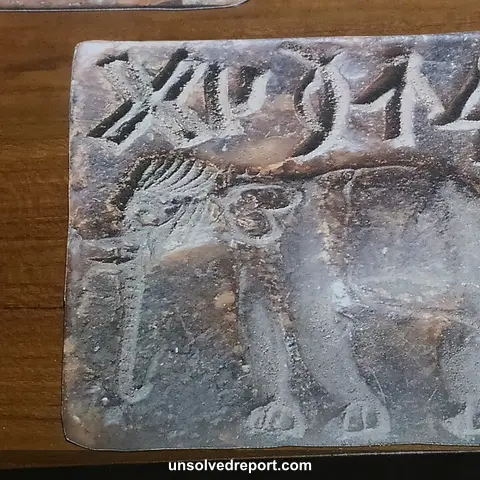
Now here's the haunting part. We have thousands of their seals, covered in their writing. And we cannot read a single word of it. The Indus script has never been deciphered — which means we can't recover one name, one prayer, one law. An entire civilization is right there in front of us, and completely silent. Even the slow decline that finally ended it is still up for debate.
4. Petra: the city carved from rose-red rock
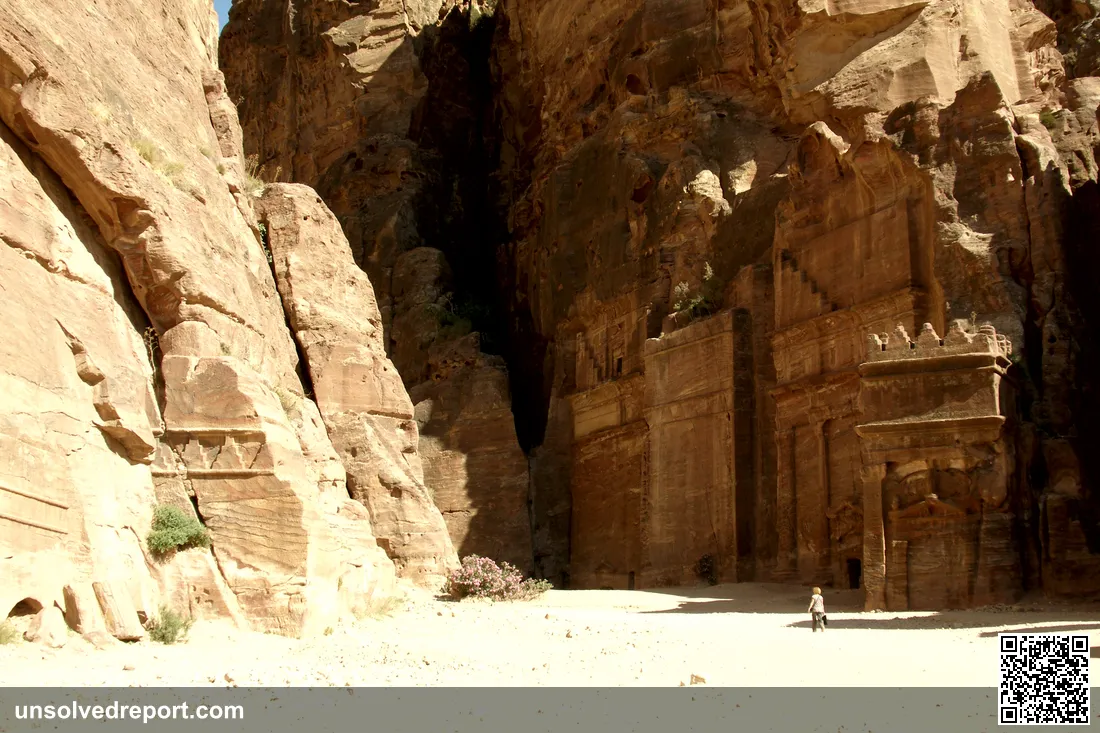
A whole capital, chiseled straight into rose-colored sandstone cliffs, deep in the desert of modern Jordan. That was Petra, the rich heart of the Nabataean kingdom — a desert people who grew wealthy by controlling the incense and spice routes. Their real genius wasn't the carving, stunning as it is. It was water. In a place with almost none, Nabataean engineers caught flash floods and funneled them into cisterns — enough to keep a city of perhaps 20,000 people alive.
Then Rome swallowed the kingdom. The trade routes drifted elsewhere. A major earthquake in 363 CE shattered much of what was left. Petra faded — so thoroughly that the wider world simply forgot it until 1812. How they mastered water in a wasteland, and how a city that spectacular could just slip out of memory for centuries, still keeps researchers awake at night.
5. Pavlopetri: streets you can swim through
Off the coast of southern Greece, in just a few meters of water, lies what may be the oldest sunken city ever found. You can still trace its streets, its courtyards, its tombs on the seabed — the whole layout lying there like a drowned blueprint. Pavlopetri was a real, working Bronze Age town, lived in for well over a thousand years before it went under. It's so intact that archaeologists have drawn up detailed maps of the entire plan.
The question that lingers: when did it sink, and what pushed it under? Slowly rising seas and a run of earthquakes are the prime suspects. But the precise moment that ended life in those streets is still being reconstructed, one survey at a time.
6. Mes Aynak: buried treasure on top of buried treasure
Under a copper-rich mountain in Afghanistan lies an entire ancient Buddhist city — monasteries, stupas, painted statues, and the traces of the very mining operation that may have made it rich in the first place. It sat right on the Silk Road and thrived for centuries before it was abandoned, possibly even before the region's later upheavals swept through.
And now the mystery comes doubled. Archaeologists still argue over why such a prosperous religious and mining hub was ever left to the desert. But there's a second, ticking question on top of that one: the site sits atop one of the world's largest copper deposits. Which turns the whole place into a race — excavation against extraction, the past against the drill.
7. Çatalhöyük: the town with no streets
Now go back further. Way back. Around 7500 BCE, in central Turkey, a settlement took root that would grow to thousands of people crammed together in one of the earliest proto-cities we know of (Wikipedia) — and it had no streets at all. None. Homes were jammed wall to wall. To get inside, you climbed down through a hole in your roof, and you got around town by walking across the rooftops, like an upper street made of houses. And the dead? Buried right beneath the floors people slept on.
Why would anyone choose to live like this — dense, doorless, with no obvious palaces and no central boss anywhere in sight? And why did they eventually walk away from it? It's one of the most chewed-over puzzles in the whole study of how humans first learned to build towns.
8. Akrotiri: the town with no bodies
On the Greek island of Santorini, a Bronze Age town vanished under volcanic ash when the Thera volcano erupted catastrophically around 1600 BCE. The ash sealed everything — multi-story buildings, vivid wall paintings — in a way that gets it compared to Pompeii. But there's one chilling difference.
No bodies. So far, not a single human remain has turned up inside Akrotiri. That emptiness is the mystery. It hints that the people read the warning signs — the tremors, the rumbling — and fled before the mountain blew. But fled to where? Did they actually make it out alive? And how far did the shockwaves of that disaster ripple through the wider Aegean world? Still open. Still unanswered.
9. Helike: the city that inspired Atlantis
One night in 373 BCE, the prosperous Greek coastal city of Helike ceased to exist. An earthquake struck, a wave came in off the sea, and together they destroyed the city, dragged it underwater, and killed the people in it. Ancient writers later described the drowned ruins still visible beneath the surface — and the catastrophe is often named as one of the sparks behind the legend of Atlantis.
For centuries, Helike hovered somewhere between history and myth. Then archaeologists found destruction layers in the region, and the half-legend turned real. The work now is matching those ruins precisely to the famous classical accounts — and figuring out exactly what kind of wave reached up and took the city.
10. Sijilmasa: the gateway to the gold
On the northern lip of the Sahara, in Morocco, stood a fabled caravan city — the place where gold and salt crossed the desert. For roughly 600 years, Sijilmasa was a hub of trans-Saharan trade, and at its peak it was famous across the medieval Islamic world as the spot where the great desert routes began. The doorway to the wealth of the Sahara itself.
And then it declined, and was largely abandoned. Historians still argue over the exact mix that emptied it — political conflict, shifting trade, environmental pressure, or all three grinding together until the city whose name meant "gold" became sand and silence.
11. Caral: the peaceful city that shouldn't exist yet
In a dry valley north of Lima, Peru, sit the remains of one of the oldest cities in all the Americas — dated to around 2600 BCE. That's astonishingly early. And it's no humble settlement: monumental platform mounds, sunken plazas, the clear fingerprints of a complex society. The strange, almost tender detail? Archaeologists have found no fortifications and barely any signs of warfare.
So how did this society hold together without obvious force keeping everyone in line? Why was Caral eventually abandoned? And how on earth did a city this sophisticated rise so early in the Americas — with so little trace of conflict to explain it? All of it is still a live debate.
12. Vijayanagara: the richest city that emptied in a flash
In the early 1500s, Vijayanagara — centered on modern Hampi — may have been among the largest and richest cities on the planet. Foreign travelers came and gawked at its markets and its temples, writing home about the sheer scale of the place.
Then came 1565, and a major military defeat. The city was sacked and largely abandoned, its vast stone temples and palaces left to crumble among the boulders of the landscape. How does a metropolis that enormous empty out so fast? And how much of its daily life, its economy, its noise and bustle, is still locked inside those ruins, waiting to be read? Historians are still working on it.
Every one of these places was once the whole center of someone's world — loud with markets, prayers, gossip, arguments, music — and every one of them slipped clean out of living memory, until the ground or the sea finally handed it back. Pick the one that unsettles you most, and follow it into its own case file. Because with lost cities, the deepest mysteries are always hiding in the details.
2026: Hampi is still handing over new pieces of Vijayanagara
The Vijayanagara story above isn't a closed file. In a report dated May 30, 2026, the Archaeological Survey of India detailed fresh excavations near Hampi's Hazara Rama Temple and its Jain temple complex: a stone-built drainage channel likely used to route monsoon rainwater and possibly for ritual purification, structural remains of a Jain temple roof measuring roughly 4.35 by 4.26 meters, and two broken Alvar sculptures. ASI's superintending archaeologist K. Ramakrishnan Reddy called the drainage system evidence of "the remarkable engineering capabilities of Vijayanagara architects" (Organiser). None of it explains why the empire's richest city emptied so fast after 1565 — but it's a reminder that Hampi's ruins keep giving up new physical evidence of daily life, faith, and engineering, seven years shy of five centuries later.
What twelve dead cities have in common
Lay these cases side by side and a pattern jumps out: almost none of these cities was killed by a single blow. The ones we can explain best were finished off by water — either water arriving (Thonis-Heracleion, Pavlopetri, Helike, drowned by some mix of rising seas, earthquakes, and liquefying ground) or water leaving (Petra and Sijilmasa, desert cities whose survival depended on catching and routing every drop, undone once the trade that funded that effort moved on). The hardest cases are the ones that emptied while the wells were still full — Cahokia, Çatalhöyük, Caral — where no single disaster shows up in the ground and the cause has to be reconstructed from what people did, not from what struck them.
A second split runs through the list: how much a city can still tell us about itself. Some of these ruins are mute by accident of preservation, but two are silenced by something deeper — an undeciphered script. That's why Mohenjo-daro stands apart. It isn't just abandoned; it's unreadable, and until the Indus script is cracked, its decline can only ever be guessed at from bricks and drains rather than read from its own records.
| City | The core unsolved question | Best-supported status / explanation |
|---|---|---|
| Cahokia | Why did North America's largest pre-Columbian city empty within ~200 years? | Unresolved; drought, flooding, deforestation, political collapse and disease all proposed, no writing to confirm |
| Thonis-Heracleion | How did Egypt's main trade gateway sink into Aboukir Bay? | Best-explained: rising seas, earthquakes and soil liquefaction; exact sequence still being reconstructed off the seafloor |
| Mohenjo-daro | Why did this Indus metropolis decline — and what did its people say? | Doubly open: decline still debated, and its script remains undeciphered |
| Petra | How did a city thrive on almost no water, then be forgotten for centuries? | Water engineering caught flash floods into cisterns; faded after Rome annexed it, trade shifted, and a 363 CE earthquake struck; unknown to the wider world until 1812 |
| Pavlopetri | When and why did the oldest known sunken city go under? | Prime suspects: gradual sea-level rise and repeated earthquakes; exact timing still being surveyed |
| Mes Aynak | Why was a rich Silk Road Buddhist-mining city abandoned? | Unresolved — and now racing extraction, as it sits atop one of the world's largest copper deposits |
| Çatalhöyük | Why build a dense, doorless, ruler-less town with no streets — then leave it? | One of the oldest open questions in the study of early urban life; no consensus |
| Akrotiri | Where did its people go before Thera erupted (~1600 BCE)? | No bodies found, suggesting an advance evacuation; their fate and the eruption's wider reach still unknown |
| Helike | What kind of wave destroyed it in 373 BCE (and inspired Atlantis)? | Confirmed real by regional destruction layers; work continues matching ruins to classical accounts |
| Sijilmasa | What emptied the Saharan "gateway to the gold" after ~600 years? | Debated mix of political conflict, shifting trade routes and environmental pressure |
| Caral | How did so complex a city arise so early (~2600 BCE) with little sign of warfare? | Live debate; no fortifications and scant evidence of conflict complicate every model |
| Vijayanagara | How did one of the world's richest cities empty so fast? | Sacked after a major military defeat in 1565, then abandoned; much of its daily life still unexcavated |
Frequently Asked Questions
What is the most mysterious lost city in the ancient world?
There's no single answer, but Mohenjo-daro stands out because it's doubly unsolved: archaeologists debate why the Indus Valley metropolis declined, and its writing system has never been deciphered, so its own people can't testify to what happened (Wikipedia: Indus script).
Are these lost cities real, or are they legends like Atlantis?
They're real. Every city on this list has been physically excavated, mapped, radiocarbon-dated, or recovered from the seabed by archaeologists — Thonis-Heracleion, for instance, was confirmed by divers in Aboukir Bay in 2000 after being dismissed for decades as a myth stitched from old Greek texts (Wikipedia: Thonis-Heracleion).
Why did so many ancient cities get abandoned?
The causes vary but cluster around two patterns: water either arriving catastrophically (rising seas, earthquakes, and tsunamis at Thonis-Heracleion, Pavlopetri, and Helike) or leaving as trade routes shifted (Petra and Sijilmasa, desert cities that depended on engineered water systems). Others, like Cahokia, emptied gradually, with drought, flooding, deforestation, political collapse and disease all proposed and no single cause confirmed (Wikipedia: Cahokia).
Has a lost ancient city been discovered recently?
Archaeologists are still actively excavating known lost cities. In a report dated May 30, 2026, the Archaeological Survey of India documented new finds at Vijayanagara's Hampi ruins, including a drainage system and Jain temple remains (Organiser).
Which ancient city vanished with no bodies found?
Akrotiri, on the Greek island of Santorini, was buried by the Thera volcanic eruption around 1600 BCE, but excavators have never found a single human remain inside it — suggesting residents fled before the eruption, though where they went and whether they survived remains unknown (Wikipedia: Akrotiri (Santorini))).
Why can't archaeologists read the Indus Valley script found at Mohenjo-daro?
There is no bilingual text, or "Rosetta Stone," pairing the Indus script with a known language, and the surviving inscriptions are extremely short, which leaves too little material to reconstruct grammar or vocabulary with confidence (Wikipedia: Indus script).
Original Data: How Long Did Four Lost Cities Last? Two Published Answers Each
The table below compares what Wikipedia and a second, separate source say about four cities from this list, then subtracts the dates to get a span in years.
| City | Dates per Wikipedia | Span, Wikipedia dates (our calculation) | Dates per second source | Span, second source (our calculation unless stated) | Sources |
|---|---|---|---|---|---|
| Cahokia | Settled around 600 CE; abandoned by 1350 CE | 750 years (1350 − 600) | World History Encyclopedia: "flourished between c. 600-c. 1350 CE" | 750 years (1350 − 600) | Wikipedia; World History Encyclopedia |
| Çatalhöyük | Existed from around 7500 BC to 5600 BC | 1,900 years (7500 − 5600) | World History Encyclopedia: "c. 7500-5600 BCE" | 1,900 years (7500 − 5600) | Wikipedia; World History Encyclopedia |
| Mohenjo-daro | Built c. 2500 BCE; abandoned by c. 1700 BCE | 800 years (2500 − 1700) | National Geographic: "heyday from about 2500 to 1900 B.C." | 600 years (2500 − 1900), heyday only | Wikipedia; National Geographic |
| Caral | Inhabited from around 2600 BC to 2000 BC | 600 years (2600 − 2000) | UNESCO advisory-body evaluation: "occupied for approximately 1,000 years" within a 3000-1800 B.C. period | About 1,000 years (as stated); the 3000-1800 B.C. window is 1,200 years (3000 − 1800) | Wikipedia; UNESCO evaluation (PDF) |
For Cahokia and Çatalhöyük the two sources give the same dates, and Çatalhöyük's 1,900 years is about 2.5 times Cahokia's 750 (1,900 ÷ 750 = 2.53, our calculation). For Caral, the UNESCO figure of roughly 1,000 years is 400 years longer than the 600 years that Wikipedia's dates give (1,000 − 600, our calculation). Mohenjo-daro's two spans differ by 200 years (800 − 600, our calculation), but they do not measure the same thing: one runs from construction to abandonment, the other covers only the city's heyday.
How We Compiled This
- Sources. Each city's Wikipedia article, plus one other publisher: World History Encyclopedia (Cahokia, Çatalhöyük), National Geographic (Mohenjo-daro) and the UNESCO World Heritage advisory-body evaluation of the Sacred City of Caral-Supe (Caral).
- Definitions. "Span" is the number of years between the two dates a source gives. The Mohenjo-daro National Geographic dates describe the city's "heyday," not its entire occupation. The Caral UNESCO figure is a stated duration ("approximately 1,000 years"), not a subtraction of two dates.
- How calculated. Span = earlier year minus later year for BCE dates (for example 7500 − 5600 = 1,900) and later year minus earlier year for CE dates (1350 − 600 = 750). All dates are the rounded "c." or "around" values the sources print, and no span crosses from BCE into CE, so the missing year zero does not matter.
- Limitations. Only four of the twelve cities in this article are covered. Dates are approximate and are the sources' own figures, so the spans are approximate too.
📌 Data status: verified 2026-09-29.
Sources & further reading
Indus Script Undeciphered: The 4,000-Year Code Nobody Can Crack
Thousands of Indus Valley seals. Over 100 failed attempts. A $1 million prize still unclaimed. So what is this ancient script actually hiding?
Classic Maya Collapse Mystery: One City Didn't Even Have Drought
Tikal and Copán emptied by 900 CE, population fell 90%. Now a 2025 lake-sediment study found one city collapsed with no drought at all. So why did it fall?
Carthage's Tophet: Sacrificed Babies or a Misread Cemetery?
20,000 burnt infant urns sit beneath Tunis. Ritual child sacrifice to the gods, or a cemetery for babies who died naturally? Scientists can't agree.