Nebra Sky Disc: The Bronze Age Star Map Looters Nearly Erased
The Nebra Sky Disc may be the oldest star map on Earth — but looters buried its proof. Is it 3,600 years old, or a thousand years younger than we think?
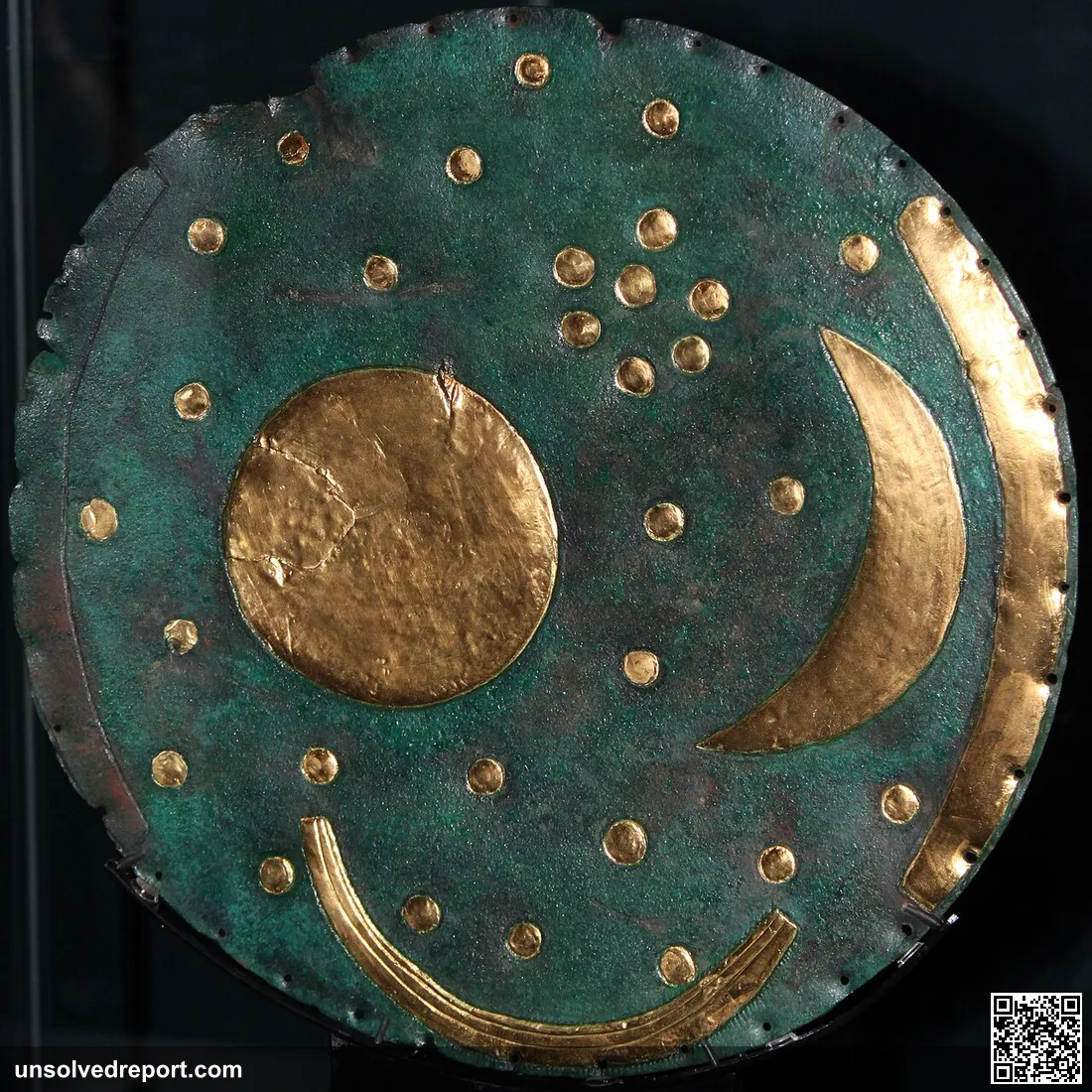
It fits in your palm. Dark bronze, cold and heavy, scattered with tiny golden suns and stars hammered straight into the metal. It looks weirdly modern — like something you'd buy in a planetarium gift shop. But you couldn't. There's only one, and the museum that guards it makes a staggering claim: this little disc may be the oldest concrete depiction of astronomical phenomena anywhere in the world (State Museum of Prehistory, Halle) — a rank it holds a full millennium before the Antikythera Mechanism baffled anyone. Stop and sit with that. More than three thousand years ago — before writing had even reached central Europe — someone looked up, understood what they saw, and pinned the sky down in gold. How? That question still hasn't been fully answered. Researchers have now reconstructed exactly how it was forged — but the disc's whole life story, from the dirt it came out of to the courtrooms it ended up in, only makes it stranger.
> The 60-Second Brief
> - The disc measures roughly 30 to 32 centimeters across and weighs about 2.2 kilograms.
> - It was looted illegally from the Mittelberg hill near Nebra, Germany, in 1999, and recovered in a 2002 police sting in Basel.
> - Its two gold horizon arcs span about 82 degrees — precisely the angle between solstice sunrise and sunset at 51°N, the disc's own burial latitude.
> - The standard dating places its burial around 1600 BC; a 2020 challenge argued it could be 1,000 years younger, from the Iron Age.
> - It was inscribed on the UNESCO Memory of the World Register in June 2013.
> - A November 2024 study, validated through 2025 replica-forging experiments, showed smiths cast the disc above 1,200°C then forged it roughly ten times, reheating to about 700°C each time.
What We Actually Know
It starts with a crime. Summer, 1999. Two men with metal detectors and no permit are digging on the Mittelberg hill, near the town of Nebra in Saxony-Anhalt, Germany — and they pull the disc out of the ground illegally (State Museum of Prehistory, Halle). No careful excavation. No record of where it lay, how deep, or what touched it. Just two looters and a treasure they couldn't legally own. So they sold it. The disc vanished into the black market, changing hands again and again, until 2002, when Saxony-Anhalt's state archaeologist helped spring a police sting operation in Basel, Switzerland to grab it back (Wikipedia summary of court records; CNN). The finders were convicted. They appealed — and their sentences were bumped up to six and twelve months (Wikipedia).
Now hold the thing itself. It's small: roughly 30 to 32 centimeters across — about a foot — and around 2.2 kilograms in your hands (Wikipedia; State Museum of Prehistory). Bronze, inlaid with gold. There's a big circle — read as the sun or full moon — a crescent moon, and stars flung across the surface. And among them, a tight little knot of seven, which most people read as the Pleiades, the same star cluster you can find tonight with your naked eye (The Past / British Museum feature).
Here's something most people miss: it wasn't made in one go. Scientific study shows the disc grew in stages, almost like a sketch reworked over generations. First came the original layout — about 32 gold circles, plus the sun/moon and crescent. Then two gold horizon arcs were added along the edges. Then a curved arc at the bottom, often called a sun barge or solar boat. And finally, a ring of small holes punched all around the rim (Wikipedia). One of the side arcs is gone now — lost somewhere in the disc's long, shadowy journey.
And the metals in it had already traveled an astonishing distance before they were ever hammered into a sky. The copper came from the eastern Alps — the Mitterberg/Bischofshofen region of Austria. The gold and tin trace back to Cornwall, in the far southwest of England, the gold pinned specifically to the River Carnon (Wikipedia; The Past). Picture that for a second. A single ritual object, pulling metals across hundreds of miles of Bronze Age Europe and fusing them into one small image of the heavens — the same kind of improbable, long-haul transport that put Stonehenge's altar stone 450 miles from where it was quarried.
Then there's the detail that genuinely raises the hair on your neck. The two horizon arcs cover an angle of about 82 degrees. That's not random. That's the exact angle between where the sun rises and where it sets at the summer and winter solstices — and not just anywhere, but at the latitude of the Mittelberg, about 51 degrees north (Wikipedia). The hill where it was buried. Whoever made this had measured their own sky. That match is real, measurable, and nobody disputes it.
The world noticed. In June 2013, the Nebra Sky Disc was inscribed on the UNESCO Memory of the World Register (State Museum of Prehistory, Halle). You can stand in front of it today, on permanent display in Halle.
The Question Nobody Can Close
Here's where the solid ground gives way. Remember the crime? It comes back to haunt everything.
Because the disc was looted instead of excavated, scholars can't fully rebuild its archaeological context — the dirt, the layers, the exact spot, the things lying next to it. And context is precisely how archaeologists normally nail down a date. The looters took that knowledge to the grave of the black market.
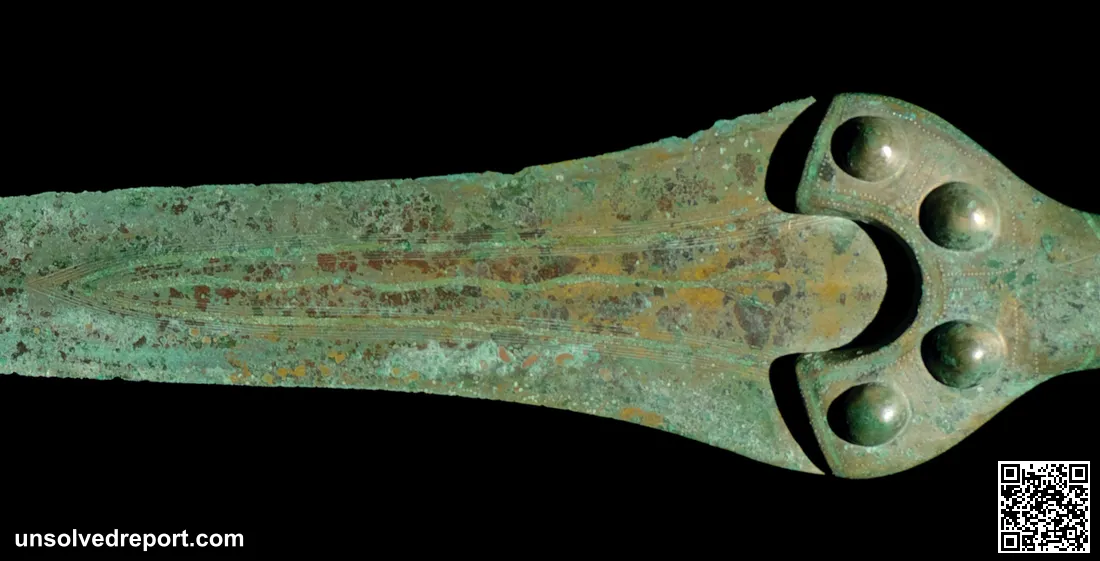
The standard story leans on the swords, axes, and bracelets said to have been buried with the disc. It puts the burial around 1600 BC, at the tail end of central Europe's Early Bronze Age — with the disc itself maybe made a century or two before that (State Museum of Prehistory; Austrian Academy of Sciences).
Then, in 2020, two archaeologists threw a grenade into that consensus. Rupert Gebhard and Rüdiger Krause went public with a sharp challenge. They argued the find was never a securely "closed" deposit — that the disc might not even come from the spot the finders pointed to — and that, treated as one uncertain stray object, it could actually belong to the Iron Age. A thousand years younger than everyone thought (Smithsonian Magazine; CNN) — the same kind of stubborn, decades-long argument over a single number that still surrounds Ban Chiang's Bronze Age dating.
The Halle team did not take that quietly. Researchers including Ernst Pernicka hit back hard in Archaeologia Austriaca, arguing the challenge brought no new data, leaned on selectively cited material, and that geochemical and other analyses confirm the Early Bronze Age date after all (Austrian Academy of Sciences). Then in 2024, a metallurgical study in Scientific Reports dug into how the disc was actually crafted — and that, too, lined up with the older dating (Nature, Scientific Reports).
So where does it stand? Most specialists still back the Bronze Age. But — and this is the honest part — the looted origin means the argument sits over a genuine hole in the evidence, not a wall of stubbornness. That gap is the true heart of the Nebra mystery. We may never be completely certain how old the oldest sky in the world really is.
So What Was It For?
The age is one puzzle. The meaning is another — and here we're firmly in the land of careful guesses. What follows are informed readings, not proven facts. Even the British Museum treats them as plausible, never settled.
Idea one: a working sky calendar. Researchers Wolfhard Schlosser and Rahlf Hansen suggested the relationship between the crescent moon and the Pleiades cluster wasn't decoration at all — it was a rule. A rule for when to slot in a leap month, keeping a lunar calendar from drifting out of step with the solar year, much like the intercalation tricks the Babylonians used much later (The Past). It's a beautiful idea. It's also a reach, and the British Museum says so plainly: the reading "does require a leap of faith" (The Past).
Idea two: a portable observatory. Those 82-degree arcs may mark exactly where the sun rises and sets at the solstices — turning the disc into a pocket-sized model of the sky as seen from the Mittelberg (Wikipedia). The geometry, again, is real. Whether the makers meant it as an instrument — that's the leap.
Idea three: science slowly turning into myth. Some scholars read those four building phases as a story in themselves — a drift away from cold observation and toward religion. That late sun barge echoes the solar-boat imagery found in other ancient cultures, as if, over time, the disc stopped being a tool and became something sacred (The Past).
Whatever it truly meant, one thing isn't in doubt, and it's quietly astonishing: Bronze Age people — the same world that would later be upended by the Sea Peoples — watched the heavens with real attention, gathered metals carried clear across a continent, and decided the sky deserved to be set in gold. The biggest questions — exactly how old, exactly what it meant — are still wide open. Which leaves you holding the same question they must have felt, looking up at the same Pleiades: what else were they trying to tell us, and what else is still waiting in the ground?
2024–2025: researchers rebuilt the disc from scratch to learn how it was forged
Dating the disc has to rely on circumstantial evidence, because looters destroyed the archaeological context. But a separate question — how was it physically made — has just been answered directly. A team led by Professor Thorsten Halle at Otto von Guericke University Magdeburg used scanning electron microscopy and electron backscatter diffraction on the original disc, published in Scientific Reports in November 2024, and found its bronze had been cast above 1,200°C and then forged roughly ten times, with repeated reheating to about 700°C to keep the metal workable without cracking. In June 2025, the team went further: working with master coppersmith Herbert Bauer, they forged full-scale replicas using only Bronze Age tools and techniques, then compared the replicas' microstructure to the original under identical analysis — confirming the reconstructed method actually works (Archaeology News Online Magazine). The team is now developing a portable eddy-current scanning app so researchers can test other ancient metal artifacts for similar manufacturing signatures without damaging them. It doesn't resolve the Bronze Age vs. Iron Age dating fight — but it does mean we now know, with unusual confidence, exactly how Bronze Age hands turned raw bronze and gold into a map of the sky.
Frequently Asked Questions
How old is the Nebra Sky Disc really?
Most specialists date its burial to around 1600 BC, in the Early Bronze Age, based on the swords, axes, and bracelets said to be buried alongside it. A 2020 challenge argued the disc could be roughly 1,000 years younger, from the Iron Age, but geochemical and metallurgical analyses published since have continued to support the older Bronze Age date (Austrian Academy of Sciences).
Why is the Nebra Sky Disc's dating so controversial?
Because it was illegally looted by treasure hunters in 1999 rather than professionally excavated, archaeologists lost the original context — the exact location, depth, and surrounding objects — that normally anchors a secure date. That gap is what let researchers Rupert Gebhard and Rüdiger Krause argue in 2020 that the find was never a securely "closed" deposit (Smithsonian Magazine).
What do the gold arcs on the Nebra Sky Disc actually represent?
The two horizon arcs span about 82 degrees, which matches the exact angle between sunrise and sunset at the summer and winter solstices as seen from the disc's own burial latitude of roughly 51 degrees north. That geometric match is measurable and undisputed, though whether the makers intended it as a working instrument is still debated (Wikipedia).
How do we know how the Nebra Sky Disc was made?
A 2024 study from Otto von Guericke University Magdeburg used electron microscopy on the original disc to show it was cast and then forged roughly ten times with repeated reheating. In 2025, the same team validated that process by forging full-scale replicas with a master coppersmith using only Bronze Age tools (Archaeology News Online Magazine).
Where can you see the Nebra Sky Disc today?
It's on permanent display at the State Museum of Prehistory in Halle (Saale), Germany. It was inscribed on the UNESCO Memory of the World Register in June 2013 (State Museum of Prehistory, Halle).
Were the people who found the Nebra Sky Disc punished?
Yes. The two looters who illegally excavated it with metal detectors in 1999 were convicted after a 2002 police sting recovered the disc in Basel, Switzerland; on appeal, their sentences were increased to six and twelve months (Wikipedia).
Original Data: Putting Three "Oldest Sky" Record-Holders on One Timeline
Three different objects are each credited as the "oldest" of their kind in the story of humans tracking the heavens, but no single source lines up their dates side by side to show how far apart they actually sit. The table below pulls the published date for each object and calculates the time gap between them and the Nebra Sky Disc's own burial date.
| Object | Type of "oldest" claim | Approximate date | Gap to Nebra Sky Disc | Source |
|---|---|---|---|---|
| Warren Field pit alignment, Aberdeenshire, Scotland | Oldest lunisolar calendar yet found | built about 8,000 BCE | 6,400 years before Nebra's ~1,600 BC burial (8,000 − 1,600, our calculation) | Wikipedia, "Warren Field" |
| Nebra Sky Disc | Oldest concrete depiction of astronomical phenomena | burial dated to about 1,600 BC (the museum page itself says the disc gives insight into the world "3,600 years ago") | reference point (0) | State Museum of Prehistory, Halle; Wikipedia, "Nebra sky disc" |
| Antikythera Mechanism | Oldest known example of an analogue computer | variously dated to about 87 BC, between 150 and 100 BC, or 205 BC; construction predates a shipwreck dated to about 70–60 BC | 1,450–1,500 years after Nebra, using the 150–100 BC estimate (1,600 − 150 = 1,450; 1,600 − 100 = 1,500, our calculation) | Wikipedia, "Antikythera mechanism" |
Lined up this way, the three "oldest" titles describe three different kinds of object, not one continuous race: Warren Field is a set of pits interpreted as a calendar monument, built 6,400 years before Nebra's burial; the Antikythera Mechanism is an analogue computer built roughly 1,450 to 1,500 years after Nebra's burial on the 150–100 BC estimate. That second figure is consistent with this article's framing of Nebra's head start over the Antikythera Mechanism as "a full millennium," and longer than it by four to five centuries.
How We Compiled This
- Sources. Wikipedia's "Warren Field" article, the State Museum of Prehistory (Halle)'s official page on the Nebra Sky Disc, Wikipedia's "Nebra sky disc" article (for the burial date), and Wikipedia's "Antikythera mechanism" article.
- Definitions. Each object holds a differently defined "oldest" record: Warren Field for a lunisolar calendar, the Nebra Sky Disc for a concrete depiction of astronomical phenomena, and the Antikythera Mechanism for an analogue computer. These are not the same category of artifact, so the comparison is a timeline of related "firsts," not a ranking of equivalent objects.
- How calculated. Time gaps were calculated by simple subtraction of BC/BCE year values (e.g., 8,000 BC − 1,600 BC = 6,400 years; 1,600 BC − 150 BC = 1,450 years; 1,600 BC − 100 BC = 1,500 years), using the Nebra Sky Disc's burial date of roughly 1,600 BC as the reference point.
- Limitations. The Nebra disc itself may have been made before its ~1,600 BC burial (Wikipedia gives circa 1800–1600 BC for the disc), so measured from manufacture instead the gaps would be larger. The Antikythera Mechanism's construction date is debated, with Wikipedia listing about 87 BC, between 150 and 100 BC, and 205 BC, so the 1,450–1,500-year gap reflects the 150–100 BC estimate only, not a settled figure.
📌 Data status: verified 2026-09-29.
Sources & further reading
- State Museum of Prehistory, Halle (Saale): The Nebra Sky Disc
- Austrian Academy of Sciences (ÖAW): The Nebra Sky Disc dates from the Early Bronze Age
- The Past / British Museum feature: Decoding a prehistoric vision of the cosmos
- Smithsonian Magazine: Is This Ancient Map of the Cosmos Younger Than Previously Thought?
- CNN: The Nebra sky disc and its sordid history
- Scientific Reports (Nature): Archaeometallurgical investigation of the Nebra Sky Disc
- Wikipedia (for consolidated specifications and court record summary): Nebra sky disc
- Archaeology News Online Magazine: Ancient manufacturing secrets of the Nebra Sky Disc reconstructed by researchers (June 2025)
Dancing Girl of Mohenjo-daro: Why Her Identity Is Still Unsolved
A four-inch bronze girl outlasted 4,000 years of silence — then made 2026 headlines when a textbook altered her body. Nobody has ever known her name.

Sanxingdui Bronze Masks Mystery: China's Buried, Burned Gods
Sanxingdui's bronze masks bulge eyes on stalks and hide a 3,000-year secret — smashed, burned, buried by their makers. Why destroy your own gods?

Rongorongo: The Writing No Living Person Can Read
Easter Island's rongorongo script has 15,000 glyphs and zero living readers. A 2024 test just rewrote its origin story. Can it ever be deciphered?