Sanxingdui Bronze Masks Mystery: China's Buried, Burned Gods
Sanxingdui's bronze masks bulge eyes on stalks and hide a 3,000-year secret — smashed, burned, buried by their makers. Why destroy your own gods?
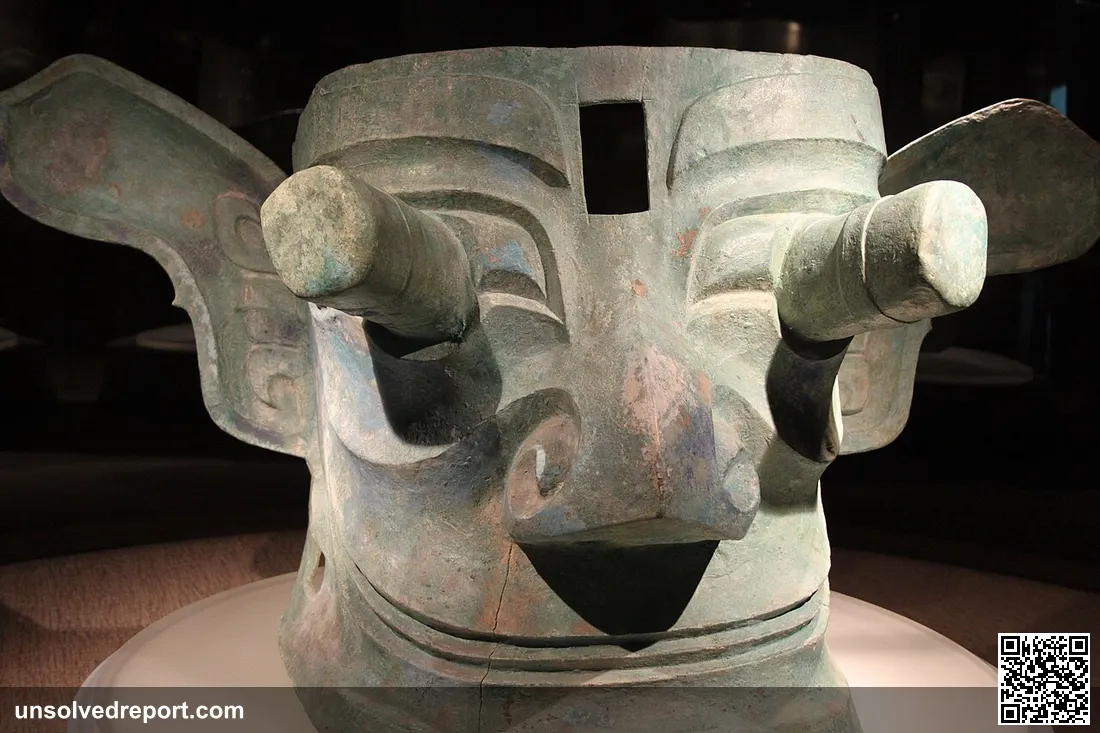
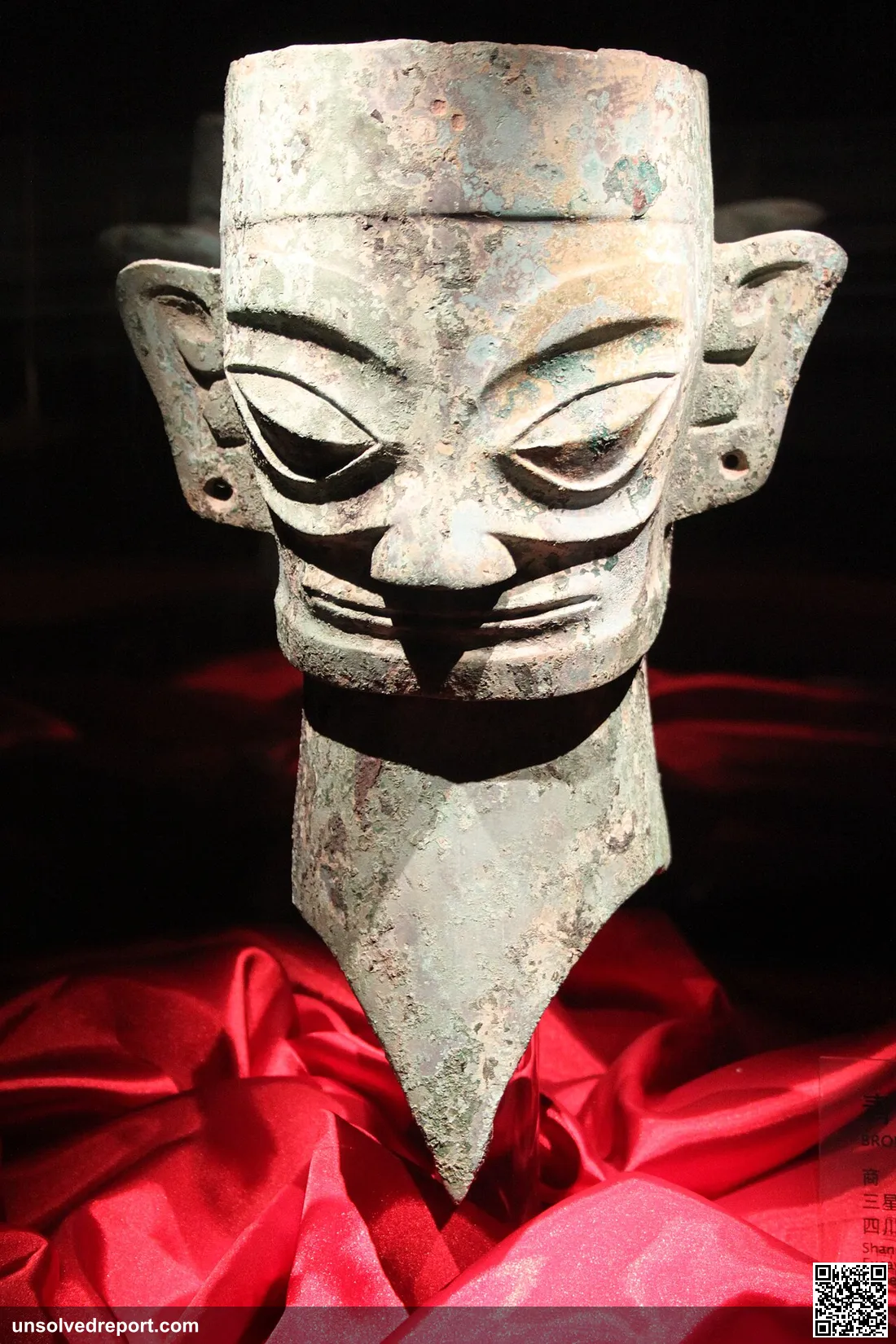
Summer, 1986. Brickyard workers are digging clay near the village of Sanxingdui in Sichuan, China, when a shovel hits something that isn't clay. It's hard. It's metal. And when they clear the dirt away, a face is staring back at them — a bronze face, with knife-sharp cheekbones, ears spread like wings, and eyes that bulge out on stalks.
Then they find another. And another. Dozens of them. Some still wearing masks of beaten gold.
The faces are roughly 3,000 years old. And here's the part that will keep you up at night: almost everything you'd want to know about the people who made them is gone. Their name for themselves. A single word of their language. Gone. The faces survived. The story did not.
This is the Sanxingdui mystery — a civilization rich enough to pour some of the most ambitious bronzes in the ancient world, yet one that left no readable text, no royal tombs, and no note explaining why it smashed its own gods, set them on fire, and buried them in pits.
> The 60-Second Brief
> - Workers opened Pit No. 1 on July 18, 1986, and Pit No. 2 barely a month later, on August 14, 1986 (World Archaeology).
> - Those first two pits alone held more than 1,000 objects of gold, bronze, jade, and ivory (World Archaeology).
> - Between 2020 and 2022, archaeologists opened six more sacrificial pits, pulling out thousands more relics (Archaeology Magazine).
> - The largest bronze mask stands about 65 cm tall and 138 cm wide, with eyes jutting roughly 16 cm out from the face (Sanxingdui Archaeology).
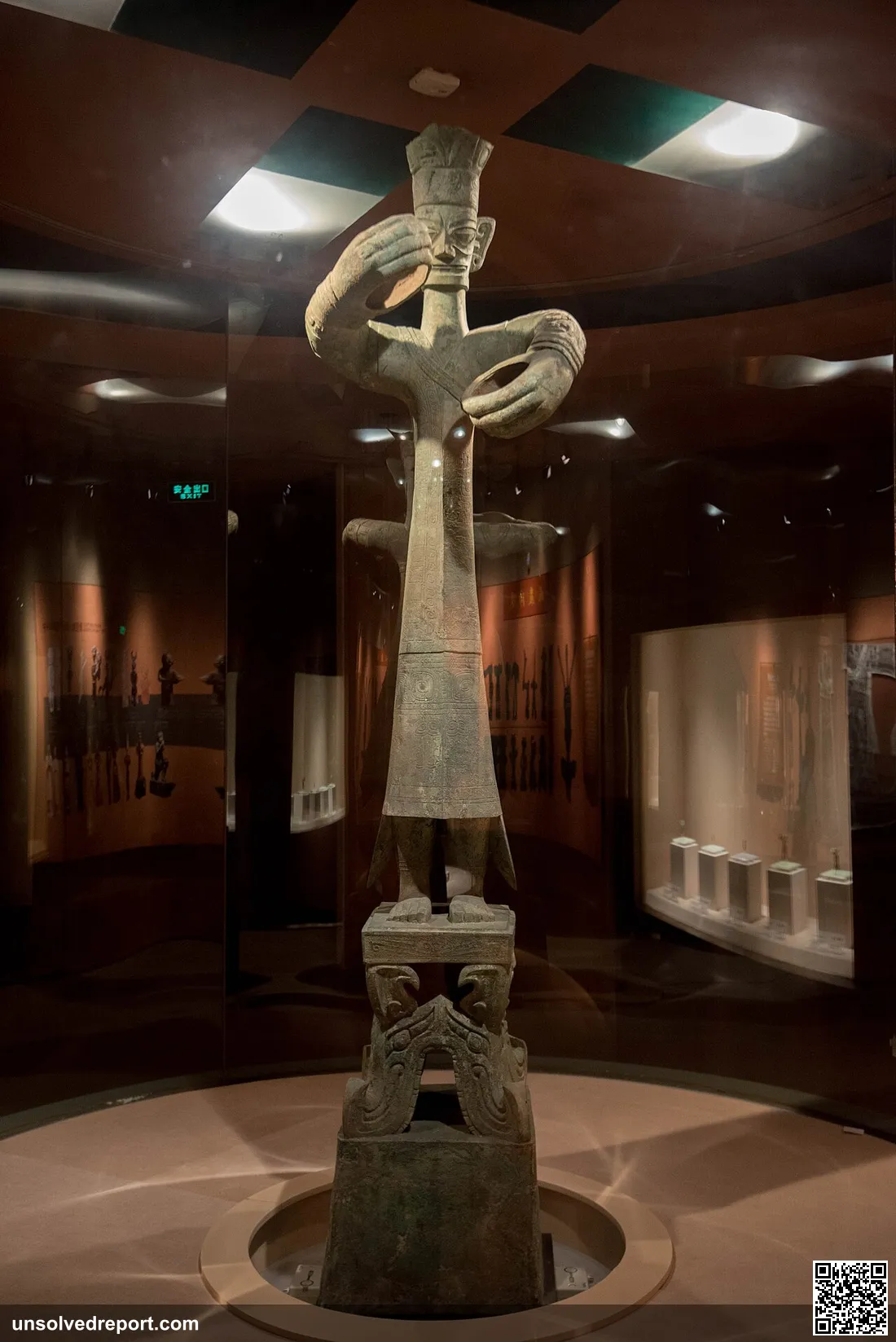
> - The pits also held a 260 cm-tall bronze figure weighing about 180 kg and a bronze "sacred tree" reaching 396 cm into the air (Wikipedia).
> - A 2025 joint study found a 95.4 percent probability that four of the pits were buried between 1201 and 1012 BC, in a single coordinated event (CGTN).
What we actually dug up
The first whisper came decades before the faces. Around 1927, a local farmer cleaning out an irrigation ditch pulled up a cache of jade, and a preliminary dig followed in 1934 (Wikipedia, "Sanxingdui"). Then it went quiet — for half a century.
1986 is when the ground gave up everything. Pit No. 1 opened on July 18. Less than a month later, on August 14, Pit No. 2 turned up just meters away (World Archaeology). Between the two pits: over a thousand objects of gold, bronze, jade, and ivory.
And the ground wasn't done. Between 2020 and 2022, archaeologists cracked open six more sacrificial pits, hauling out thousands more relics and yanking the whole world's attention back to a quiet corner of Sichuan (Archaeology Magazine, Nov/Dec 2024).
Now picture the masks. Nothing else in the whole sweep of early Chinese art looks like them. Sharp, angular human features. Huge almond eyes, some with pupils that push right out of the face. Big upper ears. Many still carry black paint around the eyes and vermilion on the lips, as if someone had made them up to be seen (Wikipedia). The wildest of them all — the great Bronze Mask with Protruding Eyes — stands about 65 cm tall and a startling 138 cm wide, with cylindrical eyeballs that shoot roughly 16 cm straight out from the face (Sanxingdui Archaeology, official site). Eyes on stalks. Cast in bronze. Three thousand years ago.
The masks weren't even the strangest finds. The pits also held a life-size bronze figure standing about 260 cm tall and weighing some 180 kg, a bronze "sacred tree" climbing 396 cm into the air, and a gold-foil funerary mask weighing roughly 280 grams at about 84 percent pure gold (Wikipedia).
For decades, nobody could pin down exactly when all this happened — the dates were guesswork. That just changed. In 2025, a joint study by the Sichuan Provincial Institute of Cultural Relics and Archaeology and Peking University reported that Pits 3, 4, 6, and 8 have a 95.4 percent probability of being buried between 1201 BC and 1012 BC, dropping them squarely into the late Shang period (CGTN; Global Times). And here's the detail that gives me chills: matching fragments of the same broken bronze objects were found scattered across six of the pits (Nos. 1, 2, 3, 4, 7, and 8) — which means those pits were filled at roughly the same moment, in one coordinated event (Global Times). Somebody shattered the gods and split the fragments among the graves. On purpose. All at once.
Archaeologists say Sanxingdui was a center of the ancient kingdom of Shu, a Bronze Age city that may have held tens of thousands of people (Archaeology Magazine). Later, the action seems to shift to the nearby Jinsha site, in present-day Chengdu, where many of the same traditions carry on (Live Science). A people moved on. The faces stayed in the dirt.
Two questions nobody can answer
So why is this a real mystery and not just an old story with the ending torn off? Two reasons, and they're huge.
First: nobody knows why the treasures were destroyed and buried.
The wrecking was no accident. Many objects were deliberately broken, scorched by fire, then carefully laid in the ground (Archaeology Magazine). This wasn't taking out the trash. It took planning, and it apparently happened across all the pits in a single slice of time. Imagine the scene: priceless masterworks, smashed and burning, lowered into the earth by the same hands that made them.
Second: nobody can read a single word these people wrote — because not one word has ever been found.
Sit with how strange that is. As archaeologist Yu Lei put it, "It's hard to imagine that the people could create their city and complex bronzes without any written records" (Archaeology Magazine). And yet — nothing. Everything we think we know about the Shu kings comes not from the Shu themselves but from the Chronicles of Huayang, a text written down more than a thousand years later, during the Jin dynasty (266–420 AD) (Wikipedia). So the masks gaze out at us with no caption, no name, no story. We're holding a sealed book and squinting at the cover.
So who did it, and why?
Careful here. Everything below is a guess — scholarly hypotheses and old legends, not settled fact. Each one is plausible. None is proven.
They fired their gods. Jay Xu, director of San Francisco's Asian Art Museum, points out that "destroying deities perceived as ineffective and then creating new ones to replace them is a well-documented practice in ancient China" (Archaeology Magazine). Read this way, the smashing and burning wasn't rage or ruin. It was religion. The gods stopped working, so they were retired — violently — and buried.
Nature broke them first. Yu Lei suggests the burials may have come right after a brutal flood or earthquake, when a battered community looked at their idols and decided the gods had let them down (Archaeology Magazine). A related geological argument goes further: a great earthquake and the landslide it triggered may have diverted the region's water supply, nudging the people toward Jinsha. That idea has been argued in the peer-reviewed journal Geoarchaeology — but it's still debated, not decided (Lin et al., 2017, Geoarchaeology; Live Science).
It was a coup. Historian Hua Sun has proposed a power struggle — priests against secular rulers — playing out against the wider Shang–Zhou wars around 1046 BC, with the symbols of the losing side deliberately erased (Archaeology Magazine). It's a reading built on much later texts, and Sun is upfront that that's exactly what it is.
The legend of the stalk-eyed king. Now for the story that won't let go of anyone. Remember those eyes bulging out on stalks? The Chronicles of Huayang describe the very first Shu king, Cancong, as having protruding eyes (Wikipedia). It's almost impossible not to look at that stalk-eyed mask and see a portrait of him — and plenty of popular accounts take exactly that leap. But hold on. The chronicle was written over a thousand years after the masks went into the ground. So any link between them is a legend draped over the archaeology, not a fact pulled out of it. A beautiful coincidence, maybe. Proof, no.
Here's what we can say for certain, and it's humbling enough on its own: a clever, wealthy people in Bronze Age Sichuan built a great city, cast some of the most astonishing bronzes the ancient world ever saw, and then — in one deliberate act — shattered their masterpieces, burned them, buried them, and all but vanished from history. The faces lasted. The reason didn't. For now, the most honest thing to say about Sanxingdui is that we've dug up the evidence of a mystery far faster than we've dug up its answer — and somewhere under Sichuan, the rest of the story may still be waiting.
Frequently Asked Questions
What are the Sanxingdui bronze masks?
They are a set of large, highly stylized bronze human faces — some with eyes bulging out on stalks — cast roughly 3,000 years ago by a Bronze Age culture in Sichuan, China, and found deliberately broken, burned, and buried in sacrificial pits. The largest known example stands about 65 cm tall and 138 cm wide (Sanxingdui Archaeology).
Why were the Sanxingdui treasures buried and burned?
Nobody knows for certain. The destruction was deliberate — objects were broken, scorched, and carefully laid in the ground rather than discarded carelessly — but scholars disagree on the motive, with leading theories ranging from a religious "retirement" of old gods to a natural disaster or a political power struggle (Archaeology Magazine).
When were the Sanxingdui pits actually buried?
A 2025 joint study by the Sichuan Provincial Institute of Cultural Relics and Archaeology and Peking University found a 95.4 percent probability that Pits 3, 4, 6, and 8 were buried between 1201 BC and 1012 BC, placing the event in the late Shang period. Matching fragments of the same broken bronze objects, found scattered across six of the pits (Nos. 1, 2, 3, 4, 7, and 8), indicate the burials happened in one coordinated event (CGTN; Global Times).
Has the Sanxingdui civilization's writing ever been deciphered?
No writing from the people who built Sanxingdui has ever been found at all, let alone deciphered. Everything modern scholars know about the Shu kingdom comes from the Chronicles of Huayang, a text written more than a thousand years later during the Jin dynasty, not from any Sanxingdui-era record (Wikipedia).
Who made the Sanxingdui bronzes?
They were made by the people of the ancient kingdom of Shu, a Bronze Age civilization centered on a city that may have held tens of thousands of residents. The Shu left no readable script of their own, so their identity is known only through archaeology and much later Chinese chronicles (Archaeology Magazine).
What happened to the people of Sanxingdui?
The center of activity appears to have shifted to the nearby Jinsha site, in present-day Chengdu, where many of the same artistic and ritual traditions continued. What triggered that move — whether religious upheaval, natural disaster, or conflict — remains unresolved (Live Science).
Original Data: Sanxingdui's Standing Bronze Figure vs. the Shang Dynasty's Houmuwu Ding
No source places Sanxingdui's standing bronze figure next to the heaviest ancient Chinese bronze vessel, cast in the same general era by the Shang dynasty at Anyang. Wikipedia notes that no written records remain from Sanxingdui, while the Houmuwu ding carries an inscription naming its owner. Comparing the two objects' sizes puts their proportions side by side.
| Object | Culture | Date | Height | Weight | Source |
|---|---|---|---|---|---|
| Standing bronze figure | Sanxingdui | artifacts from the excavated pits were radiocarbon dated to the 12th–11th centuries BC (Wikipedia); a separate 2025 study reported by CGTN gives Pits 3, 4, 6 and 8 a 95.4% probability of burial between 1201 and 1012 BC (not stated to cover this figure's pit) | 260 cm | about 180 kg | Wikipedia, "Sanxingdui"; CGTN, 2025 dating study |
| Houmuwu ding | Shang dynasty, Anyang | 12th century BC | 133 cm | 832.84 kg | Wikipedia, "Houmuwu ding" |
| Height ratio | — | — | Sanxingdui's figure is 1.95× taller (260 ÷ 133, our calculation) | — | — |
| Weight ratio | — | — | — | The Houmuwu ding is 4.63× heavier (832.84 ÷ 180, our calculation) | — |
| Mass per centimeter of height | — | — | Sanxingdui: about 0.69 kg per cm (180 ÷ 260) | Houmuwu ding: about 6.26 kg per cm (832.84 ÷ 133) — roughly 9.0× more mass per centimeter of height (our calculation) | — |
Side by side, the Sanxingdui figure is about twice as tall as the Houmuwu ding, while the ding is about 4.6 times heavier. Wikipedia describes the ding as the heaviest piece of bronzeware to survive from anywhere in the ancient world, and says its walls are thicker than earlier ding.
How We Compiled This
- Sources. Wikipedia's "Sanxingdui" article (for the standing figure's height, weight and radiocarbon dating of the excavated artifacts), Wikipedia's "Houmuwu ding" article (for that vessel's dimensions, weight and date), and CGTN's 2025 reporting on the dating of Sanxingdui Pits 3, 4, 6 and 8.
- Definitions. "Mass per centimeter of height" is a simple proxy, calculated as total weight divided by total height — not a true physical density measurement, since the two objects have different shapes.
- How calculated. Height ratio = 260 cm ÷ 133 cm. Weight ratio = 832.84 kg ÷ 180 kg. Mass-per-height = weight ÷ height for each object, then compared as a ratio (832.84 × 260 ÷ (133 × 180) ≈ 9.05).
- Limitations. The dates apply to the excavated pits or artifact groups, not necessarily the year each object was cast, and the Houmuwu ding's "12th century BC" date is a century-level figure, so the two objects' true manufacture dates could differ by decades. The "mass per height" comparison is a simplified proxy for bulk.
📌 Data status: verified 2026-09-29.
Sources and Further Reading
- Sanxingdui — Wikipedia
- "The Many Faces of the Kingdom of Shu" — Archaeology Magazine, Nov/Dec 2024
- "The lost world of Sanxingdui" — World Archaeology
- Exact dating of the sacrificial pits officially released — CGTN
- New studies confirm late Shang dating — Global Times
- Bronze Mask with Protruding Eyes — Sanxingdui Archaeology (official)
- Great earthquakes and the fall of Sanxingdui — Lin et al., 2017, Geoarchaeology
Rongorongo: The Writing No Living Person Can Read
Easter Island's rongorongo script has 15,000 glyphs and zero living readers. A 2024 test just rewrote its origin story. Can it ever be deciphered?
10 Lost Cities the Earth Swallowed Whole
A Saharan gold hub. A drowned Egyptian port. A town buried alive by a volcano — with no bodies. Real lost cities, and the questions nobody can answer.
Indus Script Undeciphered: The 4,000-Year Code Nobody Can Crack
Thousands of Indus Valley seals. Over 100 failed attempts. A $1 million prize still unclaimed. So what is this ancient script actually hiding?