Al Naslaa Rock: The Saudi Boulder Split Like a Laser
A Saudi boulder split by a perfectly straight gap that looks laser-cut. No tool marks, no debris — so what actually sliced Al Naslaa in two?
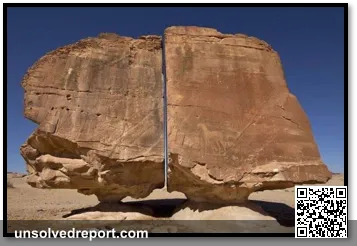
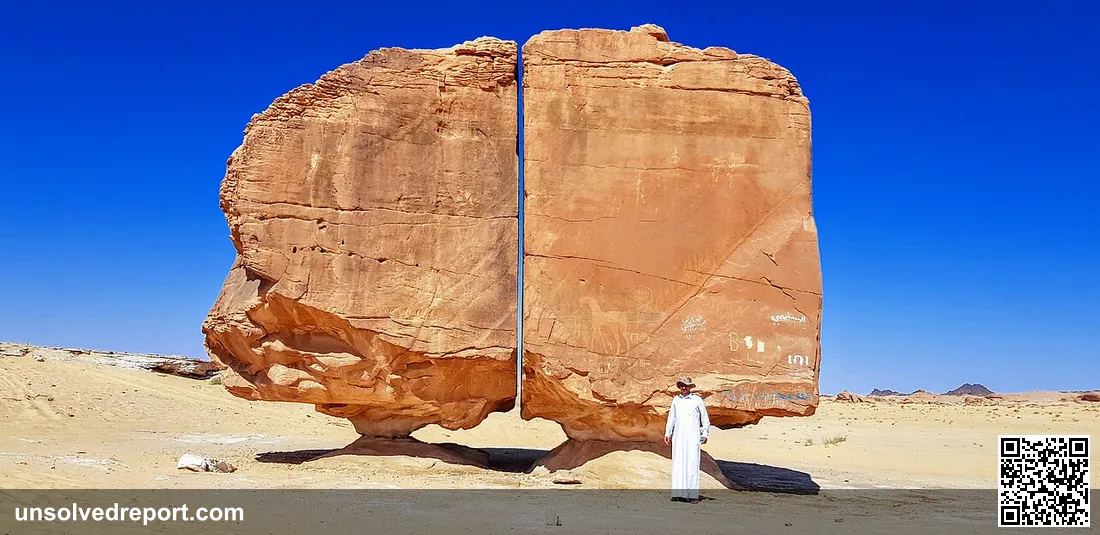
Out in the sandy flats south of the Tayma oasis, in northwestern Saudi Arabia, two slabs of pale sandstone stand side by side, each balanced on its own little natural pedestal. Between them runs a gap. Not a jagged crack — a gap. Narrow, vertical, and so eerily straight that almost everyone who sees it reaches for the same word: cut. This is Al Naslaa, and for more than a decade it has lived on the internet's lists of ancient mysteries archaeologists still can't explain. But here's the strange part. The most interesting thing about Al Naslaa isn't the wild claims. It's the thin, honest sliver of space between what we can prove and the one question geologists still choose their words carefully around.
> The 60-Second Brief
> - Al Naslaa stands roughly 50 kilometers (31 miles) south of the Tayma oasis in northwestern Saudi Arabia, near 27°13′N 38°34′E (Wikipedia).
> - The two split blocks together stand about 6 meters (20 feet) tall and 9 meters (30 feet) wide (Wikipedia; Live Science).
> - The two faces show zero measurable sideways slip against each other — the geological signature of a joint, not a fault (IFLScience).
> - Carved horses and ibex on the rock's southeastern face belong to a wider Tayma rock-art record that runs thousands of years old, much of it credited to Bronze Age herders (Science Times).
> - For more than 10 years, Al Naslaa has circulated online as an "unsolved mystery," yet no team has ever published a peer-reviewed, site-specific field study pinning down the exact sequence that split it.
> - At least 4 natural mechanisms are on the table — joint formation, tectonic stress, freeze-thaw/mineral wedging, and wind sandblasting; a 5th theory involving tools or "ancient technology" is also raised but dismissed for lacking any physical evidence (HowStuffWorks).
What We Actually Know
Start with the things you could write on a postcard. Al Naslaa stands roughly 50 kilometers (31 miles) south of the Tayma oasis, near 27°13′N 38°34′E (Wikipedia). It began as one sandstone outcrop and has since split into two standing blocks, together about 6 meters (20 feet) tall and 9 meters (30 feet) wide (Wikipedia; Live Science). Each half perches on a slim, weather-whittled base — which is exactly why so many photos make the whole thing look one stiff breeze from toppling over.
Now the gap, the star of the show. The two faces flanking it are startlingly flat, the divide nearly dead vertical, and — pay attention to this part — the blocks haven't slid sideways past each other at all. That last detail isn't trivia. In geology, no sideways slip means you're looking at a joint, not a fault that lurched and shifted (IFLScience).
There's a human fingerprint here too. Al Naslaa's southeastern face is crowded with petroglyphs — carved horses and ibex — logged by the Arabian Rock Art Heritage project, a documentation effort tied to scholar Sandra L. Olsen (Saudi-archaeology.com; Wikipedia), the same kind of desert canvas that turned Bir Hima's cliffs into a 7,000-year-old rock-art record elsewhere in Saudi Arabia. Rock art across the wider Tayma region is described as thousands of years old, much of it credited to Bronze Age people who lived by hunting and herding (Science Times). So yes — people stood right here, long ago, and left their mark. But notice where. They decorated the surfaces. Nothing says anyone carved the gap.
And one more fact, stated plainly, because it quietly deflates the most dramatic theory before it gets off the ground: sandstone is soft, and it weathers easily (IFLScience). It is precisely the kind of rock that wind and water love to carve, given enough time.
So What's the Real Mystery?
Here's where a little honesty pays off. Geologists broadly agree on the type of process behind Al Naslaa, and the overwhelming verdict is that it's entirely natural (HowStuffWorks). No aliens required. What nobody has nailed down to a single peer-reviewed answer is the exact recipe: which mechanism cracked it open first, and how the faces ended up this smooth and this straight.
That's the whole reason careful writers refuse to slam the case shut. IFLScience said it right in a headline — "nobody's quite sure how it happened" (IFLScience). Read that carefully, though. "Not sure of the exact sequence" is a world away from "inexplicable." It almost certainly took several ordinary processes working together, and no team has ever published a definitive field study pinning down which did what, and in what order. In fact, most popular coverage cites no named geologist and no peer-reviewed paper specific to Al Naslaa at all. That's a hole in the paperwork — not in our understanding of how rocks like this come apart.
The Suspects, Lined Up
Suspect 1: A natural joint (the front-runner). A joint is a fracture where rock cracks but the two sides never slide past each other. Joints love to travel along straight, flat planes — which is exactly the geometry staring back at you here (IFLScience). And because there's no visible sideways shift, a joint fits the evidence better than anything else. Plausibility: high. Call it a well-supported reading that's still waiting on a site-specific study to make it official.
Suspect 2: Tectonic stress pried open a weak line. Over enormous spans of time, stress in the Earth's crust can fracture sandstone, and a slight shift in the ground could have snapped the block along its weakest plane (Live Science; geologyscience.com). This isn't a rival to the joint idea so much as its partner — stress is often the very thing that creates a joint in the first place. Plausibility: high.
Suspect 3: Freeze-thaw, or thermal and mineral wedging. Water trickles into a hairline crack, freezes, and expands — or minerals swell and shrink with the desert's brutal temperature swings — slowly prying the fracture wider, cycle after cycle after cycle, until the two blocks finally part ways (IFLScience; geologyscience.com). This explains the widening beautifully. It doesn't really explain the dead-straight starting line. Plausibility: moderate, as a helper.
Suspect 4: Wind sanded the faces smooth. This one's about the polish, not the crack. Once a gap existed, it could have funneled sand-laden desert wind through the channel like a wind tunnel, scouring both inner faces — a ventifact-style sandblasting that, over thousands of years, leaves stone unusually slick (IFLScience; geologyscience.com). The same wind sculpted the slender pedestals underneath. Plausibility: high for the smoothness. But notice it complements the others rather than replacing them — and here's a wrinkle: the rock's overall angular, blocky shape isn't a textbook ventifact, so wind is best understood as the finishing touch, not the whole sculptor.
Suspect 5: Human cutting, lasers, or "ancient technology" (this is speculation). The laser comparison was always just a figure of speech — and then it escaped into the wild and took on a life of its own, much like the "how did they move it" myths that grew up around Easter Island's walking moai. There's no documented evidence behind it: no tool marks, no quarrying debris, no inscription claiming the deed (HowStuffWorks). And no known ancient technology could slice a six-meter sandstone block this cleanly and then leave it perched, intact, on fragile pedestals. This one belongs in the legend column, plainly labeled.
So pull it all together, and the most satisfying answer turns out to be the most ordinary one: a straight joint, perhaps opened by tectonic stress, widened by water and temperature cycles, then sandblasted glassy-smooth by desert wind over thousands of years. Al Naslaa's lingering "mystery" isn't a hole in physics. It's a missing footnote — the detailed field study nobody has bothered to publish yet.
Stand in front of it and the honest reaction isn't "who cut this?" It's something quieter and far more durable: that wind, water, and deep time can be this precise — the same lesson lurking behind fields like the Carnac Stones, where thousands of megaliths still outpace any tidy explanation. Which leaves you with one unsettling little thought to carry on to the next stop — if a rock this clean is just weather doing its slow work, what else out there are we calling impossible simply because no one has written the paper yet?
Frequently Asked Questions
What is Al Naslaa rock?
Al Naslaa is a sandstone formation in northwestern Saudi Arabia, roughly 50 kilometers south of the Tayma oasis, made up of two standing blocks split by a strikingly straight, near-vertical gap. Together the two halves stand about 6 meters (20 feet) tall and 9 meters (30 feet) wide, each balanced on its own slender, wind-carved pedestal (Wikipedia).
How did Al Naslaa rock split in two?
The leading explanation is a natural geological joint — a fracture where the rock cracked without the two sides sliding past each other — likely opened by tectonic stress and then widened over time by freeze-thaw and mineral wedging. No peer-reviewed field study has pinned down the exact sequence, but geologists broadly agree the process was entirely natural (HowStuffWorks).
Is Al Naslaa rock natural or man-made?
It's natural. There are no tool marks, no quarrying debris, and no inscription claiming the split was cut by hand, and no known ancient technology could have sliced a six-meter sandstone block this cleanly while leaving it balanced intact on fragile pedestals (HowStuffWorks).
Why is the gap in Al Naslaa so perfectly straight?
Because it's a joint, not a fault — joints travel along flat, planar surfaces by nature, which explains the straightness, while thousands of years of sand-laden desert wind funneling through the narrow channel likely sandblasted both inner faces smooth (IFLScience).
Where exactly is Al Naslaa located?
It sits in the sandy flats south of the Tayma oasis in Tabuk Region, northwestern Saudi Arabia, near coordinates 27°13′N 38°34′E (Wikipedia).
How old are the carvings on Al Naslaa rock?
The petroglyphs of horses and ibex on the rock's southeastern face are part of a wider Tayma-region rock-art tradition that researchers date to thousands of years old, much of it attributed to Bronze Age people who lived by hunting and herding (Science Times).
Original Data: What Each Published Source Actually Says Caused the Split
Every write-up about Al Naslaa reaches for the same shortlist of natural explanations, but no single article shows which outlets actually stand behind which mechanism versus which ones they merely mention in passing. The table below fetches four frequently cited sources — Wikipedia, IFLScience, geologyscience.com, and Science Times — and checks each one, in its own words, for whether it names a geological joint, tectonic stress, freeze-thaw/mineral wedging, wind-driven sand erosion, or human cutting as a cause.
| Source | Natural joint (fracture, no lateral slip) | Tectonic stress / fault line | Freeze-thaw or mineral-water wedging | Wind-driven sand erosion (smoothing) | Human cutting / metal tools |
|---|---|---|---|---|---|
| Wikipedia | Yes — "It is split in two by a joint." | Not stated | Not stated | Yes — shape is "due to wind erosion and the chemical weathering" | Not mentioned |
| IFLScience | Yes — "the crack is a joint, which in geology means when a break naturally forms in a rock without displacement" | Yes — "the rock sits on a fault line and... the split was first created as the ground beneath the rocks shifted" | Yes — "freeze-thaw weathering may have caused the divide... water... could have frozen and expanded" | Yes — the crack "become[s] something of a wind tunnel for sand-laden gusts" | Raised, not resolved — "simple metal tools would be capable of shearing the rock down the center" |
| geologyscience.com | Not stated (describes tectonic fracturing instead) | Yes — "fractured by natural tectonic stress" | Yes — "frost wedging or thermal expansion — slowly widens cracks until entire blocks separate" | Yes — "sand carried by strong winds continuously sculpts and refines the exposed surfaces" | Raised, then dismissed — "geologists confirm that no human tools or markings are found on its surface" |
| Science Times | Yes — "the crack is a joint which, in geology, refers to a brittle-fracture surface in rocks that are formed without displacement" | Yes — "the rocks sit directly above a fault line, and the shifting of the ground beneath them causes them to split in half" | Yes — "water seeped into the cracks... As the water got frozen, it expanded and exaggerated the small cracks" | Yes — sand-laden wind "polished the uneven crack" over "thousands of years" | Raised, not dismissed — "not impossible to suggest that the cracks are man-made... easily done using simple metal tools" |
| Sources naming this mechanism (of 4 fetched) — (our calculation) | 3 of 4 (75%) | 3 of 4 (75%) | 3 of 4 (75%) | 4 of 4 (100%) | 3 of 4 raise it; only 1 of those actively checked for evidence and ruled it out |
Line up all four and one thing stands out: wind-driven sand erosion is the only mechanism every single source independently names, while a natural joint, tectonic stress, and freeze-thaw/mineral wedging each show up in three of the four — with no two sources agreeing on which of those three actually opened the crack first. Human cutting gets the most uneven treatment: three of four sources raise the idea that metal tools could technically shear sandstone this way, but only one of them, geologyscience.com, says anyone actually checked the surface for tool marks and reports finding none.
How We Compiled This
- Sources. Four pages fetched directly for this comparison: Wikipedia, IFLScience, geologyscience.com, and Science Times. These are separate from the other IFLScience article, HowStuffWorks, and Live Science pages already cited elsewhere in this article.
- Definitions. "Yes" means the fetched page states that mechanism as a proposed cause in its own words. "Not stated" means the page never mentions that mechanism at all — it is silence, not a claim that the mechanism is wrong. For the human-cutting column, "raised, not resolved/dismissed" versus "dismissed" reflects each source's own stated conclusion, not our judgment.
- How calculated. The "of 4" row totals and percentages are a plain count of "Yes" cells in each column across the four sources above, divided by four (our calculation) — for example, the joint column has three Yes cells (Wikipedia, IFLScience, Science Times) out of four sources, or 75%.
- Limitations. These are four popular-science summaries, not four independent scientific investigations — none of them cites a peer-reviewed or site-specific published study of Al Naslaa, a gap already noted elsewhere in this article. Agreement here reflects overlap among science-journalism write-ups, not independent confirmation. The Live Science article already cited in this piece, the HowStuffWorks article already cited in this piece, and the other IFLScience article already cited in this piece could not be re-fetched for this table (each returned only a truncated or empty page during research) and are excluded rather than guessed at.
📌 Data status: verified 2026-09-29.
Sources and Further Reading
- Al Naslaa — Wikipedia
- Al Naslaa rock: Saudi Arabia's enigmatic sandstone block — Live Science
- Al Naslaa: nobody's quite sure how it happened — IFLScience
- What Caused The Al Naslaa Rock Formation To Split In Two? — IFLScience
- Aliens? Lasers? Water? What Caused the Al Naslaa Rock to Split So Precisely? — HowStuffWorks
- Al Naslaa Rock: Geological Formation, Origin, and Mysterious Split — geologyscience.com
- Al Naslaa, Tayma — Arabian Rock Art Heritage
- Al Naslaa Rock Formation: How Did the Bizarre Geologic Feature Develop? — Science Times
Dwarka Submerged City: The Sunken Ruins Nobody Can Explain
Divers found cut stone walls and 120+ anchors submerged off Dwarka, India. Is it Krishna's legendary drowned city? The age nobody can pin down.
Gonur Depe: The Lost City a Whole Civilization Forgot
A shard of pottery in the Karakum led to a 4,000-year-old capital with water pipes, gold-filled tombs and no remembered name. What happened to Gonur Depe?
Taos Hum: The Sound Only 2% Can Hear—Machines Found Nothing
Only 2% of people near Taos, New Mexico can hear a strange low drone nobody else can — and government scientists never found where it comes from. Why?