Cochno Stone: Scotland Buried It on Purpose. Twice.
Scotland deliberately buried the Cochno Stone in 1965, briefly dug it up in 2016, then reburied it. What do its 90 carved rings actually mean?
Stand in Faifley, on the northern edge of Clydebank, and look at the tidy patch of grass under your feet. You'd never guess what's down there. A single sheet of sandstone, roughly the size of a tennis court, carved 5,000 years ago with around 90 swirling cups, rings, and grooves — one of the most remarkable prehistoric monuments in Europe. And almost no one can see it.
Here's the strange part. In 1965, archaeologists chose to bury it. Not by accident — on purpose, to protect it. The Cochno Stone has spent most of the last sixty years deliberately hidden, surfacing only for a few carefully documented moments before vanishing again under the soil. And after more than a century of study, what those carvings actually mean is still a genuine, honest mystery — one now tangled up with a fresh fight over what gets built next to it: in August 2025, the Scottish Government approved a battery storage megasite for the fields right beside it (STV News).
> The 60-Second Brief
> - The carvings date to the Neolithic–Early Bronze Age, roughly 3000 BC — about 5,000 years old, per the University of Glasgow.
> - The exposed slab runs about 42 by 26 feet (13 by 8 metres) and carries around 90 cup-and-ring marks — SCARF's tally runs higher, at "over 100."
> - Scotland's Ministry of Works had it deliberately buried in spring 1965, dumping several hundred tons of soil over the carvings to stop vandalism.
> - In 1937, amateur archaeologist Ludovic Mann painted the prehistoric marks in white and green and overlaid his own grid in yellow, blue, and red.
> - The stone was fully uncovered for the first time in 51 years over roughly 10 days in September 2016, by a University of Glasgow team working with the Factum Foundation.
> - In August 2025, the Scottish Government approved a 560-megawatt, 29-hectare battery storage site on land next to the rock-art landscape.
What We Actually Know
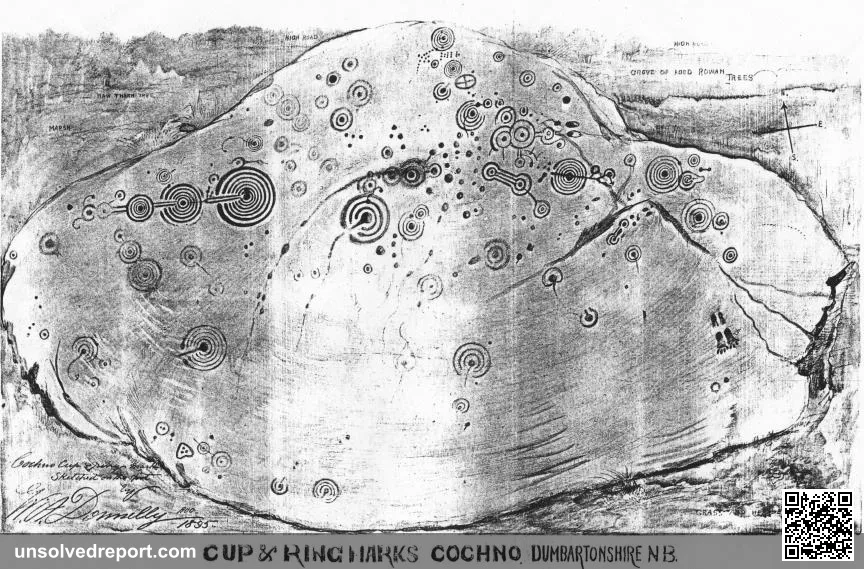
The slab lies at Auchnacraig, near Cochno farm in Faifley, West Dunbartonshire, just north of Clydebank in west-central Scotland. People first wrote it down in the late 19th century. The Reverend James Harvey usually gets the credit for documenting it in 1887, with other Victorian-era recorders — among them John Bruce and William Donnelly — adding their own work soon after (SCARF; Wikipedia).
The exposed rock runs roughly 42 by 26 feet — about 13 by 8 metres — covering close to 100 square metres (Wikipedia). Count the carvings and you'll get a different number depending on who's counting. Many accounts describe "around 90 carved indentations" (Wikipedia), while Scotland's archaeological research framework tallies "over 100 cupmarks and cup-and-rings marks" and calls it "one of the most extensive Neolithic rock-art sites in Britain" (SCARF). The shapes themselves are the classic "cup-and-ring" mark: a small cup-shaped hollow pecked into the rock, wrapped in one or more concentric rings, sometimes with a single groove running outward like a tail.
How old? Neolithic to Early Bronze Age. The University of Glasgow puts the stone at roughly 3000 BC — about 5,000 years — and one Glasgow account called it "the most important Neolithic cup and ring marked rock art panel in Europe" (University of Glasgow). Archaeologist Kenneth (Kenny) Brophy, who led the modern investigation, dates the rock art to "the third millennium BC" (The Conversation).
Then comes the strangest twist in the stone's story, and it's barely a century old. In 1937, the amateur archaeologist Ludovic Maclellan Mann got out his paint. He picked out the prehistoric cup-and-ring marks in white and green — then laid an elaborate grid of yellow, blue, and red lines over the top, built from his own theories about megalithic measurement and cosmology (SCARF; Live Science). Mann was convinced the markings encoded astronomical events — eclipses, even. His paint faded over the decades but never fully disappeared, becoming one more layer in the stone's tangled history.
By the 1960s, the slab was in real trouble. The Faifley housing estate had grown up right around it, and an open carved rock in someone's backyard is an open invitation. Foot traffic. Graffiti. Vandalism. Visitors scratching their own initials and names straight into 5,000-year-old art (The Vintage News). So the call was made: bury it. The job is credited to the period's heritage authorities — the Ministry of Works — with the burial taking place in spring 1965 "on the order of the Ancient Monuments Board" (The Conversation; SCARF). Several hundred tons of soil went down over the carvings (The Conversation).
And there it stayed, in the dark, for half a century. In 2015, a small team that included archaeologists from the University of Glasgow ran a quick test dig. The following September, in 2016, they went all the way — the first complete uncovering in 51 years (University of Glasgow; Wikipedia). Over about ten days, Brophy's team worked alongside the digital-heritage specialists at the Factum Foundation, recording every inch with high-resolution 3D laser scanning and photogrammetry (University of Glasgow; Factum Foundation). What the soil gave back was three eras at once: the prehistoric motifs, traces of Mann's 1937 paint, and generations of modern graffiti, all side by side. Then, with a millimetre-perfect digital copy safely captured, the team did the only thing that would keep the stone safe. They buried it again. "It is emotional," Brophy admitted, "when you have worked on a project such as this, touched it, walked on it and closely examined it, to then rebury it" (University of Glasgow).
The Question No One Can Answer
So here's the heart of it. More than a hundred years of study, the finest scanners money can buy, and still nobody knows what the carvings mean. Brophy doesn't dress it up: "There is no consensus among archaeologists as to what the symbols meant" (The Conversation).
The problem runs deep. The people who carved these rings left no writing behind — not a word. And cup-and-ring marks aren't rare; they cover thousands of stones across Britain and Ireland, perhaps around 6,000 decorated rocks in all, clustered mostly in northern England and Scotland (Wikipedia, Cup and ring mark). Whatever these symbols once said, the meaning lived inside a culture that disappeared, taking the key with it and leaving only the marks. Cochno is exceptional for its sheer scale and density — rivaling even France's sprawling Carnac Stones — but it shares the same silence as the entire tradition.
So What Could It Mean?
The mainstream possibilities. Scholars have floated plenty of ideas, none of them nailed down. Brophy runs through the candidates: everything "from tribal symbols and territorial markers to maps, star representations, and ritual containers" (The Conversation). Because cup-and-ring sites often sit in burial and ceremonial landscapes, a ritual or spiritual purpose comes up again and again — the same case made for Malta's megalithic Ġgantija temples (The Art Newspaper). An astronomical or calendar role has been proposed too — but as observers point out, "there is no provable celestial link." Working hypotheses, all of them. Nothing more.
Ludovic Mann's cosmology. Remember Mann's 1937 grid? It came straight from his personal conviction that the carvings encoded eclipse cycles and megalithic geometry. Today's archaeologists treat his theories as a fascinating relic of his time rather than a true reading of the stone — speculation, in other words, not a solved cipher (Live Science).
The "star map" and "lost civilization" claims. You'll find websites calling the Cochno Stone an "interdimensional star map" or proof of some "lost advanced civilization" — the same fringe leap people make about Göbekli Tepe. Let's be plain about this: there's no archaeological evidence for any of it, and no peer-reviewed research backs it up. These are stories that live on the internet, not in the science.
For now, the Cochno Stone keeps its secret beneath the Faifley turf — copied down to the millimetre in digital form, yet as enigmatic as the day it was carved. Ask "what does it mean?" and the most honest answer is also the most haunting one: we genuinely don't know. Five thousand years on, the rings are still waiting for someone to read them — and they're not the only ancient mysteries archaeologists still can't explain.
2025: A battery megasite approved next door
In August 2025, the Scottish Government granted planning consent under Section 36 of the Electricity Act 1989 for a 560-megawatt battery storage facility spanning 29 hectares near Whitehall Farm, on the boundary between East and West Dunbartonshire — close to Faifley and Hardgate, and near the concentration of prehistoric rock art that includes the Cochno Stone. The developer, Apatura, has now had eleven such storage projects approved in Scotland in two years, and the facility is licensed to run for 40 years. Local residents pushed back hard; one, Jane Forbes, called it "a money-making scheme by the company that proposed it, by the government, and by the landowner" (STV News). The stone itself remains buried and undisturbed by the project, but the approval has reopened questions about how well the wider rock-art landscape around it is actually protected.
Frequently Asked Questions
Why did Scotland bury the Cochno Stone?
Heritage authorities had it buried in spring 1965, on the order of the Ancient Monuments Board, after decades of exposure to a growing housing estate led to foot traffic, graffiti, and visitors scratching their own names into the 5,000-year-old carvings. Several hundred tons of soil went down over the slab to protect it from further damage (The Conversation).
What do the carvings on the Cochno Stone mean?
Nobody knows for certain. Archaeologist Kenny Brophy, who led the 2016 investigation, has said plainly that "there is no consensus among archaeologists as to what the symbols meant," with proposals ranging from tribal or territorial markers to maps, star charts, or ritual containers (The Conversation). The people who carved the rings left no writing behind, so the culture that could explain them disappeared along with the meaning.
Can you visit the Cochno Stone today?
No — the stone has been deliberately reburied since 2016 and sits under turf in Faifley, West Dunbartonshire. A millimetre-accurate 3D digital scan was captured during the brief 2016 uncovering, so researchers and the public can study its surface virtually even though the physical slab stays hidden (Factum Foundation).
How old is the Cochno Stone?
The University of Glasgow dates the carvings to roughly 3000 BC, in the Neolithic to Early Bronze Age — about 5,000 years old — making it, in one university account, "the most important Neolithic cup and ring marked rock art panel in Europe" (University of Glasgow).
What happened when the Cochno Stone was uncovered in 2016?
A University of Glasgow team led by Kenny Brophy worked with the digital-heritage specialists at the Factum Foundation to fully expose the stone for about ten days — the first complete uncovering in 51 years. They recorded every inch with high-resolution 3D laser scanning and photogrammetry before reburying it to keep it safe (University of Glasgow).
Is a battery storage site being built near the Cochno Stone?
Yes. In August 2025 the Scottish Government approved a 560-megawatt, 29-hectare battery storage facility on land near Whitehall Farm, close to Faifley and the rock-art landscape that includes the Cochno Stone, over strong objections from local residents (STV News).
Original Data: How Many Carvings Are Actually on the Cochno Stone?
No single source lays the Cochno Stone's official measurements next to its most-repeated headline figures. Scotland's statutory heritage record breaks the carvings into two separate counts — cup-and-ring marks and plain cup marks — but the encyclopedia and academic-framework write-ups that most readers encounter report only a single combined number. The table below lines up what each source actually publishes and adds the two official sub-counts together to see what the popular "around 90" figure leaves out.
| Type | Panel size as published | Panel area | Cup-and-ring marks | Plain cup marks | Total carved marks | Source |
|---|---|---|---|---|---|---|
| Official statutory record | "13m east-west by 8m transversely" | 104 m² (13 × 8, our calculation) | "Approximately 90 cup and ring marks... with individual examples measuring up to 90cm in diameter" | "Approximately 110 cup motifs, up to 8cm deep" | 200 (90 + 110, our calculation) | Historic Environment Scotland, Scheduled Monument record SM716 |
| Encyclopedia | "42 by 26 feet (12.8 by 7.9 metres)" | 101 m² (12.8 × 7.9, our calculation) | not split out separately | not split out separately | "around 90 carved indentations" (as stated, single undifferentiated figure) | Wikipedia, "Cochno Stone" |
| Academic research framework | not given in metres/feet | "an area almost 100 square metres" (as stated) | not split out separately | not split out separately | "over 100 cupmarks and cup-and-rings marks" (as stated, single undifferentiated figure) | SCARF case study |
All three sources agree the panel covers roughly 100 square metres, and each independently lands on a size within a few square metres of the other two. But the count of carvings tells a different story: the official Historic Environment Scotland record is the only one of the three that separates cup-and-ring marks from plain cup marks, and adding its two figures together gives 200 individual marks — more than double the "around 90" and roughly double even the "over 100" figures that Wikipedia and SCARF use as their headline counts.
How We Compiled This
- Sources. Historic Environment Scotland's official Scheduled Monument portal record for SM716, the Wikipedia article "Cochno Stone," and the Scottish Archaeological Research Framework (SCARF) case study on the Cochno Stone.
- Definitions. Historic Environment Scotland's record distinguishes "cup and ring marks" (a cup-shaped hollow encircled by one or more rings) from separately-counted "cup motifs" (plain hollows with no ring). Wikipedia's "around 90 carved indentations" and SCARF's "over 100 cupmarks and cup-and-rings marks" do not state whether they are counting one category, both categories combined, or an approximate round total.
- How calculated. Panel area for the two sources that give length and width instead of a stated area (Historic Environment Scotland, Wikipedia) was calculated as length × width. The "total carved marks" figure for Historic Environment Scotland was calculated by adding its two published sub-counts (90 cup-and-ring marks + 110 cup motifs = 200).
- Limitations. It is not confirmed whether Wikipedia's and SCARF's headline figures are meant to include plain cup marks, cup-and-ring marks, or both, so the 200 figure cannot be directly proven to be "more accurate" — only that it is the one official source that itemizes both carving types rather than giving a single rounded number. All three sources may ultimately draw on the same underlying 2016 University of Glasgow/Factum Foundation survey data, restated in different levels of detail, rather than being fully independent recounts.
📌 Data status: verified 2026-09-29.
Sources & Further Reading
- University of Glasgow — "Cochno Stone reburied" (2016)
- Kenny Brophy, "Raiders of the lost marks," The Conversation (2016)
- SCARF (Scottish Archaeological Research Framework) — Cochno Stone case study
- Factum Foundation — The Cochno Stone project
- Live Science — "5,000-Year-Old Swirling Rock Art in Scotland Remains a Mystery"
- Wikipedia — Cochno Stone
- Wikipedia — Cup and ring mark
- Brophy, K. & others, "'The finest set of cup and ring marks in existence': the story of the Cochno Stone," Scottish Archaeological Journal (2018) — peer-reviewed, abstract via Edinburgh University Press
- STV News — "Cochno Road: Outrage over plans to house battery megasite next to ancient rock art" (2025)
Catalhoyuk's No-Streets Mystery: Why This Town Had No Doors
9,000 years, zero streets, zero front doors — just rooftops and ladders. A 2025 DNA study just reopened the debate over why. Here's the evidence, ranked.
Nebra Sky Disc: The Bronze Age Star Map Looters Nearly Erased
The Nebra Sky Disc may be the oldest star map on Earth — but looters buried its proof. Is it 3,600 years old, or a thousand years younger than we think?
Dancing Girl of Mohenjo-daro: Why Her Identity Is Still Unsolved
A four-inch bronze girl outlasted 4,000 years of silence — then made 2026 headlines when a textbook altered her body. Nobody has ever known her name.