D.B. Cooper: The $200,000 Skyjacking Nobody Can Solve
D.B. Cooper grabbed $200,000, jumped into a night storm, and was never identified. What did the FBI actually prove — and what stayed fog forever?
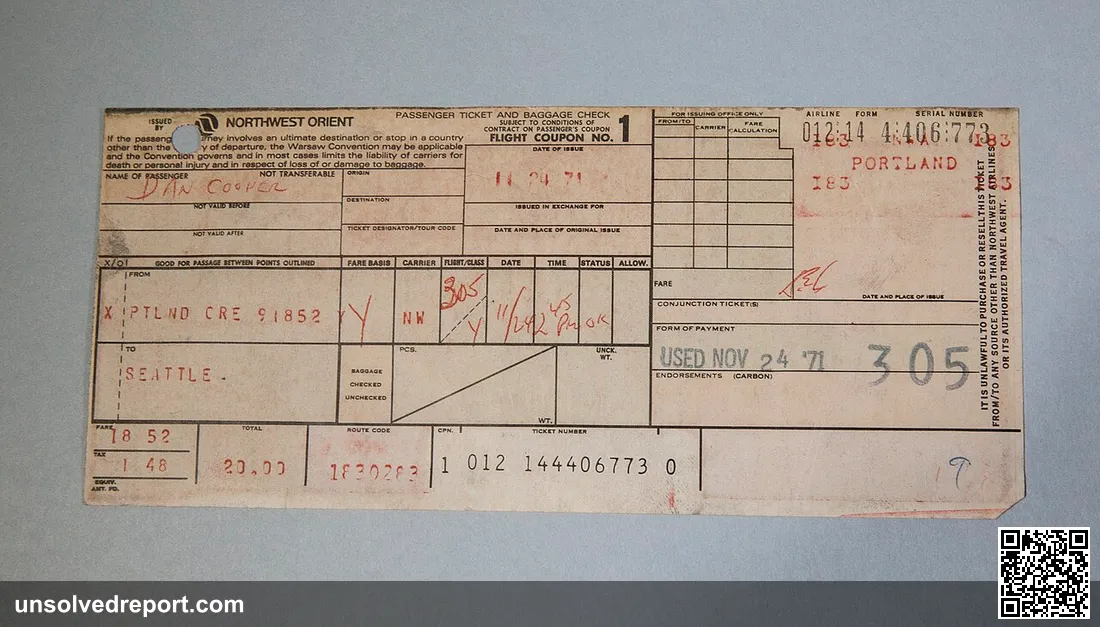
The afternoon before Thanksgiving, 1971. A man in a dark suit and tie walks up to Northwest Orient Airlines Flight 305 in Portland, Oregon, ticket in hand, and takes his seat for the short hop to Seattle. The name on the ticket: Dan Cooper. Nobody looks at him twice. He is middle-aged, calm, ordinary - the kind of face that slides out of memory the moment it leaves the room.
Within a few hours, that forgettable man will squeeze 200000 dollars out of the United States government, step off the back of a Boeing 727 into a freezing rainstorm, and disappear forever.
More than fifty years later, the FBI's files are closed and the case is still open in the only way that matters. Nobody knows who he was. Nobody knows if he lived. This is the one act of air piracy in United States history that was never solved - and one of the most mythologized too, which is exactly why it's worth slowing down and looking at what the flight crew, the FBI, and the physical evidence actually nailed down. As recently as 2024, a fresh forensic pass on the one piece of Cooper he left behind pointed toward yet another suspect - and led to yet another dead end.
> The 60-Second Brief
> - On November 24, 1971, the hijacker demanded $200,000 in twenty-dollar bills and four parachutes before jumping from Flight 305.
> - He jumped from the Boeing 727's rear airstair at roughly 10,000 feet, into freezing rain and wind near 200 mph.
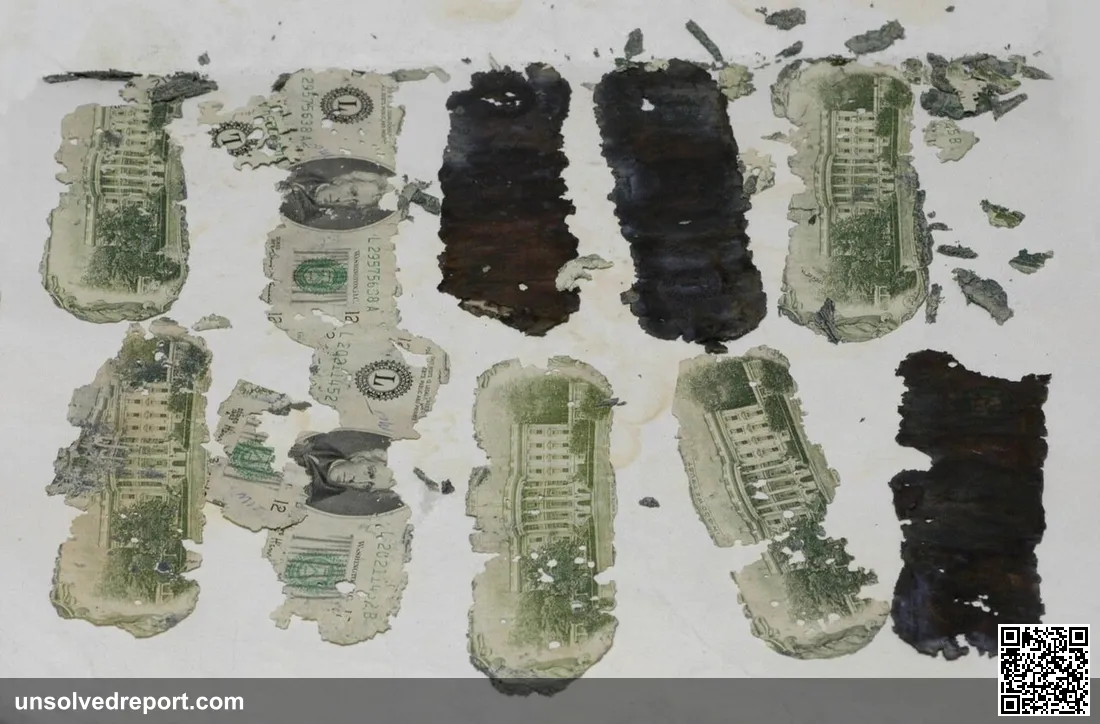
> - In February 1980, an eight-year-old boy found $5,800 of the marked ransom, still banded, on the Columbia River - the only ransom money ever recovered.
> - The FBI's NORJAK investigation ran 45 years before the bureau announced in 2016 it was suspending active investigation.
> - In January 2024, a new particle analysis of Cooper's tie pointed toward a Pittsburgh titanium engineer who had died in 2002.
> - In December 2025, after two years of DNA testing, the FBI returned a parachute seized from a copycat hijacker's family without confirming a match.
What happened on Flight 305
Shortly after takeoff, Cooper handed a note to flight attendant Florence Schaffner. She figured it was a lonely businessman sliding her his phone number and tucked it into her pocket, unread. He leaned in close and told her, quietly, that she really ought to read it. He had a bomb.
Then he opened his briefcase just long enough for her to see the inside: a tangle of wires and red cylinders. That was all the proof anyone needed. From there, his demands were short and exact, according to FBI accounts and crew statements:
- 200000 dollars in twenty-dollar bills.
- Four parachutes - two primary, two reserve.
- A fuel truck waiting in Seattle to refuel the plane the second it landed.
The 727 circled near Seattle while authorities on the ground scrambled to assemble the cash and the chutes. When it touched down at Seattle-Tacoma, Cooper made the trade: the 36 passengers and two flight attendants walked free, and the money and parachutes came aboard. He kept a small crew with him. He wasn't done.
Into the dark
Here's where Cooper tipped his hand. His next set of orders showed he knew his way around an aircraft. Fly toward Mexico City, he said - low and slow, flaps down, landing gear down. That's a very specific recipe: it's the configuration that lets a 727 crawl through the air slow enough for a person to jump out and survive the wind. And he knew something else. The Boeing 727 had a rear staircase, the aft airstair, that could be lowered while the plane was still flying. He told them to drop it.
Somewhere over the dense forests of southwestern Washington state, on the evening of November 24, 1971 - cabin depressurized, rear stairs hanging open in the cold rain - Dan Cooper jumped into the dark with the money strapped to his body. A warning light blinked on to tell the crew the airstair had been activated in flight. By the time the plane set down in Reno, Nevada, the cabin was empty. He was gone.
He left three things behind: a black clip-on tie, a tie clip, and a few cigarette butts. Remember that tie. It comes back.
Now picture the leap itself, because the movies and the legend tend to airbrush it into something clean. The 727 was punching through a cold November storm at roughly 10000 feet. Cooper depressurized the cabin, walked to the back, and stepped down the aft airstair straight into a 200-mile-per-hour blast of freezing rain and pitch black. No helmet. No jump boots. Business clothes and, by witness accounts, ordinary low shoes. For a trained parachutist, that exit would have been brutal. For an untrained one, very likely fatal. Whatever else you believe about Cooper, the jump was not the breezy cinematic getaway it's often imagined to be.
How "Dan" became "D.B."
Quick puzzle: the hijacker called himself Dan Cooper, so why does the whole world know him as D.B.? Blame the newsroom. In the chaotic hours after the hijacking, a wire-service reporter - or an early news cycle - mixed up the case with a different man named D.B. Cooper, who got briefly questioned and quickly cleared. The wrong initials stuck like glue. The man on Flight 305 never once called himself D.B. It's a tidy little lesson in how one small early mistake can fossilize into the name everybody uses for the rest of time.
NORJAK: the case that wouldn't close
The FBI gave it a codename - NORJAK, for Northwest hijacking - and turned it into one of the longest, most exhaustive investigations in the bureau's history. Agents interviewed hundreds of suspects, chased thousands of leads, and built composite sketches from the crew's memory of a man in his mid-forties.
Here's what they pinned down for the record:
- The ransom went out in twenty-dollar bills, and the FBI logged every single serial number, then handed the list to banks and the public. None of those marked bills ever turned up in circulation in a way that cracked the case open.
- They searched the presumed drop zone on the ground and found nothing - no body, no parachute, no clear landing site - in the immediate aftermath.
- In 2016, after 45 years of dead ends, the FBI announced it was officially suspending active investigation to put its resources elsewhere, while keeping the evidence intact. Note the word: suspended. Not solved.
The boy on the beach
And then, after nine years of nothing, the river coughed something up.
February 1980. An eight-year-old boy named Brian Ingram is digging in the sand at a spot called Tina Bar, along the Columbia River northwest of Vancouver, Washington. His fingers hit something soft and rotten - bundles of decaying twenty-dollar bills.
The FBI ran the serial numbers. They matched the Cooper ransom. Roughly 5800 dollars across several bundles, still wrapped in their bands. Finally, hard proof: at least some of that money had ended up on the bank of the Columbia River. But the discovery cracked open as many questions as it answered:
- The spot didn't sit neatly inside the flight path's estimated drop zone, which set off a long argument about river hydrology and whether the cash had washed downstream to get there.
- The rubber bands had survived intact, and some analysts argued that just didn't fit with years of exposure to the elements - hinting the bundles got there later than 1971. Or maybe not.
- It told investigators where some of the money was. It told them absolutely nothing about whether Cooper was alive or dead.
To this day, it's the only piece of the ransom anyone has ever recovered.
The tie, and the suspects who came and went
That clip-on tie Cooper left on his seat turned into a forensic time capsule. Decades later, citizen researchers and FBI-affiliated analysts went over the particles clinging to it and reported traces of rare elements, which fueled speculation that Cooper worked in aerospace or some metals industry. Genuinely intriguing - and genuinely inconclusive. Particle analysis can hint at the kind of place a man spent his days. It can't hand you his name.
And the names came, one after another. It's worth walking the roster, because the pattern repeats in a telling way:
- Richard McCoy Jr. pulled off an eerily similar hijack-and-parachute crime in April 1972 - demanding cash, jumping from a jet. He was caught, convicted, and later killed in a shootout after a prison escape. The resemblance is real. But the FBI decided McCoy didn't match the crew's physical description of Cooper closely enough, and his whereabouts that day are disputed.
- Kenneth Christiansen, a former paratrooper and Northwest Orient employee, was pushed by some researchers on the strength of circumstantial details and a deathbed remark. The FBI never confirmed him.
- Robert Rackstraw, a Vietnam veteran with parachute training, got a hard sell in a 2016 documentary and book. The FBI looked at the claim and effectively dismissed it, and Rackstraw himself denied it before his death.
- Sheridan Peterson and a string of others have each had their champions too.
The FBI investigated plenty of these men and confirmed none of them. Every fresh theory tends to trip over the same holes: no body, no confession that survives a hard look, no forensic match to the tie or the recovered money. There's a cautionary shape to all of it - a charismatic candidate plus a few cherry-picked circumstantial details can build a case that sounds airtight, right up until you ask the hard evidence to back it up. It never does.
2024-2026: a new tie analysis, a new suspect, a parachute that still won't confirm anything
The tie kept giving up secrets. In January 2024, private investigator Eric Ulis unveiled a fresh particle analysis of Cooper's clip-on tie and reported titanium-antimony fragments that he traced to Crucible Steel, a Pittsburgh-area supplier that shipped titanium and stainless steel to Boeing in the 1960s. Ulis named a specific man: Vince Peterson, a Pittsburgh titanium research engineer who had died in 2002. Peterson's own son was doubtful - "I just can't see it," he told reporters - but the family agreed to pursue DNA testing and asked the FBI to release the tie for comparison (Fox Weather).
A second thread ran alongside it. In 2022, retired airline pilot Dan Gryder found a parachute and harness on the family property of Richard Floyd McCoy II, the copycat hijacker who pulled off an almost identical crime in April 1972. The FBI seized the gear in 2024 and spent roughly two years running DNA analysis, soil testing, and expert examination of the parachute, checking it against a partial DNA profile the bureau had already pulled from Cooper's tie back in 2007. In December 2025, the FBI quietly returned the parachute to McCoy's children without announcing a match, saying only that agents had "got all the data off it that they could" (Cowboy State Daily).
Two new forensic passes, two new leads, zero new certainty. That's the shape this case has held for more than fifty years, and 2024-2026 didn't break the pattern - it just added two more names to the long roster of men who almost fit.
So - did he survive?
This is the question folklore answers with total confidence and the evidence refuses to answer at all. Stack up the conditions and they argue hard against him living:
- He jumped at night, in rain, into rugged forested terrain.
- He wore street clothes and loafers, not jump gear.
- One of the parachutes handed to him was a non-functional training chute, which suggests he may not have been able to fully check what he was strapping on.
- The wind chill at altitude was savage.
And yet. No body, no parachute, no remains were ever conclusively recovered. And the 1980 money find proved that at least part of the ransom reached the ground in one piece. So the honest answer - the one the FBI effectively settled on - is that survival is unproven in both directions. He may have slammed into the wilderness and died on impact. He may have limped out of the woods and walked away into a normal life. The record simply doesn't close the gap.
Fact versus legend
Let's separate the bedrock from the fog.
What's established:
- A man calling himself Dan Cooper hijacked Northwest Orient Flight 305 on November 24, 1971, using the threat of a bomb.
- He received 200000 dollars and parachutes, released the passengers in Seattle, and jumped from the 727's aft stairs in flight.
- He left a clip-on tie behind and was never identified.
- In 1980, about 5800 dollars of the marked ransom turned up on the Columbia River at Tina Bar.
- The FBI suspended active investigation in 2016 without ever naming the hijacker.
What's legend or unproven:
- That he survived the jump.
- That any specific named suspect was actually the hijacker.
- That the tie particles reveal his profession.
- The initials "D.B." as his real name - that one's a media error.
Here's what gives the Cooper case its grip: it's a narrow, well-lit window of certainty sitting in the middle of total fog. We know almost exactly what happened on that plane, minute by minute, because trained crew watched it unfold and the FBI wrote it all down. We know the money was real because a boy dug some of it out of a riverbank. And then the trail just... stops. At the open aft door of a 727, over the Washington woods, in the rain, on the night before Thanksgiving in 1971. He stepped out, and the record stepped out with him.
Frequently Asked Questions
Was D.B. Cooper ever identified?
No. The FBI's NORJAK investigation ran for 45 years and screened hundreds of suspects, but nobody has ever been definitively confirmed as the hijacker, and the bureau suspended active investigation in 2016 without naming him (FBI).
How much money did D.B. Cooper steal, and was any of it recovered?
He took $200,000 in twenty-dollar bills, and only a fraction has ever surfaced: in February 1980, an eight-year-old boy digging on the Columbia River's Tina Bar found about $5,800 of the marked ransom, still in its rubber bands (FBI).
Did D.B. Cooper survive the jump?
Nobody knows. He jumped at night, in a storm, wearing street clothes and loafers instead of jump gear, which argues against survival - but no body or parachute tied to the jump itself was ever conclusively recovered, so the FBI has never closed the question either way (Wikipedia).
Why is he called "D.B. Cooper" if his ticket said "Dan Cooper"?
It's a media error. A wire-service report in the confused hours after the hijacking mixed the case up with a different man named D.B. Cooper who was briefly questioned and cleared, and the wrong initials stuck permanently in press coverage (Wikipedia).
Is there a new suspect in the D.B. Cooper case?
As recently as January 2024, a new particle analysis of Cooper's tie led private investigator Eric Ulis to name Vince Peterson, a Pittsburgh titanium engineer who died in 2002, as a possible suspect; Peterson's own family was doubtful but agreed to pursue DNA testing (Fox Weather).
Has the FBI reopened the D.B. Cooper investigation?
Not officially - the case has remained suspended since 2016 - but the bureau did run new DNA and forensic tests in 2024-2025 on a parachute recovered from copycat hijacker Richard McCoy Jr.'s family property, returning it in December 2025 without confirming any connection to Cooper (Cowboy State Daily).
Original Data: Cooper vs. His Copycats, by the Numbers
No single source lines up Cooper's own case against the wave of copycat hijackings his stunt touched off across 1972. The table below compiles the ransom demanded, what was recovered, and the outcome for six of the documented U.S. copycat cases plus the combined totals for all thirteen, showing just how much of an outlier Cooper's still-unsolved case really is.
| Hijacker | Date | Ransom demanded | Ransom recovered | Outcome | Source |
|---|---|---|---|---|---|
| D.B. "Dan" Cooper | Nov 24, 1971 | $200,000 | $5,800 (found Feb. 10, 1980, at Tena Bar on the Columbia River) | Never identified or caught | HistoryLink.org |
| Richard McCoy Jr. | Apr 7, 1972 | $500,000 | $499,970 (found in his house) | Caught within days; 45-year sentence; killed by FBI agents in 1974 | Wikipedia: Richard McCoy Jr. |
| Robb Heady | Jun 2, 1972 | $200,000 | Recovered by FBI agents two days later (Heady himself was captured the next morning) | Captured; 30-year sentence | Wikipedia: D.B. Cooper copycat hijackings |
| Frederick Hahneman | May 5, 1972 | $303,000 | $303,000 (full amount) | Escaped to Honduras, later surrendered; life sentence, served 12 years | Wikipedia: D.B. Cooper copycat hijackings |
| Martin McNally | Jun 23, 1972 | $500,000 | Lost during the jump | Captured; said Cooper inspired him | Wikipedia: D.B. Cooper copycat hijackings |
| Melvin Fisher | Jul 13, 1972 | $550,000 | $200,000 | Surrendered; life sentence | Wikipedia: D.B. Cooper copycat hijackings |
| All 13 documented U.S. copycats, Dec. 1971–Jul. 1972 | Dec 24, 1971 – Jul 13, 1972 | $5,208,000 combined (sum of all 13 cases' demands, our calculation) | Varies by case | 13 of 13 (100%) captured or surrendered | Wikipedia: D.B. Cooper copycat hijackings |
Every single one of the thirteen men who copied Cooper's hijack-and-parachute method within eight months of his crime was eventually caught or surrendered — some within a day, none longer than a few years. Cooper, who demanded the smallest ransom of the group at $200,000, remains the only one of the fourteen who was never identified at all.
How We Compiled This
- Sources. Wikipedia's dedicated "D. B. Cooper copycat hijackings" article, which compiles case-by-case details for the thirteen documented 1971–72 U.S. copycat hijackings; Wikipedia's separate Richard McCoy Jr. biographical article; and HistoryLink.org's account of the 1980 Tena Bar ransom-money discovery.
- Definitions. "Ransom demanded" is the dollar figure each hijacker asked for at the time of the hijacking. "Ransom recovered" reflects whatever each source states was later found, seized, or otherwise accounted for — the amounts and circumstances differ case to case (found in a house, lost mid-jump, handed over on surrender), so this column is not a strictly uniform measurement. "Outcome" summarizes whether the hijacker was identified/captured and what became of them.
- How calculated. The $5,208,000 combined-demand figure is our own sum of the thirteen individual ransom-demand amounts listed in the Wikipedia copycat-hijackings article ($300,000 + $1,000,000 + $50,000 + $200,000 + $500,000 + $500,000 + $303,000 + $200,000 + $500,000 + $50,000 + $455,000 + $600,000 + $550,000 = $5,208,000). The "13 of 13 captured" figure is stated directly by that source, not calculated.
- Limitations. "Ransom recovered" is not a clean single-unit measurement across rows — some entries reflect cash found intact, some reflect partial recovery, and some (like several others in the full copycat list) are marked "unknown" in the source and were left out of this six-case sample for that reason. The full copycat-hijackings article lists other cases with recovery amounts marked unknown; those are included in the 13-case combined ransom total but aren't shown as individual rows here. Robb Heady's own capture ("the next morning" per the source) and the recovery of his ransom money ("two days later," per the same source) are two separately timed events; this table's "Ransom recovered" column reports the money's own recovery timing specifically, not Heady's capture date.
📌 Data status: verified 2026-09-29.
Sources & further reading
- FBI: D.B. Cooper Hijacking (Famous Cases) - https://www.fbi.gov/history/famous-cases/db-cooper-hijacking
- Wikipedia: D. B. Cooper - https://en.wikipedia.org/wiki/D._B._Cooper
- FBI National Press Release (2016): D.B. Cooper investigation suspended - https://www.fbi.gov/history/cases-and-criminals/db-cooper-hijacking
- The New York Times archive - coverage of Northwest Orient Flight 305 hijacking - https://www.nytimes.com/
- Fox Weather (January 2024): New evidence discovered in D.B. Cooper skyjacking case - https://www.foxweather.com/lifestyle/new-evidence-d-b-cooper-skyjacking-case
- Cowboy State Daily (February 2026): FBI's "one-in-a-billion" parachute returns and revives D.B. Cooper mystery - https://cowboystatedaily.com/2026/02/22/fbis-one-in-a-billion-parachute-returns-and-revives-d-b-cooper-mystery/


Eltanin Antenna: The 1964 'Alien Machine' That Was Alive
A 1964 Navy photo two miles deep showed what looked like a built antenna on the seafloor. It wasn't. Here's the 1971 identification — and what's been found since.

Gardner Museum Heist: The $500M Theft Nobody Can Solve
Gardner Museum heist: two fake cops, 13 masterpieces, $500M gone in 81 minutes. The FBI says it knows who did it — so why is the art still missing?
The Dancing Plague of 1518: 400 Danced, No One Could Stop
In July 1518, one woman's dancing spread to 400 people in Strasbourg who couldn't stop. The records are real — so why has no one ever explained why?